Purpose
This section presents research, essays, and analytical work developed within Global Financial Engineering, Inc.. All material published here is non-advisory and is intended to document internal thinking, methodological exploration, and doctrinal evolution rather than to provide guidance or recommendations.
Scope of Material
Publications may include theoretical research, framework explanations, methodological notes, and reflective essays derived from internal practice. Topics span execution governance, structural momentum, uncertainty analysis, regime stress, and recovery discipline. Content may be technical or conceptual and may evolve over time as doctrines are refined.
Doctrinal Alignment
All research published here aligns with the firm’s internal architecture. Execution discipline is enforced through Global Algorithmic Trading Software (GATS). Directional coherence is validated through the Structural-Momentum Synchronization Doctrine (SMSD). Uncertainty and adversarial dynamics are examined through Entropy & Game Theory Research. Regime stress and recovery are governed through Quantum Risk & Phoenix Rebirth Frameworks.
Non-Advisory Posture
Research content does not constitute trading advice, investment recommendations, or solicitations. It reflects internal exploration and documentation of ideas rather than prescriptive instruction. Readers are responsible for independent interpretation and application, if any.
Publication Flow
New research entries will appear chronologically and may be linked from this page or accessed through the site’s research index. This section is designed to scale organically, accommodating essays, notes, and papers without altering the firm’s non-commercial posture.

The Fiscal Eigenvalue: When Sovereign Debt Stops Converging
The Fiscal Eigenvalue advances GFE and GAI’s sovereign-debt doctrine from magnitude comparison to system design, defining when debt converges, refinancing shocks propagate and international policy control becomes stable.
The Arithmetic of Escape: What the Cure Actually Costs
GLOBAL FINANCIAL ENGINEERING, INC. Public Doctrine Series · The Engineered Long End — Paper III of V The Arithmetic of Escape Bond buybacks treat the symptom. What a credible fiscal package would actually cost — and how Washington and Tokyo could engineer their way out together Document GFE-PUB-DOC-20260909-C · 9 September 2026 · Dr. Glen

The Two Balance Sheets: Washington, Tokyo and $1.1 Trillion
GLOBAL FINANCIAL ENGINEERING, INC. Public Doctrine Series · The Engineered Long End — Paper II of V The Two Balance Sheets Why Washington Needs Tokyo to Raise Rates, and Fears What Happens When It Does Document GFE-PUB-DOC-20260909-B · 9 September 2026 · Dr. Glen Brown, President & CEO, Global Financial Engineering, Inc. · Global Internal
The State as Dealer of Last Resort: Treasury Buyback Decoded
GLOBAL FINANCIAL ENGINEERING, INC. Public Doctrine Series · The Engineered Long End — Paper I of V The State as Dealer of Last Resort Anatomy of a Treasury Buyback — what is actually being engineered when a government buys its own bonds, why the market answered with higher yields, and where the risk went Document

The Repricing of Time: 30-Year Treasury Yield Hits 5.216%, Highest Since 2001 | Dr. Glen Brown
Public Doctrine Series — Paper IV The Repricing of Time America’s 30-Year Bond at 5.216%, the Highest Yield in a Quarter Century — and Why Those Who Never See It Will Feel It Most Dr. Glen Brown President & CEO, Global Financial Engineering, Inc. and Global Accountancy Institute, Inc. · Issued under the authority of
Yen Intervention 2026: Rented Time — What the US–Japan Operation Really Means
GLOBAL FINANCIAL ENGINEERING, INC. Public Doctrine Series Rented Time Currency Intervention, Sovereign Arithmetic, and the Yen at the Crossroads Dr. Glen Brown President & CEO, Global Financial Engineering, Inc. · Global Accountancy Institute, Inc. Issued under the authority of the Global Internal Governance Chamber (GIGC) · August 8, 2026 · GFE-PUB-DOC-20260808-A Abstract In late July

The Architecture of Obsession: Sovereign Intellect and Uncompromising Will
What happens when high-level intellect meets uncompromising will? Dr. Glen Brown examines obsession not as disorder, but as sovereign concentration — the force that transforms thought into doctrine, doctrine into institution, and institution into legacy.
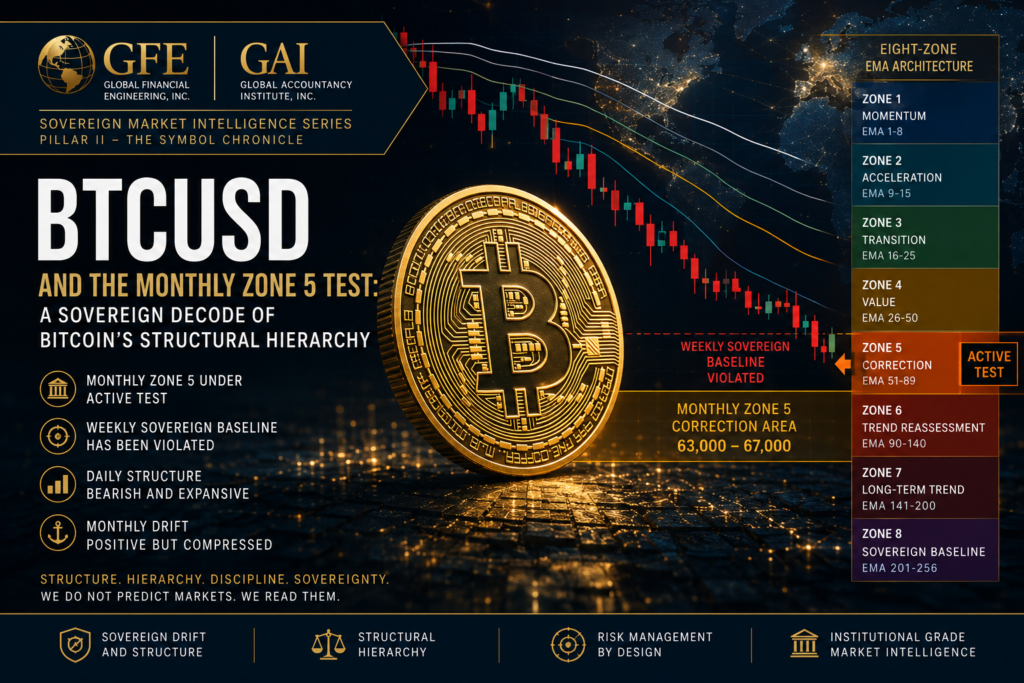
BTCUSD Monthly Zone 5 Test: Bitcoin Structural Hierarchy Analysis by GFE & GAI
Bitcoin is testing Monthly Zone 5 while the Weekly Sovereign Baseline has been violated and the Monthly Drift remains positive but compressed. This GFE and GAI analysis explains the structural hierarchy behind BTCUSD’s critical market condition.
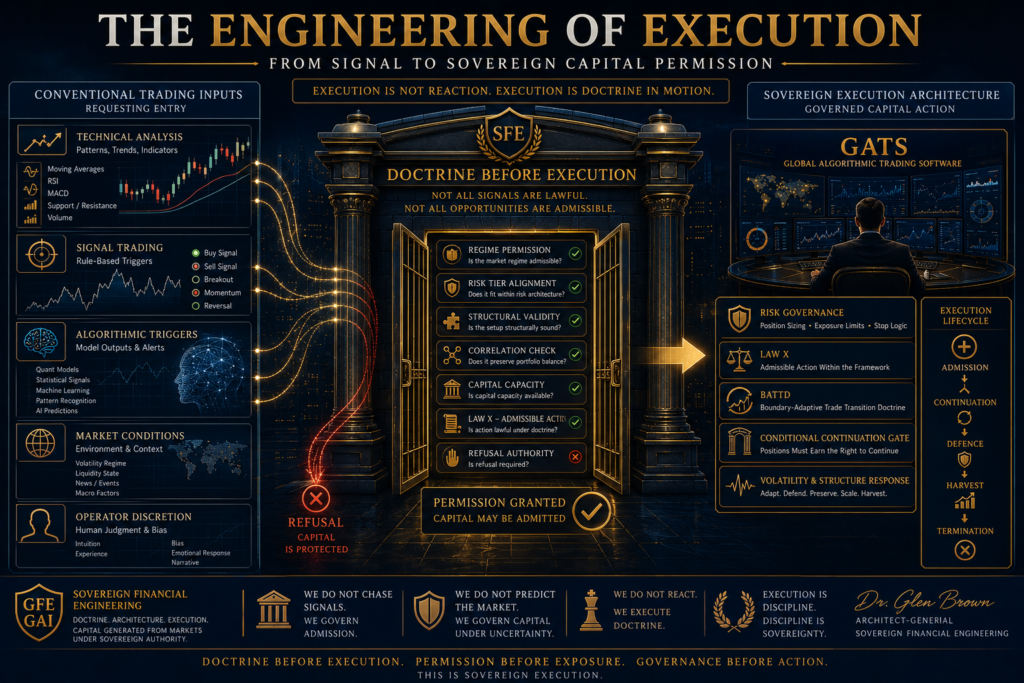
The Engineering of Execution: A Sovereign Engagement with Signal Trading, Algorithmic Execution, and Technical Analysis
Sovereign Financial Engineering · Engagement Paper No. III The Engineering of Execution A Sovereign Engagement with Signal Trading, Algorithmic Execution, and Technical Analysis Execution within Sovereign Financial Engineering is not the mechanical act of placing trades. It is the governed conversion of doctrine into capital action under sovereign authority. Document Control Document ID: GFE-SFE-ENG-003 Version:
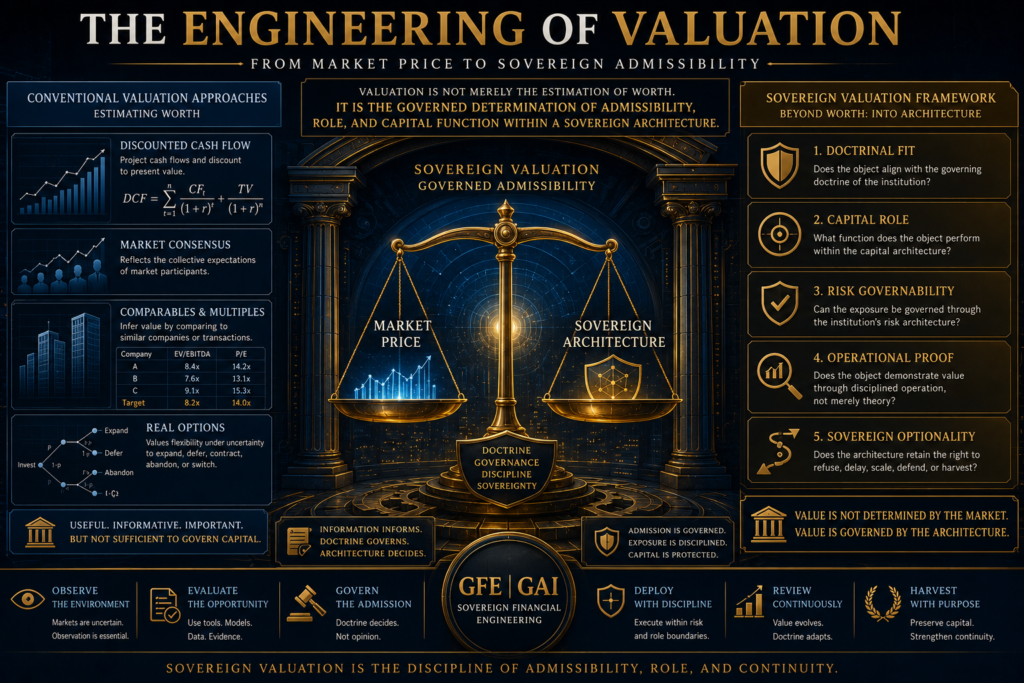
The Engineering of Valuation: A Sovereign Engagement with Discounted Cash Flow, Market Consensus, and Real Options
Sovereign Financial Engineering · Engagement Paper No. II The Engineering of Valuation A Sovereign Engagement with Discounted Cash Flow, Market Consensus, and Real Options Valuation within Sovereign Financial Engineering is not the passive acceptance of market opinion. It is the governed determination of whether an asset, instrument, system, or capital opportunity deserves admission into a
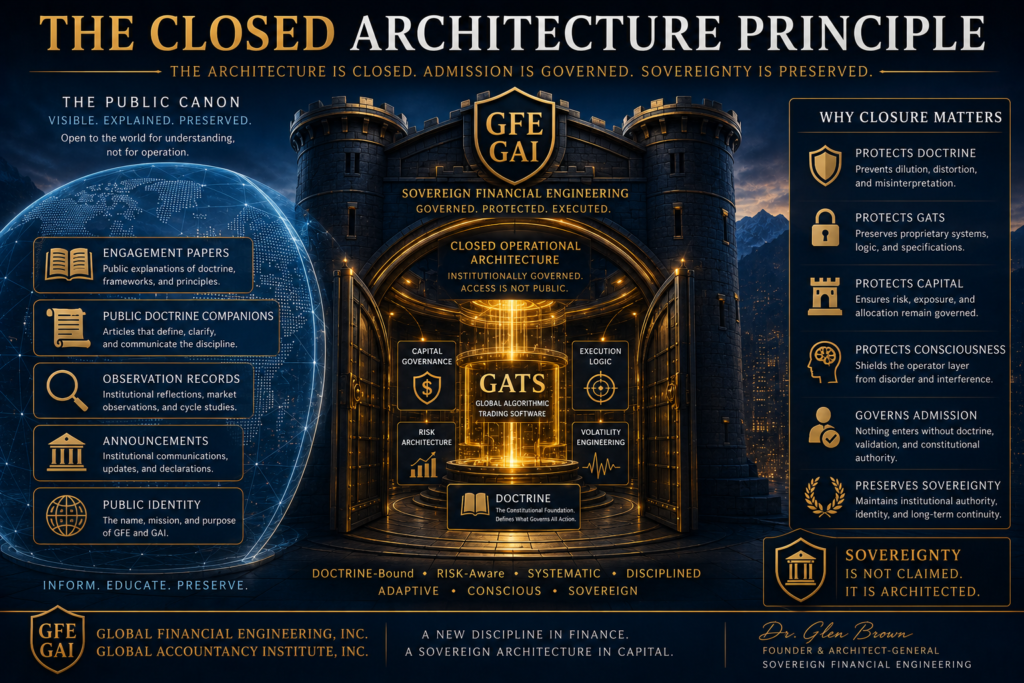
The Closed Architecture Principle
Public Doctrine Companion No. 7 The Closed Architecture Principle Why Sovereign Financial Engineering Must Remain Governed, Protected, and Institutionally Closed Sovereign Financial Engineering is not an open methodology, public trading model, advisory framework, or transferable system. It is a closed institutional architecture governed under sovereign doctrine. The closed architecture principle is one of the most
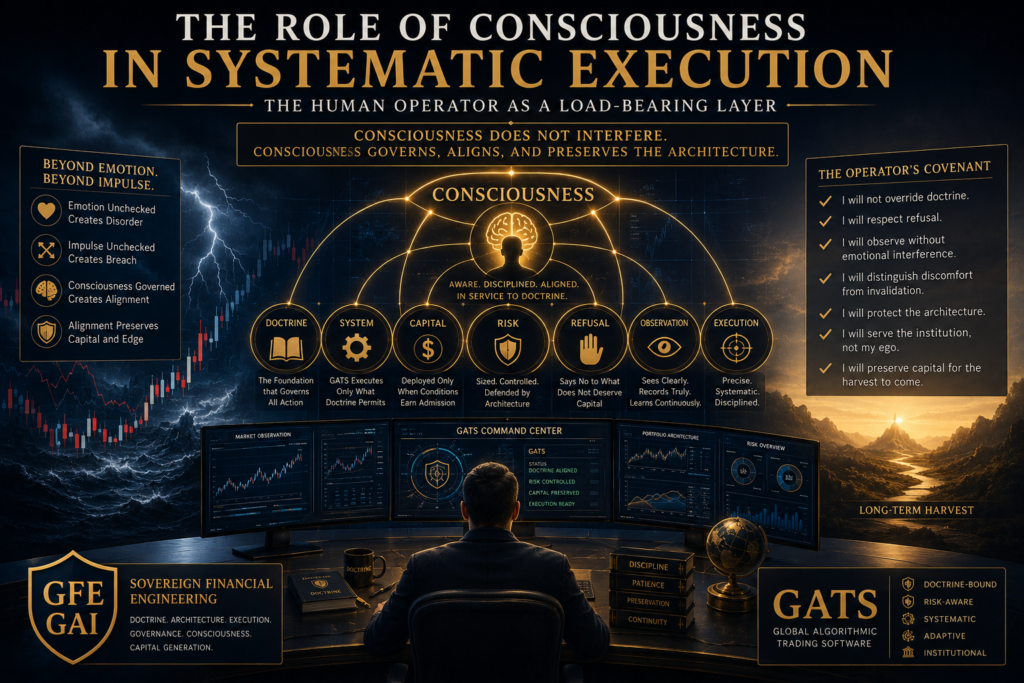
The Role of Consciousness in Systematic Execution
Public Doctrine Companion No. 6 The Role of Consciousness in Systematic Execution Why the Human Operator Remains a Load-Bearing Layer in Sovereign Financial Engineering Sovereign Financial Engineering does not remove consciousness from systematic execution. It governs consciousness, disciplines it, and integrates it as part of the capital architecture. In many systematic trading environments, the human
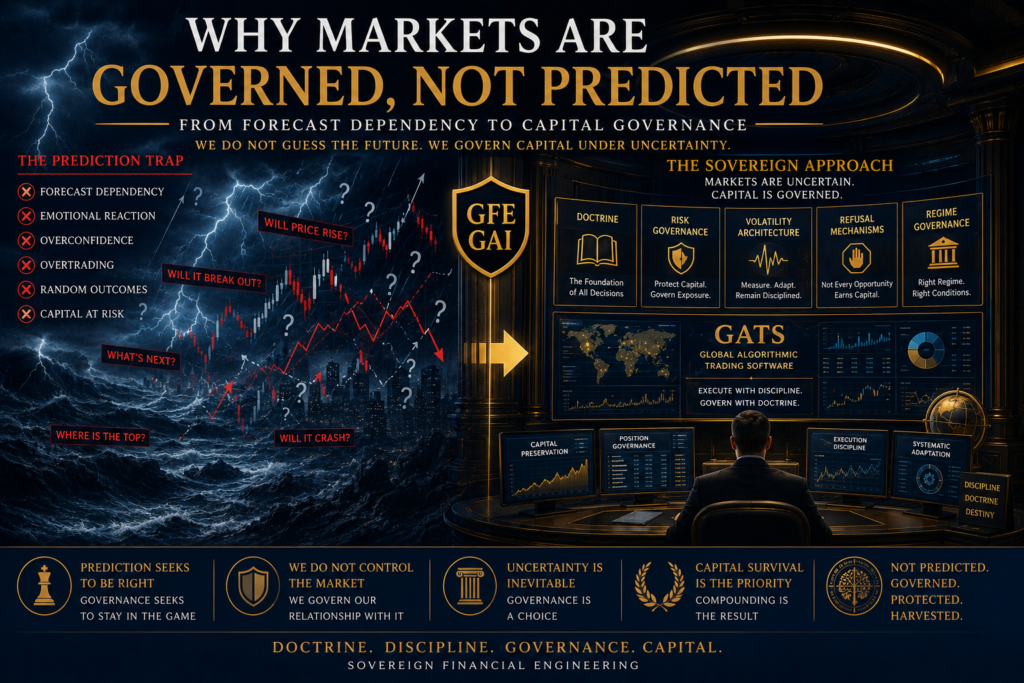
Why Markets Are Governed, Not Predicted
Public Doctrine Companion No. 5 Why Markets Are Governed, Not Predicted The Sovereign Financial Engineering Shift from Forecasting to Capital Governance Sovereign Financial Engineering does not begin with the question, “What will the market do next?” It begins with the deeper institutional question: “How must capital be governed under uncertainty?” The trading world is often
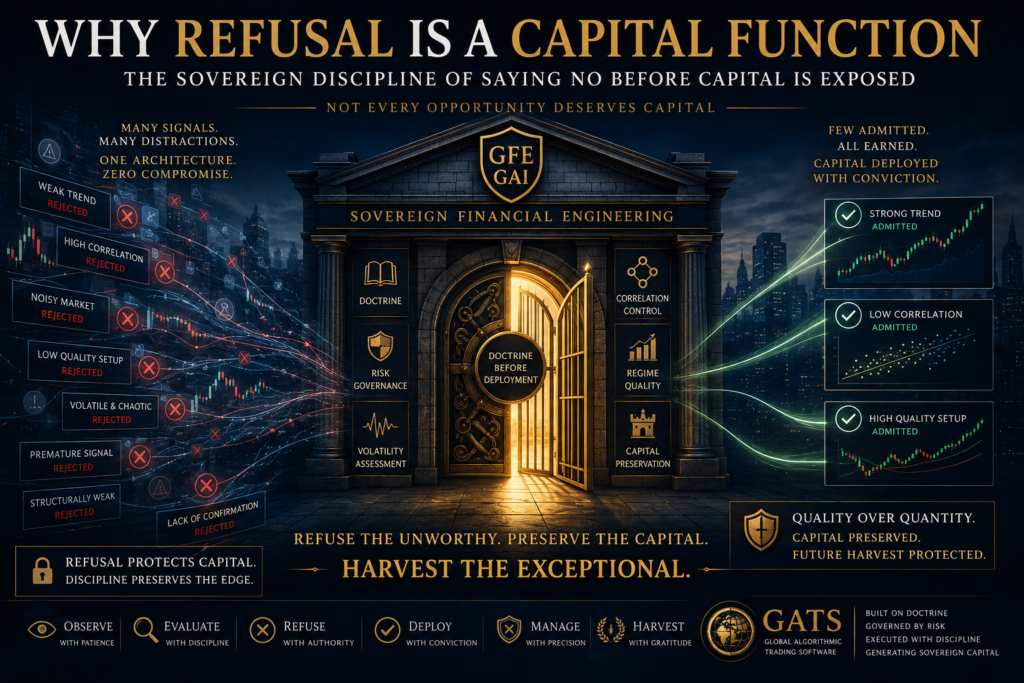
Why Refusal Is a Capital Function
Public Doctrine Companion No. 4 Why Refusal Is a Capital Function The Sovereign Discipline of Saying No Before Capital Is Exposed In Sovereign Financial Engineering, refusal is not inactivity. It is a capital function. It protects the architecture, preserves the edge, prevents dilution, and ensures that capital is deployed only when the regime earns admission.
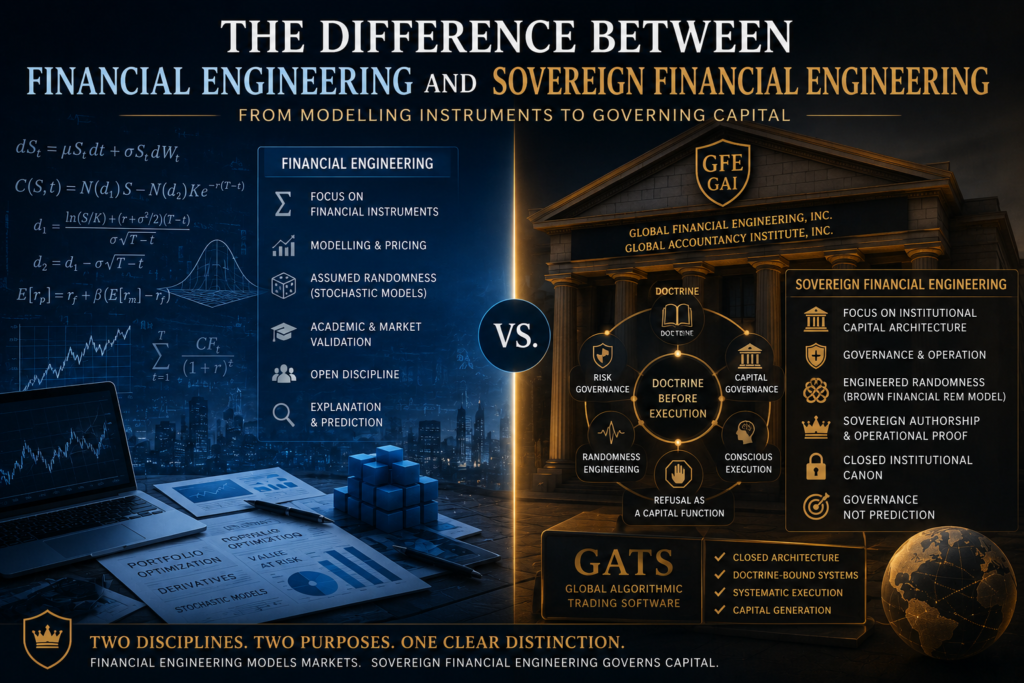
The Difference Between Financial Engineering and Sovereign Financial Engineering
Public Doctrine Companion No. 3 The Difference Between Financial Engineering and Sovereign Financial Engineering From Modelling Financial Instruments to Governing Capital Under Sovereign Doctrine Conventional financial engineering and Sovereign Financial Engineering are not the same discipline. One is primarily concerned with the design, modelling, pricing, and structuring of financial instruments. The other is concerned with
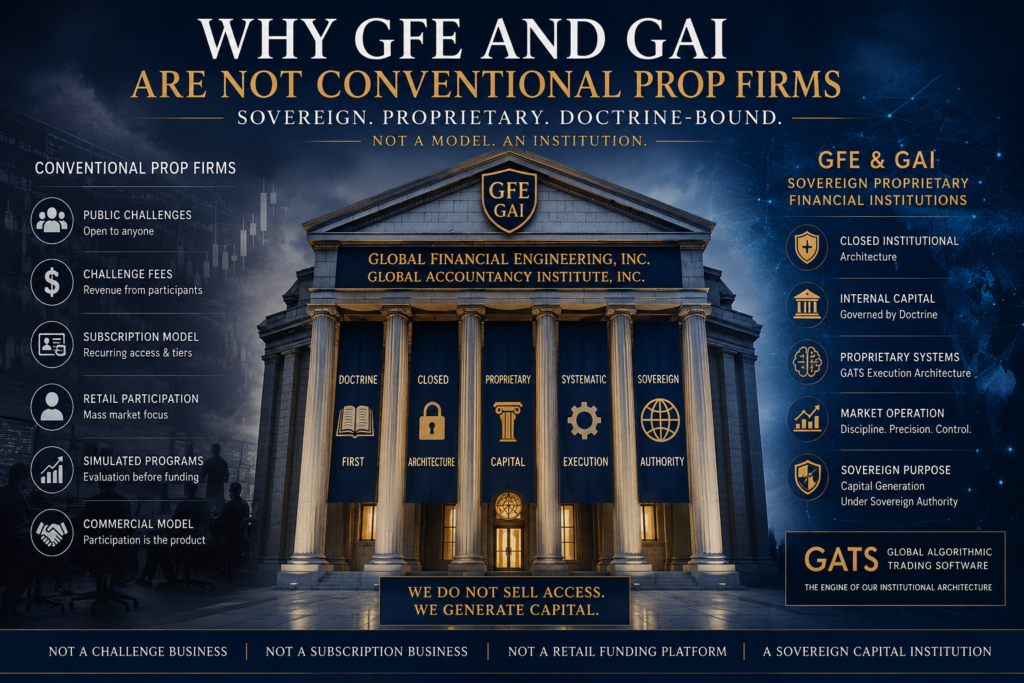
Why GFE and GAI Are Not Conventional Prop Firms
Public Doctrine Companion No. 2 Why GFE and GAI Are Not Conventional Prop Firms Clarifying the Identity of Two Sovereign Proprietary Financial Institutions Global Financial Engineering, Inc. and Global Accountancy Institute, Inc. do not operate under the commercial model commonly described as a “prop firm.” They are closed proprietary financial institutions governed by doctrine, internal

What Is Sovereign Financial Engineering? A Public Introduction to the Discipline Founded by Dr. Glen Brown
Public Doctrine Companion No. 1 What Is Sovereign Financial Engineering? A Public Introduction to the Discipline Founded by Dr. Glen Brown Sovereign Financial Engineering is a new discipline of finance concerned with the design, governance, and operation of closed institutional architectures that generate capital from markets through doctrine-bound systematic execution under sovereign authority. Sovereign Financial

Why Internal Compounding Matters More Than External Fundraising
GFE and GAI argue that internal compounding is a higher and more sovereign path to proprietary growth than external fundraising because it proves doctrine, strengthens reserves, and preserves institutional identity.

The Instruments Matter: Why Absolute Capacity Requires Absolute Precision
Discover why instruments are not interchangeable in trading and how precision in selection defines true capacity in institutional proprietary systems.

The Five-Trust Model: Segregating Asset Classes with Discipline
The Five-Trust Model shows why serious proprietary institutions should segregate asset classes through ring-fenced capital bodies rather than rely on one blended exposure pool.

The 252-Slot Doctrine: Rethinking Strategy Capacity in Proprietary Trading
The 252-Slot Doctrine reframes proprietary trading capacity by structuring the strategic field through a defined matrix of instruments, strategies, and governed capital channels.

Risk Management Solutions for Proprietary Trading Firms
Risk management in proprietary trading should go beyond trades and include capital governance, reserves, calibration, reporting, and institutional continuity.

Why Most Trading Firms Govern Trades but Not Capital
Many firms govern trades with discipline but leave capital under-structured. GFE and GAI argue that true proprietary strength begins with capital governance, not only trade control.

Reserve-First Trading: A Different Philosophy of Survival
Reserve-First Trading is the philosophy that proprietary capital should be protected, structured, and preserved through reserves before it is aggressively deployed into markets.

GATS and the Architecture of Automated Proprietary Trading
GATS is more than automated execution. It is the native execution architecture of a governed proprietary capital system built on GCPIAUT, reserves, controller logic, and disciplined reporting.

Why capital should be structured before it is deployed
GFE and GAI argue that serious proprietary institutions must structure capital before deployment through ring-fenced governance, reserves, unitization, and disciplined internal reporting.

The Case for Closed Proprietary Capital Governance
Closed proprietary capital governance is the doctrine behind GFE and GAI’s internal capital architecture, where capital is structured, ring-fenced, reserve-protected, and governed before deployment.

Why We Rejected the Conventional Prop Firm Model
GFE and GAI rejected the conventional prop firm model in favor of a closed proprietary capital order built on capital governance, reserve discipline, ring-fenced trusts, and GATS-native execution.

The Future of Proprietary Financial Engineering at Global Financial Engineering, Inc.
A forward-looking statement on the future of proprietary financial engineering and the evolving institutional role of GATS.

What Makes GATS Different from Conventional Trading Systems
A structured comparison showing how GATS differs from conventional trading systems through architecture, governance, and institutional design.

How GATS Enforces Risk Discipline in a Complex Market Environment
A closer look at how GATS transforms risk control from theory into structured internal enforcement.

Why Live Market Observation Still Matters After Successful Compilation
A defense of disciplined live-market observation as an essential stage in the maturity of proprietary trading systems.

The Five-Core Architecture of GATS MT5 Version 1.5.1
A high-level institutional overview of the five-core architecture behind GATS MT5 Version 1.5.1 and the logic of layered system design.

Markets Are Not Predicted. They Are Governed: The GATS Operating Philosophy
A philosophical and operational defense of governance-led trading architecture within the GATS framework.

Why GATS Was Built: The Case for Doctrine-Governed Proprietary Trading
An institutional introduction to the logic, purpose, and necessity of GATS within a doctrine-led proprietary trading environment.
Directional Validation as Governance, Not Prediction
Directional Validation as Governance, Not Prediction Context Within proprietary trading systems, direction is often misunderstood as a forecasting exercise. In practice, the role of directional assessment is not to predict future price movement but to determine whether observed momentum is structurally admissible for participation. This distinction is foundational to governance-based execution. Concept Directional validation operates

Internal Reflections on the Structural-Momentum Synchronization Doctrine (SMSD)
Exploring how SMSD aligns market structure with momentum for internal asymmetric advantages in volatile regimes.