
Global Multi-Asset ETF Master Portfolio for GFE & GAI
- November 28, 2025
- Posted by: Drglenbrown1
- Category: Global Multi-Asset Portfolios
By Dr. Glen Brown
President & CEO, Global Accountancy Institute, Inc. (GAI)
President & CEO, Global Financial Engineering, Inc. (GFE)
1. Introduction: A Global ETF Engine for Proprietary Capital
Global Financial Engineering, Inc. (GFE) and Global Accountancy Institute, Inc. (GAI) operate under a closed, proprietary business model, deploying internal capital through advanced algorithmic frameworks rather than offering products or advice to the public. This Global Multi-Asset ETF Master Portfolio has been designed as an institutional-grade structure that aligns with the Global Algorithmic Trading Software (GATS), the Global 9-Tier Trading System (G9TTS), DAATS (Dynamic Adaptive ATR Trailing Stops), and the Nine-Laws Framework for Adaptive Volatility & Risk Management.
The objective is simple yet powerful: create a globally diversified ETF universe that can be traded systematically using trend-following and regime-adaptive overlays, while maintaining robust risk controls, disciplined breakeven logic, and clearly defined “Death Stops” anchored on higher timeframes.
2. Core Building Blocks: The Initial ETF Set
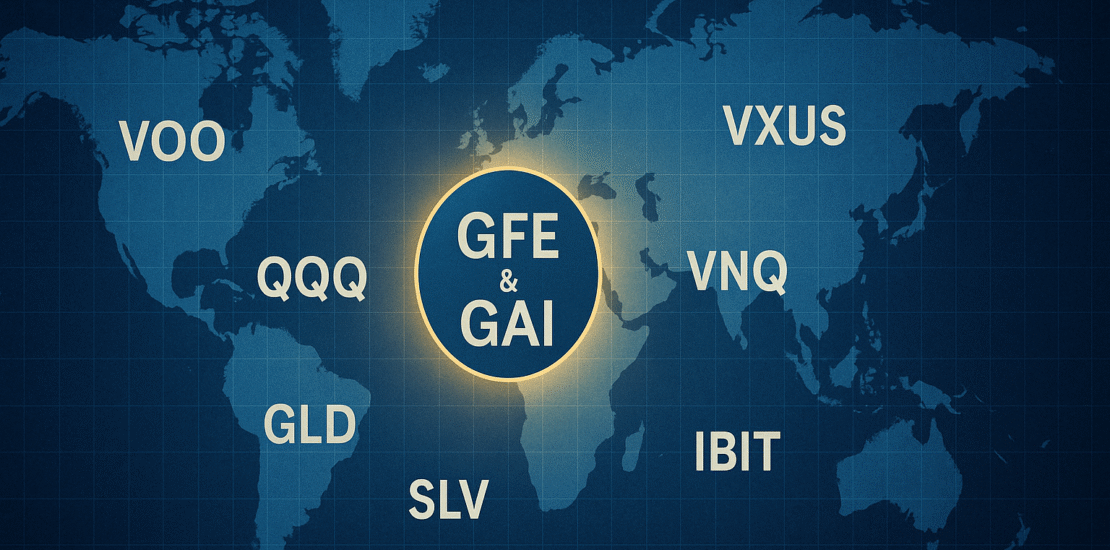
The initial set of ETFs, which serve as the foundational building blocks of this portfolio, includes:
- SLV – iShares Silver Trust: A physically backed vehicle designed to reflect generally the performance of the price of silver bullion, before expenses.
- GLD – SPDR Gold Shares: A physically backed gold vehicle designed to track the price performance of gold bullion (spot gold), less fees and expenses.
- VXUS – Vanguard Total International Stock ETF: Seeks to track the performance of the FTSE Global All Cap ex US Index, providing broad exposure to developed and emerging markets outside the United States.
- QQQ – Invesco QQQ Trust: Provides exposure to the Nasdaq-100 Index, heavily weighted toward large-cap technology and growth-oriented companies.
- VOO – Vanguard S&P 500 ETF: Tracks the S&P 500 Index, offering broad, low-cost exposure to U.S. large-cap equities.
- BND – Vanguard Total Bond Market ETF: Provides broad exposure to U.S. investment-grade bonds across government, corporate, and securitized sectors.
- VNQ – Vanguard Real Estate ETF: Tracks an index of U.S. equity REITs (real estate investment trusts), delivering listed real estate exposure.
- IBIT – iShares Bitcoin Trust ETF: Designed to reflect generally the performance of the price of bitcoin, providing a listed vehicle for spot bitcoin exposure in ETF form.
These eight ETFs introduce exposure to precious metals, U.S. equities, international equities, fixed income, real estate, and digital assets—forming a robust foundation for global risk deployment.
3. Expanding to a 25-ETF Global Master Portfolio
To fully exploit global trends across asset classes and regions, the initial eight ETFs are expanded into a diversified universe of twenty-five. This broader universe allows GATS to rotate and allocate risk dynamically across growth, value, international, commodities, fixed income, real estate, infrastructure, and digital assets.
3.1 Final 25-ETF Universe
| # | Ticker | Name / Focus | Primary Role in Portfolio |
|---|---|---|---|
| 1 | VOO | Vanguard S&P 500 ETF | Core U.S. large-cap equity exposure |
| 2 | QQQ | Invesco QQQ Trust | U.S. technology and growth momentum |
| 3 | VUG | Vanguard Growth ETF | Large-cap growth complement to QQQ |
| 4 | IJR | iShares Core S&P Small-Cap ETF | U.S. small-cap cyclicals and beta |
| 5 | ARKK | ARK Innovation ETF | Higher-volatility innovation sleeve |
| 6 | VXUS | Vanguard Total International Stock ETF | Broad developed and emerging ex-U.S. equity |
| 7 | VWO | Vanguard FTSE Emerging Markets ETF | Dedicated EM growth allocation |
| 8 | GLD | SPDR Gold Shares | Monetary hedge and crisis hedge |
| 9 | SLV | iShares Silver Trust | Secondary precious metal and cyclical hedge |
| 10 | PPLT | Aberdeen Standard Physical Platinum Shares ETF | Industrial precious metal diversification |
| 11 | PALL | Aberdeen Standard Physical Palladium Shares ETF | Palladium exposure linked to auto/industry |
| 12 | DBC | Invesco DB Commodity Index Tracking Fund | Broad commodity exposure (energy, metals, agriculture) |
| 13 | GSG | iShares S&P GSCI Commodity-Indexed Trust | Alternative commodity beta and inflation hedge |
| 14 | BND | Vanguard Total Bond Market ETF | Core U.S. investment-grade bond exposure |
| 15 | TLT | iShares 20+ Year Treasury Bond ETF | Long duration and crisis-duration hedge |
| 16 | SHY | iShares 1-3 Year Treasury Bond ETF | Short-duration, rate-sensitive defense |
| 17 | HYG | iShares iBoxx $ High Yield Corporate Bond ETF | High-yield credit and spread risk premium |
| 18 | LQD | iShares iBoxx $ Investment Grade Corporate Bond ETF | Corporate credit exposure |
| 19 | VNQ | Vanguard Real Estate ETF | U.S. listed real estate (REITs) |
| 20 | VNQI | Vanguard Global ex-U.S. Real Estate ETF | International real estate exposure across developed and emerging markets |
| 21 | IGF | iShares Global Infrastructure ETF | Global infrastructure (transport, utilities, energy) |
| 22 | IBIT | iShares Bitcoin Trust ETF | Spot bitcoin exposure via listed ETF structure |
| 23 | ETHE | Grayscale Ethereum Trust (or successor Ethereum spot ETF) | Ethereum-linked digital asset exposure |
| 24 | TIP | iShares TIPS Bond ETF | Inflation-protected U.S. Treasuries |
| 25 | VT | Vanguard Total World Stock ETF | Global equity market umbrella (U.S. + international) |
This 25-ETF universe gives GFE & GAI a comprehensive global canvas: U.S. and international equities, growth and small caps, emerging markets, commodities, precious metals, fixed income, real estate, infrastructure, and digital assets.
4. Strategic Weights: A Representative Allocation
A representative strategic allocation (which GATS can tilt dynamically) might be expressed as follows:
- Core Growth & Equity (VOO, QQQ, VUG, IJR, ARKK, VXUS, VWO, VT): ~45%
- Real Assets & Commodities (GLD, SLV, PPLT, PALL, DBC, GSG): ~20%
- Fixed Income & Credit (BND, TLT, SHY, HYG, LQD, TIP): ~20%
- Real Estate & Infrastructure (VNQ, VNQI, IGF): ~10%
- Digital Assets (IBIT, ETHE): ~5%
These weights are indicative and subject to dynamic tilt based on volatility regimes, DAATS conditions, macro signals, and GATS trend diagnostics. Strategic risk is not expressed only through static weights but through the interaction of volatility, Death Stops, breakevens, and DAATS behaviour.
5. GATS Overlay: Timeframes, Stops, and Breakevens
The ETF portfolio is traded within the Global Algorithmic Trading Software (GATS) using a disciplined, multi-timeframe framework:
- Primary execution timeframe: M60 (Hourly)
- Macro anchors: M240, M1440, M10080
- Death Stop anchor: DS = 16 × ATR256 on the Daily (M1440) timeframe
- DAATS: Default 12 × ATR50, with regime-adaptive widening and compression under the Nine-Laws Framework
- Breakeven logic: Fractional breakeven around 0.1875 × DS, subject to GNASD-enhanced GASBET rules and regime clustering
- Profit targets: PT typically scaled around 5 × ATR50, with extensions into the x6 and x9 zones of the GATS 369 Channel for strong trends
Entries are only taken when EMA Zones, HAS (Heiken Ashi Smoothed) structure, MACD coherence, and higher timeframe structure all align with the dominant trend. Exits are governed primarily by the Death Stop or breakeven triggers; discretionary exits are intentionally minimized to preserve the integrity of the system.
6. Role of IBIT and Digital Assets in the Portfolio
IBIT – iShares Bitcoin Trust ETF serves as the primary listed vehicle for bitcoin exposure in this portfolio. It seeks to reflect generally the performance of the price of bitcoin, and is structured as a trust that is not registered as a traditional investment company or commodity pool, which has implications for regulatory treatment and risk disclosures.
The inclusion of IBIT (and a companion Ethereum vehicle such as ETHE or a future spot Ethereum ETF) allows GFE & GAI to integrate a 24/7 digital asset component into the broader ETF framework. However, risk management remains anchored on higher timeframes (M240 and M1440), with the Death Stop and DAATS logic explicitly defined to accommodate elevated volatility and gap risk.
7. From Static Allocation to Adaptive Global Risk Deployment
This portfolio is not intended to be a static “buy and hold” basket. Instead, it is designed as a universe of opportunity through which GATS can:
- Identify and ride major trends in U.S. and global equity markets
- Rotate toward commodities and precious metals during inflationary and crisis regimes
- Use fixed income and duration as hedging and risk-balancing tools
- Exploit structural trends in global real estate and infrastructure
- Integrate digital assets with clearly defined Death Stops and fractal breakeven rules
By unifying all of this under the G9TTS and the Nine-Laws Framework, GFE & GAI can express a coherent, quantum-inspired approach to portfolio construction that treats volatility as a measurable, tradable structural feature rather than a mere nuisance.
About the Author
Dr. Glen Brown stands at the forefront of the global financial and accounting sectors, with a career spanning more than a quarter of a century of visionary leadership, research, and innovation. He is the President & CEO of Global Accountancy Institute, Inc. and Global Financial Engineering, Inc., two interconnected proprietary trading and research firms that integrate advanced financial engineering, quantitative trading, and algorithmic technology into a unified, closed-capital model.
Holding a Doctor of Philosophy (Ph.D.) in Investments and Finance, Dr. Brown has developed a range of proprietary frameworks—including the Global Algorithmic Trading Software (GATS), the Global 9-Tier Trading System (G9TTS), the Market Expected Moves Hypothesis (MEMH), DAATS (Dynamic Adaptive ATR Trailing Stops), and the Nine-Laws Framework for Adaptive Volatility & Risk Management. His work blends rigorous quantitative structure with a broader philosophical vision of transformation, rebirth, and intellectual mastery.
Business Model Clarification
Global Accountancy Institute, Inc. (GAI) and Global Financial Engineering, Inc. (GFE) operate under a closed, proprietary business model. The strategies, portfolios, systems, and frameworks described in this article are developed solely for internal use in managing the firms’ own proprietary capital and for the internal education of their teams.
The firms do not solicit or accept external capital from the public, do not manage third-party funds, and do not provide investment advice, portfolio management, or trading signals to clients or the general public. All descriptions of trading systems, portfolios, ETFs, or processes are strictly illustrative and educational from the perspective of the firms’ internal intellectual capital and research programs.
General Risk Disclaimer
High Risk of Loss: Trading and investing in financial markets—including equities, exchange-traded funds (ETFs), bonds, commodities, real estate securities, and digital assets such as bitcoin—carry a substantial risk of loss and are not suitable for every investor. Prices can move rapidly and unpredictably, and past performance is not indicative of future results.
No Guarantees: There is no guarantee that any strategy, model, or portfolio construction approach described in this article will achieve profits or avoid losses. All markets are subject to structural breaks, macro shocks, liquidity events, slippage, and other factors that may differ materially from historical conditions.
No Investment Advice: Nothing in this article should be interpreted as personalized investment advice, a recommendation, an offer, or a solicitation to buy or sell any financial instrument or to engage in any trading strategy. The information is shared solely for educational and informational purposes within the context of Global Accountancy Institute, Inc. and Global Financial Engineering, Inc.’s internal research.
Independent Assessment: Any individual or institution that encounters this material must conduct its own independent research, due diligence, and consultation with appropriately licensed financial, legal, and tax professionals before making any investment or trading decisions.
By reading this article, you acknowledge that you alone bear full responsibility for your decisions, actions, and outcomes in financial markets.