
Global Multi-Asset ETF Portfolio White Paper v1.0 – GAI & GFE
- November 28, 2025
- Posted by: Drglenbrown1
- Categories: Global Proprietary Trading Research, Research & White Papers
Global Multi-Asset ETF Portfolio White Paper v1.0
Powered by the GATS Universal Risk Doctrine and the Dr. Glen Brown Timeframe-Indexed Risk Allocation Model
Author: Dr. Glen Brown
Institutions: Global Accountancy Institute, Inc. (GAI) & Global Financial Engineering, Inc. (GFE)
Date: November 28, 2025
Table of Contents
- Chapter 1 — Executive Summary
- Chapter 2 — Introduction to the Global ETF Universe
- Chapter 3 — The Universal Risk Doctrine (DS = 16 × ATR256)
- Chapter 4 — The Timeframe-Indexed Risk Allocation Model (1–9%)
- Chapter 5 — GATS Nine-Strategy Multi-Timeframe Architecture
- Chapter 6 — Constructing the 50-ETF Multi-Tier Global Portfolio
- Chapter 7 — The Volatility Root Law & The Death-Stop Constant
- Chapter 8 — Integration With the Nine-Laws Framework
- Chapter 9 — Implementation, Position Management & Trade Examples
- Chapter 10 — Macro Regime Filters, Sentiment Layers & Thematic Alignment
- Chapter 11 — Business Model Clarification
- Chapter 12 — Integrated Vision: A Unified Global Trading Doctrine for GFE & GAI
Chapter 1 — Executive Summary
Global Multi-Asset ETF Portfolio White Paper v1.0
Powered by the GATS Universal Risk Doctrine and the Dr. Glen Brown Timeframe-Indexed Risk Allocation Model
1. Overview
This white paper introduces the Global Multi-Asset ETF Portfolio, an institutional-grade framework designed exclusively for Global Accountancy Institute, Inc. (GAI) and Global Financial Engineering, Inc. (GFE). The portfolio integrates a globally diversified universe of fifty (50) exchange-traded funds across equities, commodities, bonds, real estate, infrastructure, and digital assets. It is engineered to align with the Global Algorithmic Trading Software (GATS), the Global 9-Tier Trading System (G9TTS), and the Nine-Laws Framework for Adaptive Volatility & Risk Management.
What differentiates this white paper from traditional portfolio construction documents is the incorporation of a universal, cross-timeframe risk management doctrine derived from the most recent evolution of GATS—anchored by:
- The Death-Stop Constant: DS = 16 × ATR(256) on the Daily (M1440) timeframe.
- The Timeframe-Indexed Risk Allocation Model: risk per trade increases systematically from 1% (M1) to 9% (M43200).
- Unified breakeven and post-breakeven logic tied directly to the risk percentage of the executing timeframe.
This creates a single, universal GATS architecture capable of operating coherently across all asset classes and all timeframes simultaneously.
2. Purpose of the White Paper
The purpose of this white paper is to:
- Define a globally diversified 50-ETF master universe suitable for systematic deployment across multiple regimes.
- Integrate the new GATS universal risk doctrine across all nine default trading strategies.
- Demonstrate how the Death-Stop, DAATS, and the Timeframe-Indexed Risk Model create a unified multi-timeframe execution environment.
- Explain the macro, micro, and volatility-driven logic behind ETF selection and portfolio tiering.
- Establish an institutional template for long-term proprietary capital deployment by GFE & GAI.
This portfolio is not intended for retail use, advisory services, or third-party management. It represents internal intellectual capital and serves as the strategic blueprint for systematic portfolio development under the firms’ closed business model.
3. The Core Innovation: A Universal Risk Anchor for All Timeframes
The heart of this document is the formal introduction of the Universal Risk Doctrine, built on the constant:
DS = 16 × ATR(256)
This is more than a stop-loss rule. It is a structural volatility invariant that:
- Stabilizes trading across all market conditions.
- Eliminates the distortions of timeframe-specific volatility.
- Imposes a universal risk floor for every position trader.
- Ensures that short-term noise cannot prematurely terminate long-duration trades.
4. The 50-ETF Multi-Tier Global Portfolio
The portfolio construction expands the initial eight ETFs into a structured universe of fifty globally representative ETFs organized into five distinct tiers:
- Tier 1 — Core Global Beta (S&P 500, Nasdaq-100, global equities)
- Tier 2 — Factor & Style Exposure (value, momentum, quality, low-vol)
- Tier 3 — Regional & Country Specialists (Japan, Europe, EM, Asia)
- Tier 4 — Sector & Thematic ETFs (tech, energy, defense, cybersecurity)
- Tier 5 — Alternatives & Real Assets (gold, silver, commodities, REITs, BTC)
5. A Multi-Timeframe, Multi-Strategy Execution Engine
This white paper also formalizes how all nine default GATS trading strategies can be run concurrently in a single master position-trading account. This unified architecture ensures:
- Continuous opportunity capture across all time horizons.
- Freedom from timeframe conflicts.
- A deterministic risk curve governing all trades.
- Fractal coherence between micro-structure and macro-structure.
6. Institutional Relevance
This white paper marks the first time that GFE & GAI have published a fully unified, multi-asset, multi-timeframe trading doctrine. The concepts herein serve as the foundation for:
- Long-term proprietary portfolio development
- Internal research initiatives
- Algorithmic model expansions
- Cross-asset macro integration
- Future academic publications
7. Conclusion
This executive summary introduces the strategic, mathematical, and conceptual pillars of the Global Multi-Asset ETF Portfolio. The remaining chapters expand these foundations into a complete institutional protocol, covering portfolio construction, volatility dynamics, regime analysis, GATS execution logic, the Nine-Laws Framework, macro-sensitivity overlays, and position-trading governance within the GFE & GAI ecosystem.
Chapter 2 — Introduction to the Global ETF Universe
The modern financial landscape has evolved into an interconnected matrix of asset classes, cross-border capital flows, inflationary regimes, liquidity cycles, technological disruption, and shifting geopolitical realities. In this environment, Exchange-Traded Funds (ETFs) have emerged as one of the most efficient instruments for capturing global exposures with transparency, liquidity, and structural diversification.
For Global Accountancy Institute, Inc. (GAI) and Global Financial Engineering, Inc. (GFE), ETFs represent an ideal foundation for the development of institutional multi-asset portfolios. Their standardized construction, broad market coverage, and high liquidity make them perfectly compatible with systematic execution models such as GATS (Global Algorithmic Trading Software).
1. The Role of ETFs in Modern Portfolio Construction
ETFs combine the diversification benefits of traditional mutual funds with the intraday tradability of stocks. Their structure allows GATS to:
- Capture global trends across multiple asset classes
- Execute efficiently in highly liquid markets
- Apply uniform stop-loss, breakeven, and volatility models
- Maintain consistent risk controls across instruments
- Build a portfolio that responds to macroeconomic shifts in real time
2. Why ETFs Fit the GATS Architecture
A. ETFs Reflect Broad Market Structure
ETFs represent diversified baskets of assets—indices, sectors, regions, commodities—making their price structure cleaner and less prone to erratic noise than single-name stocks or highly illiquid products.
B. ETFs Provide Cross-Asset Coverage
Within a single unified framework, the portfolio can include U.S. equities, global equities, EM, bonds, commodities, real estate, and digital assets via spot Bitcoin ETFs.
C. ETFs Support Systematic Volatility Anchoring
The universal risk anchor—DS = 16 × ATR(256)—can be applied uniformly across all ETFs, regardless of sector or region.
3. From Eight ETFs to a Fifty-ETF Global Universe
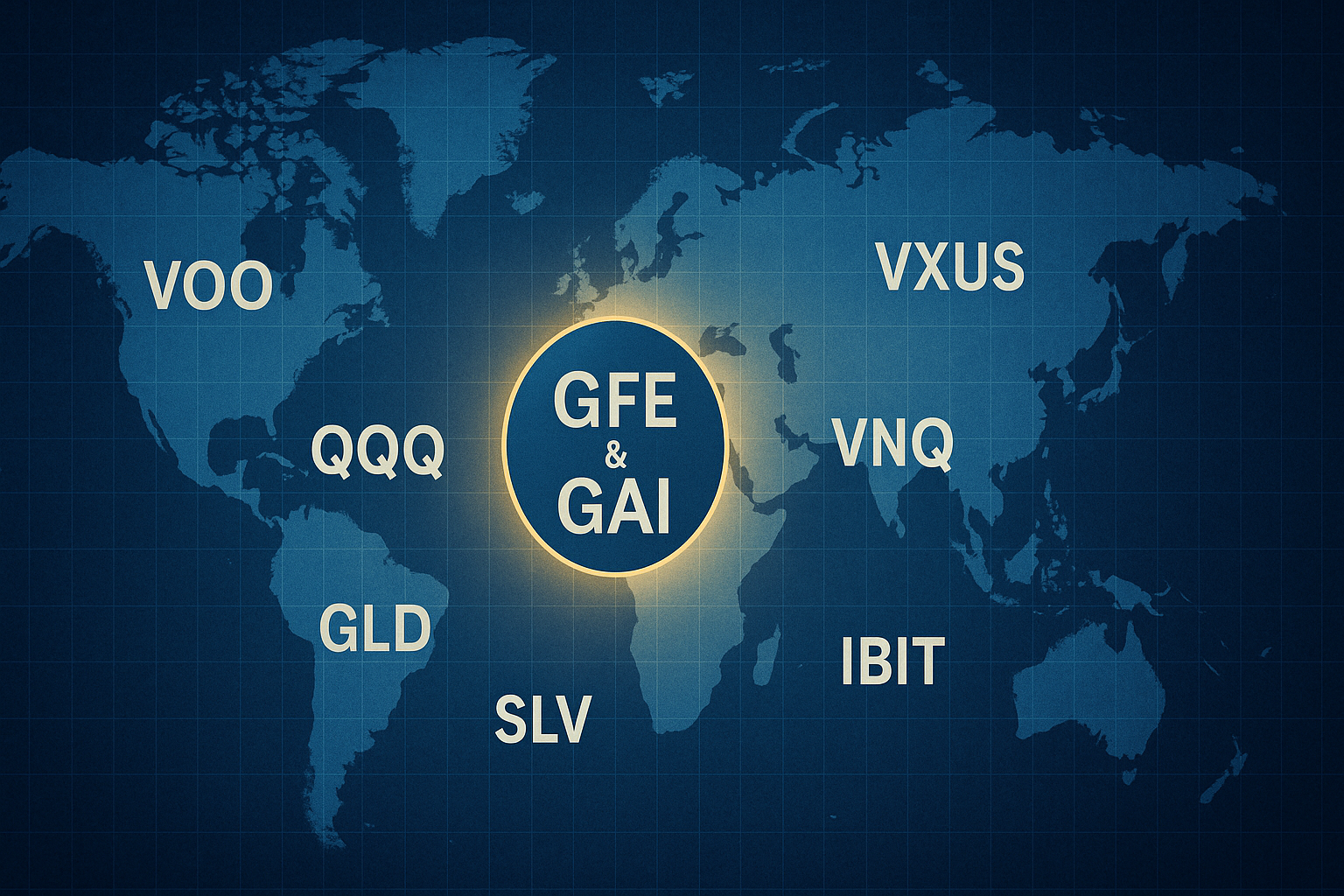
The initial ETF set (SLV, GLD, VXUS, QQQ, VOO, BND, VNQ, IBIT) forms a robust foundation. However, for a complete multi-asset architecture, GATS requires a broader universe to rotate between regimes, sectors, and regions.
Thus, the portfolio expands into a meticulously curated set of 50 ETFs across five tiers:
Tier 1 — Core Global Beta
Tier 2 — Factor & Style Exposures
Tier 3 — Regional & Country Specialists
Tier 4 — Sector & Thematic ETFs
Tier 5 — Alternatives & Real Assets
4. Structural Advantages of a 50-ETF Universe
The diversified ETF architecture provides significant advantages for systematic trading:
- Multi-regime resilience: different ETFs react differently to inflation, recession, and shocks.
- Lower correlation risk: sector and regional diversification reduce concentration.
- Enhanced trend capture: certain ETFs trend smoothly during sector or regional expansions.
- Cross-timeframe robustness: ETFs support both short-term and long-term GATS strategies.
5. The Importance of Universality
A defining characteristic of this white paper is its dedication to building a universal portfolio—deployable:
- Across all asset classes
- Across all nine GATS strategies
- Across all timeframes
- Across all volatility regimes
6. Conclusion
This chapter establishes the foundation for the white paper’s deeper analysis of ETF construction, volatility behaviour, risk management, and GATS execution. In the next chapter, we formally introduce the Universal Risk Doctrine—the structural architecture that unifies the entire portfolio across all timeframes and strategies.
Chapter 3 — The Universal Risk Doctrine (DS = 16 × ATR256)
At the heart of this white paper lies a single, unifying idea: all trades, on all timeframes, in all asset classes, can and should be anchored to one universal volatility constant. This constant is expressed through the concept of the Death Stop, defined as a long-horizon volatility-based protective level that transcends intraday noise and preserves the structural integrity of position trading.
Death Stop (DS) = 16 × ATR(256) on the Daily (M1440) timeframe
1. Conceptual Definition of the Death Stop (DS)
The Death Stop is the maximum protective stop distance used for position traders within the GATS ecosystem. ATR(256) represents the Average True Range computed over 256 daily bars, capturing roughly one full trading year of daily volatility. The multiplier 16 is the square root of 256, encoding a “volatility root law” that balances stability with sensitivity.
2. The Volatility Root Principle: Why 16 and 256?
- 256 ≈ one full year of trading days and is 28.
- ATR(256) smooths transitory volatility spikes.
- √256 = 16 provides a natural scaling factor that connects long-term horizon length with a volatility amplitude multiplier.
3. Universality Across Timeframes
All trades, regardless of the executing timeframe, recognize the same DS = 16 × ATR(256) Daily anchor. Timeframes differ in risk percentage, not in structural boundary definition.
4. Relationship Between DS, DAATS, and Breakeven
- DS defines the maximum permissible adverse movement.
- DAATS dynamically manages trailing stops within DS.
- BE% and Post-BE% are computed as fractions of DS, linked to timeframe-based risk.
5. Structural Protection for Position Traders
A. Protection From Intraday Compression
Anchoring on ATR(256) prevents premature exits due to short-term noise.
B. Protection From Over-Optimization
A fixed universal constant discourages curve-fitting and emotional stop adjustments.
C. Protection Across Asset Classes
DS can be applied uniformly to Forex, ETFs, commodities, indices, and digital assets.
6. Mathematical and Philosophical Implications
- Volatility is treated as a structural property, not a nuisance.
- The √256 rule reflects sublinear volatility scaling over time.
- Risk management becomes the governance of structural boundaries rather than arbitrary stop placement.
7. Summary and Forward Link to the Timeframe-Indexed Model
This chapter has established the Universal Risk Doctrine as the central pillar upon which the entire white paper rests. In Chapter 4, we extend this doctrine into a complete Timeframe-Indexed Risk Allocation Model, where risk per trade rises from 1% to 9% as we ascend from M1 to M43200.
Chapter 4 — The Timeframe-Indexed Risk Allocation Model (1–9%)
The Universal Risk Doctrine establishes a single long-horizon structural boundary for all trades through DS = 16 × ATR(256). Building on this foundation, the Timeframe-Indexed Risk Allocation Model defines how much capital risk should be deployed on each trade based on the executing timeframe.
1. Overview of the Timeframe-Indexed Risk Curve
| Timeframe | Risk per Trade | Breakeven Level | Post-Breakeven Level |
|---|---|---|---|
| M1 | 1% | 1% of DS | 1% × DS |
| M5 | 2% | 2% of DS | 2% × DS |
| M15 | 3% | 3% of DS | 3% × DS |
| M30 | 4% | 4% of DS | 4% × DS |
| M60 | 5% | 5% of DS | 5% × DS |
| M240 | 6% | 6% of DS | 6% × DS |
| M1440 | 7% | 7% of DS | 7% × DS |
| M10080 | 8% | 8% of DS | 8% × DS |
| M43200 | 9% | 9% of DS | 9% × DS |
2. Mathematical Structure of the Model
Risk%(TF) is a fixed constant per timeframe (1–9). Breakeven and Post-BE levels are simply:
BE(TF) = Risk%(TF) × DS
Post-BE(TF) = BE(TF)
3. Philosophical Foundations: Time as a Risk Dimension
The model recognizes time as a quantitative risk dimension. The longer the timeframe, the more stable the signal and the more capital it deserves. Shorter timeframes carry more noise and therefore receive less capital.
4. Eliminating the Conflict Between Timeframes
The model ensures higher-timeframe trades are always more structurally significant than lower-timeframe trades, eliminating internal conflicts and reducing overexposure.
5. Symmetry Between BE% and Post-BE%
The model’s symmetry—BE% = Post-BE%—ensures structural elegance, capital preservation, and long-term algorithmic discipline.
6. Integration with the Universal Death Stop
- DS defines the structural boundary.
- Risk%(TF) defines capital exposure.
- BE%(TF) defines when capital moves to protection.
- Post-BE%(TF) defines how capital remains protected.
7. Position-Trading Integrity Across All Nine GATS Strategies
Because each GATS strategy operates on a different timeframe, this risk curve becomes the mathematical backbone allowing all nine strategies to coexist in a single master account.
8. Summary and Transition to the Next Chapter
This chapter introduced a fractal, timeframe-indexed risk curve that governs capital exposure from M1 to M43200. In Chapter 5, we assemble the architecture by integrating all nine default GATS strategies into a unified, multi-timeframe execution framework.
Chapter 5 — GATS Nine-Strategy Multi-Timeframe Architecture
The Global Algorithmic Trading Software (GATS) contains nine default trading strategies, each designed to capture trend dynamics from its unique timeframe. Together, these strategies form a fractal execution engine capable of harvesting opportunities from minute-by-minute microstructure to multi-month macro trends.
1. The Nine Default GATS Strategies
| Strategy | Timeframe | Structural Role |
|---|---|---|
| GATS-1 | M1 | Microstructure scalping and early flow detection |
| GATS-2 | M5 | Short-term momentum and flow amplification |
| GATS-3 | M15 | Intraday swing formation and consolidation breaks |
| GATS-4 | M30 | Transitional trend detection and volatility alignment |
| GATS-5 | M60 | Core trend following and intraday continuation |
| GATS-6 | M240 | Structural swing trading and macro inflection identification |
| GATS-7 | M1440 | Long-term trend establishment and regime definition |
| GATS-8 | M10080 | Cyclical, sector, and thematic trend capture |
| GATS-9 | M43200 | Structural macro trend commitment and long-duration risk allocation |
2. Timeframe Hierarchy as a Cohesive Execution Engine
- GATS-1 to GATS-4: flow detection and short-term momentum.
- GATS-5 to GATS-7: core trends and structural swings.
- GATS-8 and GATS-9: macro and cyclical trend commitment.
3. Structural Non-Conflict Through the Universal Risk Doctrine
All trades share the same DS. Timeframe differences are expressed through risk percentage, not stop distance. This avoids conflicts between strategies and stabilizes multi-timeframe trading.
4. Multi-Timeframe Confirmation Protocol
- EMA Zone alignment
- HAS (Heiken Ashi Smoothed) trend state
- MACD dual-mode logic (25,26,5 + Quick MACD 25,26,2)
5. The Unified Position-Trading Account
All nine strategies run concurrently inside one master trading account, made possible by the DS anchor and the timeframe-indexed risk curve.
6. Hierarchy of Trade Importance
Higher timeframes (M1440–M43200) define structural importance, while lower timeframes contribute flow and refinement.
7. Elimination of Redundant Signals
Shared DS and BE logic naturally prevent over-pyramiding and overexposure.
8. Integration With the 50-ETF Universe
The nine-strategy architecture integrates seamlessly with the ETF tiers, allowing trends to be captured from intraday breakouts to multi-quarter macro cycles.
9. Transition to the Next Chapter
This chapter established the unified role of the nine GATS strategies. In Chapter 6, we construct the full 50-ETF Multi-Tier Global Portfolio that these strategies operate within.
Chapter 6 — Constructing the 50-ETF Multi-Tier Global Portfolio
The construction of the Global Multi-Asset 50-ETF Portfolio defines the universe of instruments through which GATS deploys capital and adapts to macro and sector regimes.
1. Portfolio Construction Philosophy
- Universality across asset classes and regions.
- Trend expressiveness and liquidity.
- Diversified volatility sources.
- GATS compatibility with stable ATR(256) profiles.
2. Tier Structure Overview
- Tier 1 — Core Global Beta (12 ETFs)
- Tier 2 — Factor & Style Exposure (10 ETFs)
- Tier 3 — Regional & Country Specialists (10 ETFs)
- Tier 4 — Sector & Thematic ETFs (12 ETFs)
- Tier 5 — Alternatives, Commodities & Digital Assets (6 ETFs)
3. Tier 1 — Core Global Beta (12 ETFs)
| Ticker | Name | Core Function |
|---|---|---|
| VOO | Vanguard S&P 500 ETF | U.S. large-cap equity benchmark |
| QQQ | Invesco QQQ Trust | Technology-driven growth |
| VTI | Vanguard Total U.S. Market ETF | Broad U.S. equity exposure |
| VT | Vanguard Total World Stock ETF | Global equity umbrella |
| VXUS | Vanguard Total International Stock ETF | International ex-U.S. |
| VWO | Vanguard FTSE Emerging Markets ETF | Emerging markets |
| IJR | iShares S&P Small-Cap ETF | Small-cap cyclic sensitivity |
| SPY | SPDR S&P 500 ETF | High-liquidity S&P proxy |
| DIA | SPDR Dow Jones Industrial Average ETF | Blue-chip industrial leadership |
| MDY | SPDR Mid-Cap ETF | Mid-cap diversification |
| ACWI | iShares MSCI ACWI ETF | All-country world exposure |
| IVV | iShares Core S&P 500 ETF | Institutional S&P exposure |
4. Tier 2 — Factor & Style Exposure (10 ETFs)
| Ticker | Name | Factor Exposure |
|---|---|---|
| VTV | Vanguard Value ETF | Value |
| VUG | Vanguard Growth ETF | Growth |
| MTUM | iShares MSCI Momentum Factor ETF | Momentum |
| QUAL | iShares MSCI Quality ETF | Quality |
| USMV | iShares Minimum Volatility ETF | Low volatility |
| VLUE | iShares Value Factor ETF | Deep value |
| SCHD | Schwab Dividend Equity ETF | Dividend/quality blend |
| SIZE | iShares MSCI USA Size Factor ETF | Size factor |
| SPHQ | Invesco S&P 500 Quality ETF | Quality targeting |
| EWMC | Invesco MidCap Momentum ETF | Mid-cap momentum |
5. Tier 3 — Regional & Country Specialists (10 ETFs)
| Ticker | Name | Region / Country |
|---|---|---|
| EWJ | iShares MSCI Japan ETF | Japan |
| IEUR | iShares Core MSCI Europe ETF | Europe |
| EEM | iShares MSCI Emerging Markets ETF | Emerging Markets |
| AAXJ | iShares MSCI Asia ex-Japan ETF | Asia ex-Japan |
| INDA | iShares MSCI India ETF | India |
| EWZ | iShares MSCI Brazil ETF | Brazil |
| EWW | iShares MSCI Mexico ETF | Mexico |
| FXI | iShares China Large-Cap ETF | China |
| ILF | iShares Latin America 40 ETF | Latin America |
| Optional Slot | Regional/Frontier ETF | Flexible allocation |
6. Tier 4 — Sector & Thematic ETFs (12 ETFs)
| Ticker | Name | Sector / Theme |
|---|---|---|
| XLK | Technology Select Sector SPDR | Technology |
| XLF | Financial Select Sector SPDR | Financials |
| XLV | Health Care Select Sector SPDR | Healthcare |
| XLE | Energy Select Sector SPDR | Energy |
| XLY | Consumer Discretionary SPDR | Discretionary |
| XLU | Utilities Select Sector SPDR | Utilities |
| XLI | Industrial Select Sector SPDR | Industrials |
| XLB | Materials Select Sector SPDR | Materials |
| HACK | Cybersecurity ETF | Cybersecurity |
| ICLN | iShares Global Clean Energy ETF | Clean energy |
| ITA | U.S. Aerospace & Defense ETF | Defense |
| SOXX | iShares Semiconductor ETF | Semiconductors |
7. Tier 5 — Alternatives, Commodities & Digital Assets (6 ETFs)
| Ticker | Name | Asset Class |
|---|---|---|
| GLD | SPDR Gold Shares | Gold |
| SLV | iShares Silver Trust | Silver |
| DBC | Invesco DB Commodity Index | Broad commodities |
| VNQ | Vanguard Real Estate ETF | REITs |
| IGF | Global Infrastructure ETF | Infrastructure |
| IBIT | iShares Bitcoin Trust | Bitcoin (digital asset) |
8. Cross-Tier Interaction with GATS
The tiered structure allows GATS to deploy capital into macro beta, factors, regional divergences, sector leadership, and alternative volatility sources in a coherent and unified way.
9. Summary & Transition to the Next Chapter
This chapter defined the structural foundation of the 50-ETF universe. In Chapter 7, we formalize the mathematical and conceptual basis for the Death-Stop Constant and the Volatility Root Law.
Chapter 7 — The Volatility Root Law & The Death-Stop Constant
The introduction of the Universal Risk Doctrine established the Death-Stop—DS = 16 × ATR(256)—as the structural boundary for all GATS trades. This chapter expands that doctrine into the Volatility Root Law, which connects long-horizon volatility to the structural “breathing room” necessary to preserve trends.
1. Origins of the Volatility Root Law
The Volatility Root Law recognizes that traditional volatility metrics are often too narrow or too reactive. Position trading requires a boundary anchored in long-horizon dynamics rather than short-term spikes.
2. Why 256? A Power-of-Two Horizon for Long-Term Structure
- 256 ≈ one full year of trading days.
- As 28, it is consistent with fractal reasoning and digital sampling.
- ATR(256) captures structural volatility regimes with sufficient smoothing.
3. Why the Square Root? The Geometry of Volatility Scaling
Volatility scales approximately with the square root of time. For a 256-day horizon, the structural amplitude is √256 = 16, used directly as the ATR multiplier in DS.
4. The Death-Stop as a Structural Boundary
DS = 16 × ATR(256) forms a boundary between normal fluctuation and structural failure of a trade, acting as a trend invalidation level rather than a conventional tight stop.
5. DS as a Universal Constant Across Asset Classes
Because ATR(256) can be computed on Forex, ETFs, equities, commodities, and digital assets, the Death-Stop becomes a cross-asset invariant, giving a uniform structural language across the system.
6. DS as a Volatility “Containment Envelope”
DS is a containment envelope that converts typical volatility into time-based discomfort rather than immediate capital loss.
A. Containment, Not Constraint
- Defines how far a valid trend may pull back and remain intact.
- Prevents premature exit from long-duration trades.
- Absorbs volatility spikes that would stop out conventional systems.
B. Drawdown → Time Conversion
Small stops create capital loss during noise; DS allows drawdown to be expressed in time, not immediate loss.
7. Integration with DAATS and Multi-Timeframe Structure
- DS defines the outer hull of the trade.
- DAATS manages internal adaptive trailing.
- BE% and Post-BE% define capital protection transitions inside DS.
8. DS in the Context of Multi-Timeframe Trend Hierarchy
DS provides a common anchor for all nine GATS timeframes, ensuring that intraday trades, swing trades, and macro trades all reference the same structural volatility envelope.
9. Philosophical Importance of the Volatility Root Law
- Volatility is structured, not chaotic.
- Structure emerges from long-horizon averages.
- Market movement is fractal, scaling with √time.
- Risk management must respect volatility geometry.
10. Summary and Transition to Chapter 8
The Volatility Root Law provides the foundation for DS as a universal boundary. In Chapter 8, we integrate DS and the risk curve into the Nine-Laws Framework, completing the volatility-governance structure of GATS.
Chapter 8 — Integration With the Nine-Laws Framework
The Nine-Laws Framework is the advanced volatility and risk-governance backbone of GATS. While DS defines boundaries and the 1–9% curve defines exposure, the Nine Laws govern how volatility regimes are interpreted and acted upon throughout the life of a trade.
1. Overview of the Nine Laws
- CRTL — Correlation Regime Transition Law
- WDHDI — Weighted Decay of DAATS
- MSPL — Macro Shock Propagation Law
- E&DS — Exposure & Death-Stop Law
- EOD — Exit Only on Death Law
- ADBED — Adaptive Break-Even Decision Law
- PLBND — Portfolio-Level Noise Budget Law
- TCSOL — Transaction-Cost & Slippage Optimization Law
- CMV — Continuous Model Validation & Rebirth Law
2. Interaction with the Universal Risk Doctrine
The Nine Laws manage adaptive behaviour inside the DS envelope. DS is fixed; DAATS, BE decisions, noise budgeting, and slippage controls are adaptive.
3. Integration with the Timeframe-Indexed Risk Curve
The Nine Laws do not change exposure percentages (1–9%), but influence when trades activate, how they are trailed, and how exits occur under different regimes.
4. Multi-Timeframe Synchronization Under the Nine Laws
The Nine Laws synchronize all nine GATS strategies by controlling risk gating (CRTL, MSPL), break-even logic (ADBED), and portfolio noise budgets (PLBND) across timeframes.
5. Integration With the 50-ETF Portfolio
Different ETF tiers interact with the Nine Laws according to their volatility profiles and macro sensitivities, with Tier 1 heavily influencing macro noise budgets and Tier 5 interacting strongly with volatility and macro shock laws.
6. Why the Nine Laws Are Essential
They enable GATS to manage Forex microstructure, ETF sector rotation, commodity shocks, digital-asset volatility, and global macro transitions within a single coherent framework.
7. Transition to Chapter 9
The Nine Laws turn the GATS-ETF system into a living, regime-aware trading organism. In Chapter 9, we demonstrate how these principles manifest in day-to-day trading via concrete implementation and trade examples.
Chapter 9 — Implementation, Position Management & Trade Examples
This chapter moves from doctrine to practice, illustrating how DS, DAATS, BE%, the 1–9% curve, and the Nine Laws are applied in live ETF trading scenarios.
1. Implementation Workflow Overview
- Signal detection (EMA Zones, HAS, MACD/Quick MACD).
- Timeframe-indexed risk assignment (1–9%).
- Death-Stop calculation (DS = 16 × ATR(256)).
- Entry execution when structural filters align.
- DAATS & BE% management during trade evolution.
- Exit via DS or break-even projection as per EOD Law.
2. Multi-Timeframe Entry Matrix
Entries on lower timeframes must align directionally with higher timeframe EMA Zones, HAS state, and MACD structure.
3. Position Size Determination Using the 1–9% Curve
| TF | Risk% | BE% | Post-BE% |
|---|---|---|---|
| M1 | 1% | 1% DS | 1% DS |
| M5 | 2% | 2% DS | 2% DS |
| M15 | 3% | 3% DS | 3% DS |
| M30 | 4% | 4% DS | 4% DS |
| M60 | 5% | 5% DS | 5% DS |
| M240 | 6% | 6% DS | 6% DS |
| M1440 | 7% | 7% DS | 7% DS |
| M10080 | 8% | 8% DS | 8% DS |
| M43200 | 9% | 9% DS | 9% DS |
Position Size = (Risk$) / (Distance to DS)
4. VOO Example – M60 Execution
- M60 EMA Zones: bullish alignment.
- M240/M1440 HAS: blue.
- MACD 25-26-5: bullish crossover.
- Quick MACD 25-26-2: flipped earlier, confirming momentum.
DS, BE%, and DAATS are then applied to manage the trade from initiation to exit.
5. IBIT (Bitcoin ETF) – M240 Execution
Example of applying DS in a high-volatility environment to avoid premature stops while respecting macro and volatility conditions.
6. Sector Rotation Example: XLK vs XLE – M1440 Execution
GATS uses EMA Zones, HAS, MACD, and relative strength to allocate into tech (XLK) while de-emphasizing energy (XLE) during certain macro cycles.
7. Multi-Timeframe Cohesion in Real Execution
During strong ETF trends, GATS layers entries across multiple timeframes, with DS and BE rules ensuring that the entire stack is coherent and disciplined.
8. Summary & Transition to Chapter 10
This chapter demonstrated real-world execution of the full doctrine. In Chapter 10, we layer in macro regime filters, sentiment, and thematic overlays to complete the full operational framework.
Chapter 10 — Macro Regime Filters, Sentiment Layers & Thematic Alignment
This chapter explains how GATS incorporates macro regimes, sentiment, liquidity, and thematic trends into the ETF-based trading architecture.
1. Necessity of Macro-Regime Awareness
Macro regimes determine which ETF trends are structurally valid and which should be filtered out. GATS uses macro regime detection to contextualize signals without violating DS or the Nine Laws.
2. The Four Global Macro Regimes
A. Inflationary Expansion (Reflation)
Benefits energy, materials, commodities, and EMs.
B. Liquidity Expansion (Risk-On)
Boosts tech, growth, small caps, and Bitcoin.
C. Liquidity Contraction (Risk-Off)
Favors defensives (utilities, healthcare), bonds, and gold.
D. Recession/Deflation
Favors staples, healthcare, bonds, and gold; hurts cyclicals.
3. Macro Filters Integrated Into GATS
- Liquidity indicators
- Inflation gauges
- Volatility indices
- Rate expectations
- Cross-asset confirmations
4. Sentiment Layers
- Price-volume interactions
- ETF flow data
- Volatility compression/expansion
- Sector rotation models
- Relative strength analysis
5. Thematic Alignment
GATS aligns with themes such as AI, cybersecurity, clean energy, defense, infrastructure, and digital assets when structural and relative strength conditions converge.
6. Interaction With DS & the Nine Laws
- Macro filters gate entries.
- Sentiment layers validate breakouts.
- Volatility regime changes adjust DAATS behaviour.
- Noise budgets limit portfolio exposure.
7. Regime Mapping Across Tiers
Different ETF tiers respond to different macro regimes, allowing GATS to rotate appropriately based on global conditions.
8. Summary & Transition to Chapter 11
This chapter introduced macro and sentiment overlays that guide GATS through global transitions. In Chapter 11, we clarify the closed proprietary business model of GAI & GFE.
Chapter 11 — Business Model Clarification
Global Accountancy Institute, Inc. (GAI) and Global Financial Engineering, Inc. (GFE) operate under a closed-loop proprietary business model anchored in internal capital, internal research, and internal execution.
1. Internal Proprietary Trading as the Core Business
There are no external clients, managed accounts, investor funds, or advisory services. The institutions trade only their own capital, removing conflicts of interest and fee-driven distortions.
2. The Role of GATS Within the Business Model
GATS is the internal execution, risk, and strategy engine of GAI & GFE. It is not commercialized or sold; it is the core of the internal operating system.
3. Intellectual Capital as the Primary Asset Class
- Proprietary research
- Internal models and doctrines
- Internal software systems
- Multi-asset trading architectures
4. Portfolio Architecture as a Self-Contained Universe
All global portfolios—ETFs, FX, commodities, crypto—exist inside an integrated internal ecosystem designed solely for proprietary capital growth.
5. The Role of This White Paper Inside the Closed Model
This white paper is an internal doctrinal reference and legacy document, not a promotional brochure. It defines the official trading and risk philosophy of the institution.
6. Distinction From Traditional Asset Management
GAI & GFE are not asset gatherers; they are intellectual and trading engines dedicated to internal compounding and internal mastery.
7. Philosophical Foundation
“We must consume ourselves in order to transform ourselves for our rebirth.”
This principle drives continuous internal transformation, model evolution, and intellectual rebirth.
8. Summary & Transition to Chapter 12
This chapter clarified the business model context in which the white paper operates. In Chapter 12, we present the integrated vision—a unified global trading doctrine for GFE & GAI.
Chapter 12 — Integrated Vision: A Unified Global Trading Doctrine for GFE & GAI
The Global 50-ETF Portfolio and the GATS Universal Framework are part of a broader unified doctrine that connects structure, risk, volatility intelligence, macro adaptation, and institutional philosophy into a single architecture.
1. Core Pillars of the Unified Doctrine
- Universal Risk Doctrine — DS = 16 × ATR(256).
- Timeframe-Indexed Exposure Curve — 1%–9% risk across M1–M43200.
- Nine-Laws Framework — volatility-adaptive governance.
- Closed Institutional Model — internal-only research and execution.
2. Cross-Asset Universality: One Doctrine for All Markets
The same structural logic is applied to Forex, ETFs, indices, commodities, digital assets, and equities, making the doctrine globally universal.
“One risk doctrine, one structural boundary, one volatility law, one execution engine.”
3. The ETF Universe as a Macro-Structural Spine
The 50-ETF architecture serves as the macro spine of the institution’s global exposures, representing global beta, regions, factors, sectors, themes, and alternatives.
4. Multi-Timeframe Harmony Across the Nine GATS Strategies
Each timeframe has a dedicated role, but all share DS, BE/Post-BE logic, DAATS adaptation, and the Nine Laws, creating a fractal, harmonious system.
5. Philosophical Foundations: Internal Transformation
Trading is viewed as an act of internal transformation and structural discipline. Old models are continuously consumed and reborn through new insight.
6. The Path Forward: Evolution, AI, and Quantum Alignment
- AI-driven sentiment integration.
- Machine-learning macro regime tools.
- Quantum-inspired volatility extensions within the Nine Laws.
- Reinforcement learning overlays for continual improvement.
7. The Unified Doctrine as Institutional Legacy
This white paper serves as a doctrinal and legacy statement, defining how GAI & GFE think, trade, and evolve.
8. White Paper Closure
The Global 50-ETF Universal Framework White Paper concludes with a complete synthesis of:
- Global asset architecture
- Risk and volatility structure
- Macro integration
- Strategic philosophy
- Proprietary institutional identity
This is the doctrine of GAI & GFE:
A unified global trading system built on structural truth, adaptive intelligence, and internal rebirth.
About the Author
Dr. Glen Brown is the President & CEO of Global Accountancy Institute, Inc. and Global Financial Engineering, Inc. He is a visionary financial engineer, quantitative researcher, and proprietary trader whose career spans more than a quarter century at the intersection of finance, investments, accounting, and advanced trading systems.
Holding a Doctor of Philosophy (Ph.D.) in Investments and Finance, Dr. Brown has dedicated his life to developing integrated frameworks that bridge institutional-grade risk management with cutting-edge quantitative research. His work encompasses:
- The Global Algorithmic Trading Software (GATS) — a multi-asset, multi-timeframe trading engine.
- The Nine-Laws Framework for Adaptive Volatility & Risk Management.
- The Global 9-Tier Trading System (G9TTS).
- Advanced ATR- and volatility-based doctrines for position trading across all asset classes.
Dr. Brown is deeply committed to the idea that true trading excellence is achieved at the intersection of structural discipline, intellectual rigor, and inner transformation. His guiding principle:
“We must consume ourselves in order to transform ourselves for our rebirth.”
Under his leadership, Global Accountancy Institute, Inc. and Global Financial Engineering, Inc. operate as closed proprietary institutions that trade only internal capital, develop only internal intellectual property, and continuously refine a self-contained ecosystem of models, systems, and doctrines for long-term compounding and institutional resilience.
General Disclaimer
Educational and Informational Purposes Only
The material contained in this white paper is provided strictly for educational and informational purposes. It is intended for internal use within Global Accountancy Institute, Inc. and Global Financial Engineering, Inc., and for individuals authorized to review the firm’s research and intellectual frameworks. Nothing in this document should be interpreted as personalized financial advice, investment advice, legal advice, tax advice, or any form of recommendation to buy or sell any security, derivative, cryptocurrency, or financial product.
No Investment Advice – No Offer, No Solicitation
This document does not constitute an offer to sell, or a solicitation of an offer to buy, any securities or investment products. The concepts, models, and frameworks described herein are part of an internal proprietary trading and research architecture and are not presented for public marketing, fund distribution, or client advisory purposes.
Proprietary Trading and Internal Use
Global Accountancy Institute, Inc. (GAI) and Global Financial Engineering, Inc. (GFE) operate as proprietary trading institutions. The strategies, systems, and models referenced in this document are used exclusively for trading the firms’ own capital. They are not licensed, sold, or otherwise offered to external clients. Any description of performance, risk management, or portfolio construction relates to internal proprietary activity and should not be interpreted as a representation or guarantee of future performance.
Risk of Loss
Trading and investing in financial markets—including but not limited to equities, ETFs, bonds, commodities, foreign exchange, derivatives, and digital assets—carry a high degree of risk. Markets can move rapidly and unpredictably. It is possible to lose some, all, or more than the capital initially committed due to leverage, gaps, volatility shocks, liquidity events, and other market factors. Past performance is not indicative of future results. No methodology, including those described in this white paper, can eliminate the risk of loss.
No Guarantees
While the concepts and frameworks presented are developed with rigorous care, no guarantee is made or implied regarding the accuracy, completeness, or future applicability of any model, parameter, or assumption. All examples, case studies, and scenarios are hypothetical or illustrative in nature and do not represent actual or guaranteed trading outcomes.
Independent Judgment Required
Any individual or institution that encounters this document, whether directly or indirectly, must exercise their own independent judgment. They should conduct independent research, seek qualified professional advice where appropriate, and carefully evaluate their own financial situation, objectives, risk tolerance, and regulatory environment before engaging in any trading or investment activity.
Regulatory and Jurisdictional Considerations
The concepts discussed herein may not be appropriate or permissible in all jurisdictions. It is the sole responsibility of any reader to ensure compliance with all applicable laws, regulations, and licensing requirements in their own jurisdiction. GAI and GFE make no representation that the material in this white paper is suitable or compliant for use outside of their own internal, proprietary context.
No Duty to Update
Markets evolve, regulations change, and models are refined. GAI and GFE have no obligation to update this document, publicly or otherwise, to reflect new information, changing circumstances, or subsequent research developments. Any evolution of the underlying models, including GATS, DAATS, the Nine Laws, or the ETF architecture, may occur without prior notice and may not be reflected in this version of the white paper.
Limitation of Liability
To the fullest extent permitted by law, Global Accountancy Institute, Inc., Global Financial Engineering, Inc., Dr. Glen Brown, and any associated officers, directors, employees, or agents shall not be liable for any direct, indirect, incidental, consequential, or special damages arising out of or in any way connected with the use of, or reliance upon, the information contained in this document.
Acceptance of Terms
By reading or accessing this white paper, you acknowledge that you have fully understood and accepted the terms of this General Disclaimer and agree that you are solely responsible for any decisions made based on the ideas, frameworks, or information presented herein.