Public Doctrine Series
Monetary Engineering
Fiscal Space Is a Price
Why a sovereign risk premium can turn a fiscal backstop into a debt spiral, the eigenvalue condition that tells the two apart, and a rule that obeys it
Dr. Glen Brown · President & CEO, Global Financial Engineering, Inc. and Global Accountancy Institute, Inc.
GFE-PUB-EMF-20261031-C · 31 October 2026
Abstract
The previous paper of this series, The Backstop at the Floor, showed that a fiscal rule written into law in advance, spending only when the interest rate is pinned at its floor, removes the deflation trap that a central bank acting alone cannot prevent. Its debt converged because the government repaid as monetary room returned. That paper said plainly that its public debt carried no risk premium. This paper adds one. Above a threshold of 90 per cent of GDP, lenders charge the government a premium that rises with its debt, the premium reaches the debt stock as it rolls over, and part of it passes into private borrowing costs. I test the backstop at initial debt of 60, 90 and 120 per cent of GDP, with no premium, a moderate one and a steep one, and I wrote five tests down before computing any result.
Three findings carry the paper. First, fiscal space is a price, not a ratio. What decides whether the backstop’s debt converges is the marginal cost of the next point of debt: the interest-growth differential, plus the premium, plus the rise in the premium on the whole stock that the extra point causes. Where the premium is steep and debt is high, that marginal cost reaches about 13 per cent a year while the average premium is under 3. A simple condition, that consolidation in the time when monetary room exists must outpace this marginal cost, classifies 26 of 27 tested economies correctly as convergent or divergent. Second, where it fails, the backstop becomes a doom loop: at 120 per cent debt with a steep premium, the backstop of the previous paper produces a sovereign crisis in three paths out of four. The loop is driven by compounding on the debt stock, not by contagion to private credit: removing the pass-through to private rates barely changes it. Third, a rule that sets its consolidation from the marginal cost of debt and scales its backstop by the same measure, EMF-6, cuts those crises from 75 per cent to about 4, costs little where the premium is moderate, and nothing where there is none. It does not meet the standard I set for the most stressed economy, and the honest conclusion there is that fiscal space must be built before the floor arrives, because it cannot be found once it has.
I. The question the backstop left open
The Backstop at the Floor ended with a condition: the debt its backstop takes on converges only if consolidation outpaces the gap between the interest rate on public debt and the growth rate of the economy. With a gap of half a point and consolidation of 5 per cent a year, that condition held comfortably. It held because the interest rate on the debt did not depend on the debt. In many economies it does. When lenders begin to doubt a government’s willingness or ability to repay, they demand a premium, and the premium rises with the debt. Laubach (2009) estimated that in the United States each point of debt to GDP projected ahead raises long-term rates by a few basis points; in the euro-area crisis of 2010 to 2012, premiums on the debt of several governments rose by several hundred basis points within months, and De Grauwe and Ji (2013) argued that much of that rise reflected self-fulfilling fears rather than fundamentals alone.
A premium changes the arithmetic of the backstop in a way that the average cost of debt conceals. When a government with debt of 120 per cent of GDP borrows one more point, it pays the premium on that point, but it also raises the premium on the 120 points it already owes, as they roll over. The second effect is usually far larger than the first. Figure 1 shows the two costs side by side. With a premium of 8 basis points per point of debt above 90 per cent, the average cost of debt at 120 per cent of GDP is about 3 per cent a year, but the marginal cost of the next point is about 12.5. A consolidation rate set against the average, as the previous paper’s was, can be several times too slow.
Figure 1. The average and the marginal cost of public debt under a sovereign premium
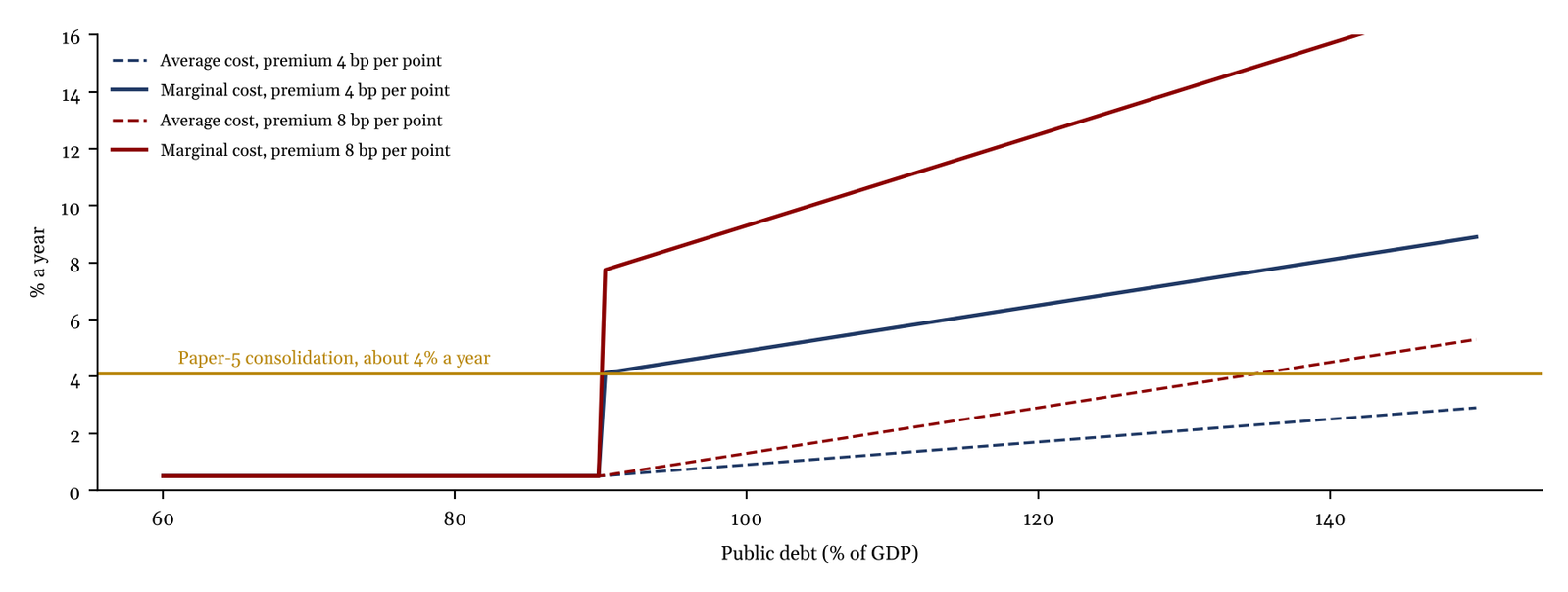
[Derived] Average cost: the interest-growth differential plus the premium. Marginal cost: the same plus the slope of the premium times the debt stock. The marginal cost jumps at the 90 per cent threshold because the premium then begins to apply to the whole stock.
II. The premium
The economy is that of The Backstop at the Floor, with its monetary rule (EMF-4), its fiscal backstop and its consolidation. Total public debt is the government’s initial debt plus the excess debt the fiscal rule adds. Above 90 per cent of GDP, the market premium rises by a fixed number of basis points per point of debt: none, 4, or 8. The second is close to the range of empirical estimates for advanced economies in normal times; the third is a stressed case. The premium reaches the debt stock gradually, as debt with an average maturity of six years rolls over. Half of any rise in the premium passes into private borrowing costs, lowering output and raising mortgage payments as mortgages reprice. A sovereign crisis is defined as a premium above 4 points at any time after the burn-in, a level comparable to the spreads several euro-area governments paid at the height of their crisis.
One amendment was made to the specification after a single trial run and before any test result was computed, and it is recorded with the tests. As first written, the premium on the government’s initial debt acted from the first quarter with nothing servicing it, so that an economy with high initial debt and a steep premium was not in a steady state even before any shock arrived; every design, including no fiscal rule at all, diverged, and the tests could not discriminate. The amended model treats the premium on the initial debt as already priced in, serviced by the government’s baseline budget and embedded in private rates and the central bank’s neutral rate. Only changes in the premium caused by new debt act on the economy. The marginal cost of a point of new debt is unchanged by the amendment.
Designs
Four fiscal designs are tested against no fiscal rule. The first two are those recommended by the previous paper: the shadow-rate backstop with its cap of 4 per cent of GDP and consolidation at 5 per cent a year as monetary room returns, alone and combined with ordinary stabilisers. The third and fourth are EMF-6, alone and with stabilisers. EMF-6 changes two things, both fixed before the run. Its consolidation rate is set each quarter at one and a half times the marginal cost of a point of debt, and never below the previous 5 per cent, so that it always outpaces the cost by half. Its backstop cap shrinks from 4 per cent of GDP as debt rises from 90 to 150 per cent, but never below 1. No coefficient is re-tuned: the backstop keeps the coefficient of the previous paper. The main setting is the forward weight of 0.3 and the neutral nominal rate of three per cent at which the previous two papers found the trap most dangerous.
III. Five tests
Table 1 gives the five tests and their verdicts. After the first results two variants of EMF-6 were tested and are reported as such: one in which consolidation never falls below a quarter of its strength, even at the floor; and one in which the backstop cap is scaled by the marginal cost of debt rather than by the debt ratio, with its constants fixed before that run.
Table 1. Tests fixed in advance and their verdicts
| Test | Criterion written before the run | Verdict |
|---|---|---|
| H1 Fiscal space | With the moderate premium, the backstop’s advantage over no fiscal rule shrinks as initial debt rises from 60 to 90 to 120% of GDP | Holds, but barely: 3.27, 3.25, 3.22. The cost of high debt appears in the debt tail (99th percentile 15, 29, 47% of GDP), not in household loss |
| H2 Crisis | At 120% debt with the steep premium, the previous paper’s backstop produces a sovereign crisis in more than 5% of paths | Holds: 75% of paths |
| H3 EMF-6 | In every economy tested, EMF-6 keeps crises below 1% of paths and keeps at least half of the backstop’s reduction in deflation traps | Fails in one of nine economies: 4.2% of paths at 120% debt with the steep premium. It keeps at least 81% of the trap reduction everywhere |
| H4 Eigenvalue | The condition that consolidation in the time room exists outpaces the marginal cost of debt classifies at least 90% of 27 economies correctly | Holds: 26 of 27. The one miss lies on the boundary |
| H5 Doom loop | Removing the pass-through of the premium to private rates at least halves the crises of H2 | Fails: from 75% to 71%. The loop is driven by compounding on the debt stock, not by contagion |
IV. The eigenvalue condition
The house’s paper The Fiscal Eigenvalue argued that a debt path should be judged by the condition that governs it rather than by its latest reading, and the previous paper of this series applied the argument to a backstop without a premium. With a premium the condition keeps its form but changes its content. Excess debt grows each quarter by its marginal cost, the interest-growth differential plus the premium plus the slope of the premium times the stock, and shrinks by consolidation, which acts only in the time when monetary room exists. Debt converges when the second exceeds the first, and diverges when it does not.
To test this I ran the backstop of the previous paper with consolidation fixed at 2.5, 5 and 10 per cent a year, at each initial debt and premium, twenty-seven economies in all, and compared the condition, evaluated at the average premium, debt and monetary room of each economy’s first twenty-five years, with what its debt actually did over the next fifteen. The left panel of Figure 2 shows the result. Every economy above the line, where the marginal cost exceeds consolidation, saw its excess debt keep rising, by more than five points of GDP over the last fifteen years; every economy below it saw its debt settle. The one exception lies on the line itself. [Derived] The condition is not an approximation that holds on average. It is the boundary between two kinds of fiscal arithmetic, and it can be computed in advance from quantities a finance ministry already publishes.
Figure 2. The eigenvalue condition, and sovereign crises under three fiscal rules
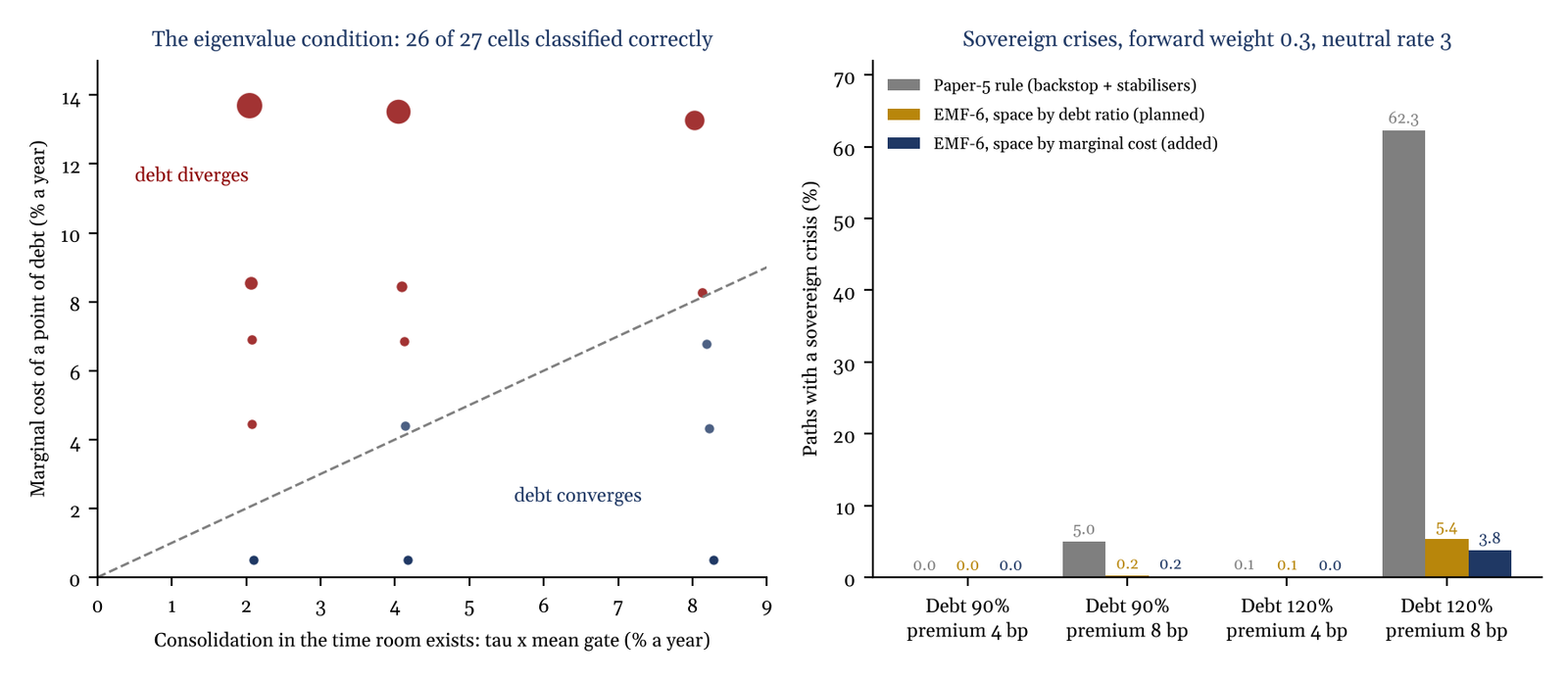
[Derived] Left: each point is an economy; red where excess debt diverged, navy where it converged; size shows the share of paths with a crisis. Right: the previous paper’s rule, EMF-6 as planned, and EMF-6 with its cap keyed to the marginal cost of debt, all with stabilisers.
Table 2. The condition at work: the previous paper’s backstop, forward weight 0.3, neutral nominal rate 3
| Initial debt, premium | Rate set (% a year) | Rate in the time room exists | Marginal cost of debt | Condition | Excess debt, change years 25–40 (pts) | Paths in crisis (%) |
|---|---|---|---|---|---|---|
| 90%, 4 bp | 5 | 4.1 | 4.4 | Diverge | +4.0 | 0.0 |
| 90%, 4 bp | 10 | 8.2 | 4.3 | Converge | +1.8 | 0.0 |
| 90%, 8 bp | 10 | 8.1 | 8.3 | Diverge | +5.1 | 0.9 |
| 120%, 4 bp | 5 | 4.1 | 6.9 | Diverge | +7.3 | 0.1 |
| 120%, 4 bp | 10 | 8.2 | 6.8 | Converge | +3.3 | 0.0 |
| 120%, 8 bp | 5 | 4.0 | 13.5 | Diverge | +41.5 | 74.8 |
| 120%, 8 bp | 10 | 8.0 | 13.3 | Diverge | +19.7 | 45.2 |
[Derived] Rates in per cent a year. The first row is the one economy the condition misclassifies: predicted to diverge, its debt rose by 4.0 points, just below the 5-point mark. A selection; Figure 2 shows all twenty-seven. Every economy with debt below 90 per cent, or with no premium, converged.
V. The doom loop
Where the condition fails badly, the backstop becomes the mechanism of the crisis it was meant to prevent. Table 3 follows the most stressed economy, initial debt of 120 per cent of GDP and the steep premium. Without a fiscal rule there is no sovereign crisis, but 9 per cent of paths fall into a deflation trap. With the backstop of the previous paper, traps almost disappear and a sovereign crisis takes their place in three paths out of four: the backstop fires at the floor, the debt it adds raises the premium on the whole stock, the premium compounds faster than consolidation can repay it, and mean excess debt after forty years reaches 60 per cent of GDP, with a 99th percentile of 375.
The fifth test asked whether the loop runs mainly through private credit, the channel that the euro-area crisis made familiar, in which a rising sovereign premium raises the cost of borrowing for banks and firms and deepens the recession. In this model it does not. With the pass-through to private rates switched off, crises fall only from 75 to 71 per cent. [Inference] The engine is the arithmetic of compounding: a marginal cost of 13 per cent a year against consolidation of 4 per cent a year will carry the debt away whatever happens to private credit. That makes the problem simpler to diagnose and harder to escape: it cannot be solved by protecting banks, only by changing the fiscal arithmetic itself.
Table 3. Initial debt 120% of GDP, steep premium, forward weight 0.3, neutral nominal rate 3, fixed mortgages
| Design | Loss | Trapped paths (%) | Paths in crisis (%) | Excess debt after 40 years, mean / 99th pct (% GDP) |
|---|---|---|---|---|
| No fiscal rule | 7.45 | 9.3 | 0.0 | 0 / 0 |
| Previous paper’s backstop | 4.88 | 2.1 | 74.8 | 60 / 375 |
| The same, no pass-through to private rates | 4.32 | 0.2 | 71.4 | 43 / 201 |
| Previous paper’s backstop plus stabilisers | 4.36 | 1.5 | 62.3 | 58 / 430 |
| EMF-6 (planned) | 5.11 | 2.9 | 4.2 | 7 / 80 |
| EMF-6, consolidation never below a quarter (added) | 5.39 | 3.6 | 2.9 | 5 / 45 |
| EMF-6, cap keyed to marginal cost (added) | 5.56 | 4.2 | 3.0 | 6 / 88 |
| EMF-6 plus stabilisers (planned) | 4.23 | 1.0 | 5.4 | 7 / 59 |
| EMF-6 plus stabilisers, cap keyed to marginal cost (added) | 4.28 | 1.3 | 3.8 | 6 / 59 |
[Derived] Every EMF-6 variant cuts crises by more than nine-tenths while keeping most of the backstop’s protection against deflation traps. None brings crises below 1 per cent in this economy.
VI. A rule that obeys the condition
EMF-6 writes the condition into the rule. Its consolidation is set from the marginal cost of debt, so that it rises automatically as the premium rises and as debt grows, and its backstop is scaled down as fiscal space shrinks. Table 4 compares it, with stabilisers, to the previous paper’s rule across the economies tested. Where debt is below 90 per cent of GDP, or there is no premium, nothing changes. Where the premium is moderate, EMF-6 cuts the 99th percentile of excess debt by a quarter to a half, at a cost of at most about 1 per cent in household loss. Where it is steep, it removes the crises at 90 per cent initial debt, from 5 per cent of paths to 0.2, and cuts them from 62 to under 4 per cent at 120.
The first results showed a flaw in the planned design. Its cap shrinks with the debt ratio, and so at 120 per cent debt with no premium at all it cuts the backstop for no reason, raising the share of trapped paths from 0.1 to 1.4 per cent. The principle of this paper says that fiscal space is the marginal cost of debt, not the ratio, and I therefore tested a version whose cap shrinks as the marginal cost rises from 4 to 14 per cent a year, with those constants fixed before the run. It costs nothing where there is no premium, is better where the premium is moderate, and is more cautious where it is steep, with fewer crises and somewhat more traps. Combined with stabilisers it is the rule I recommend, and Table 4 reports it.
Table 4. The previous paper’s rule and EMF-6, both with stabilisers, forward weight 0.3, neutral nominal rate 3
| Initial debt, premium | Previous: loss | Previous: crisis (%) | Previous: debt 99th pct | EMF-6: loss | EMF-6: crisis (%) | EMF-6: debt 99th pct |
|---|---|---|---|---|---|---|
| 60%, any premium | 3.77 | 0.0 | 14 | 3.77 | 0.0 | 14 |
| 90% or 120%, no premium | 3.77 | 0.0 | 14 | 3.77 | 0.0 | 14 |
| 90%, 4 bp | 3.80 | 0.0 | 28 | 3.81 | 0.0 | 21 |
| 90%, 8 bp | 3.89 | 5.0 | 78 | 3.95 | 0.2 | 25 |
| 120%, 4 bp | 3.82 | 0.1 | 47 | 3.86 | 0.0 | 23 |
| 120%, 8 bp | 4.36 | 62.3 | 430 | 4.28 | 3.8 | 59 |
| Weight 0, 120%, 4 bp | 3.42 | 1.4 | 77 | 3.45 | 0.1 | 39 |
[Derived] EMF-6 here is the version with its cap keyed to the marginal cost of debt, added after the first results. Debt in per cent of GDP, excess over the initial level, after forty years.
Where no rule is safe
The third test failed in one economy, and I do not think a better coefficient would rescue it. At 120 per cent debt with the steep premium, the marginal cost of debt is over 13 per cent a year. Every variant tested cuts crises by more than nine-tenths, but none brings them below about 3 per cent of paths. Consolidating harder makes the recessions that call on the backstop deeper; shrinking the backstop brings back the deflation traps. The government of such an economy faces a choice that no rule can make for it, between a 9 per cent risk of a deflation trap with no fiscal response and a 3 to 4 per cent risk of a sovereign crisis with one. [Inference] The only way out is to arrive at the floor with more fiscal space, and the model shows how much that is worth. With the same steep premium, an economy that starts at 90 per cent of GDP has crises in 0.2 per cent of paths under EMF-6; one that starts at 120 has them in 3.8. Thirty points of debt, reduced in good years, are the difference between a backstop that can be used and one that cannot.
VII. What this changes in the earlier papers
One rule of The Backstop at the Floor is incomplete, and its web edition now carries a note pointing here. That paper told governments to consolidate at a pace that exceeds the interest rate on public debt less the growth rate. Where debt carries a premium that rises with debt, that pace is too slow, often by a factor of three or more: the pace must exceed the marginal cost of debt, which includes the rise in the premium on the whole stock. The same paper set the backstop’s cap at a fixed 4 per cent of GDP; where a premium applies, the cap must shrink as the marginal cost rises. Everything else in that paper stands, including the backstop itself, which remains unchanged wherever debt is below the premium threshold. The Half-Credible Economy recommended a neutral nominal rate of four to five for a central bank acting alone, and the previous paper three to four with a backstop. [Inference] Where fiscal space is exhausted, the backstop cannot be relied upon, and the higher figure applies again.
VIII. Guidance
The fiscal half of the framework can now be stated in five rules, which replace the fiscal rules of the previous paper; the monetary rules of the series are unchanged.
| Rule | Basis |
|---|---|
| 1. Measure fiscal space as a price: the marginal cost of the next point of debt, which is the interest-growth differential, plus the premium, plus the slope of the premium times the debt stock. Publish it alongside the debt ratio. | Figure 1; Section IV |
| 2. Consolidate faster than that marginal cost, in the time when monetary room exists, and write the rate into the rule so that it rises automatically with the premium. Never consolidate while the policy rate is at its floor. | Table 2; H4 |
| 3. Keep the fiscal backstop, legislated in advance, but scale its cap down as the marginal cost of debt rises, from 4 per cent of GDP where debt is cheap toward 1 per cent where it is dear. | Tables 3 and 4 |
| 4. Keep ordinary stabilisers on at all times, built into taxes and transfers so that they act without delay. | Table 4; The Backstop at the Floor |
| 5. Build fiscal space before the floor. Where the premium is steep, reducing debt from 120 to 90 per cent of GDP in good years is what turns a backstop that cannot be used into one that can. | Section VI |
The series has asked what monetary policy owes to the households that live with its consequences. Six papers in, the answer has become an argument about time. The central bank must have room before the downturn; the government must have its backstop in law before the floor; and the backstop must have fiscal space behind it before the crisis tests it. Each of these is cheap to provide in advance and expensive or impossible to provide in the moment. A framework that serves households is, in the end, one that does its work in the good years.
IX. Limits
The premium is a simple function of debt, with a threshold and a constant slope, and its parameters are chosen rather than estimated; real premiums depend on growth prospects, the currency in which debt is issued, the holders of the debt and the credibility of the fiscal framework itself, which a rule like EMF-6 might improve. The model contains no default, no maturity choice and no central bank purchases of government debt, and the last omission matters: a central bank willing to cap premiums, as the European Central Bank has offered to do under conditions, changes the condition by removing the slope of the premium, though it raises questions of its own. The premium on the initial debt is assumed to be priced in, by an amendment recorded before the tests were run. The pass-through to private rates is fixed at a half. The two EMF-6 variants were added after the first results. Every number here is model-dependent; the orderings are more robust than the magnitudes.
Table 5. The seam: principal claims by evidential status
| Claim | Status |
|---|---|
| Whether the backstop’s debt converges is decided by its marginal cost against consolidation in the time room exists | Derived |
| Under a steep premium at high debt, the marginal cost of debt is several times its average cost | Derived |
| The doom loop is driven by compounding on the debt stock rather than by contagion to private credit | Derived; inference as mechanism |
| EMF-6 cuts sovereign crises by more than nine-tenths at little or no cost elsewhere | Derived; cap keyed to marginal cost added after first results |
| At high debt and a steep premium no debt-financed backstop is safe; fiscal space must be built in advance | Derived; inference as policy |
| Sovereign premiums rise with debt and can rise abruptly in a crisis | Witnessed in the literature |
Method note
The model is that of The Backstop at the Floor with a sovereign premium added; with no premium it reproduces that model to machine precision. Excess debt follows d′ = d(1 + 0.005/4) + (ρ̄(b₀ + d) − ρ₀b₀)/4 + q/4 − s/4 in per cent of GDP, where ρ̄ is the premium on the stock, which moves a twenty-fourth of the way to the market premium each quarter, and ρ₀ the premium on the initial debt. Every design is evaluated on fifty-four economies with two hundred unseen paths of 160 quarters after a burn-in of forty, with no coefficient re-tuned. The five tests and the one amendment to the specification were written down before any test result was computed; the two EMF-6 variants were added afterwards.
References
De Grauwe, P. and Y. Ji (2013), “Self-Fulfilling Crises in the Eurozone: An Empirical Test”, Journal of International Money and Finance 34.
Laubach, T. (2009), “New Evidence on the Interest Rate Effects of Budget Deficits and Debt”, Journal of the European Economic Association 7.
Rudebusch, G. and L. Svensson (1999), “Policy Rules for Inflation Targeting”, in J. Taylor (ed.), Monetary Policy Rules, University of Chicago Press.
The Monetary Engineering series
The Better Ways: the engineered framework: a rate rule with a credit instrument and supply relief, tested against the best conventional rule.
Room Above the Floor: the inflation target as the room an economy needs above the floor, and a mortgage reset cap that pays for itself.
The Half-Credible Economy: the framework under forward-looking expectations: why partial credibility is the most dangerous state, the revised room rule, and the bound on mortgage easing.
The Backstop at the Floor: a fiscal rule written in advance that removes the deflation trap, the debt it leaves and the condition under which that debt converges.
Fiscal Space Is a Price: the backstop under a sovereign risk premium: the marginal cost of debt, the eigenvalue condition that separates convergence from a doom loop, and a fiscal rule that obeys it.
The Engineered Monetary Framework: the whole framework in one specification, with every rule, the conditions under which it holds and the evidence behind it; the place to start.
Download the PDF
About the Author
Dr. Glen Brown is President & CEO of Global Financial Engineering, Inc. and Global Accountancy Institute, Inc. He is the architect of the GCPIAUT framework and the broader GATS-native proprietary capital doctrine. His work focuses on sovereign capital governance, algorithmic trading architecture, reserve-first compounding systems, and institutional financial engineering within closed proprietary environments.
Business Model Clarification
Global Financial Engineering, Inc. and Global Accountancy Institute, Inc. operate as closed-loop proprietary institutions. They do not offer public investment products and do not invite retail participation into their proprietary capital architecture. This paper is policy research published for intellectual and institutional discussion.
Disclaimer
This paper is analysis, not advice. It takes no position on any particular decision of any central bank or government, and nothing in it constitutes investment advice, an offer, a solicitation, or a recommendation to buy or sell any financial instrument.