Public Doctrine Series
Monetary Engineering
The Backstop at the Floor
How a fiscal rule written in advance removes the deflation trap, what it costs in public debt, and the condition under which that debt converges
Dr. Glen Brown · President & CEO, Global Financial Engineering, Inc. and Global Accountancy Institute, Inc.
GFE-PUB-EMF-20261031-B · 31 October 2026
Revision note, 31 October 2026. This paper’s public debt carried no risk premium. Where a premium rises with debt, its consolidation rule is too slow: consolidation must outpace the marginal cost of the next point of debt, which includes the rise in the premium on the whole stock, and the backstop’s cap must shrink as that cost rises. The revised fiscal rule, EMF-6, is in Fiscal Space Is a Price. Everything else in this paper stands; the PDF below is the original edition.
Abstract
The previous paper of this series, The Half-Credible Economy, found that a central bank believed only in part is exposed to a deflation trap that neither a fully trusted nor a wholly ignored one faces. At a neutral nominal interest rate of three per cent, nearly one path in ten ends with the policy rate pinned at its floor and prices falling without limit, and no monetary rule I tested prevents it. That paper left one question open, because its economy had no government. This paper adds one. I give the economy a fiscal block, with public spending that raises output and public debt that must be serviced, and test four ways of using it: none; ordinary stabilisers that lean against the output gap at all times; and two backstops that act only at the floor, one triggered by the shortfall of output and inflation and one by the cut in the interest rate that the floor prevents. I wrote seven tests down before computing any result.
The backstop works, and decisively. The version that fills the gap the floor leaves cuts the share of trapped paths from 9.3 per cent to 0.1 and the household-weighted loss by 44 per cent, while acting in only one quarter in twelve. Where traps are absent it costs nothing. The public debt it leaves converges, but only because the government consolidates as monetary room returns, a condition that is the debt-path counterpart of the eigenvalue argument the house has made elsewhere; without it, the debt rises for forty years with nothing to stop it. With a backstop in place the room an economy needs falls from four or five points of neutral nominal rate to three or four. Two results qualify the case. Where expectations look backward and traps are rare, ordinary stabilisers do as well as a backstop, so the targeting is worth its complexity only where traps are a real danger; the best design of all combines both. And every quarter of implementation lag costs: a backstop that has to be voted when the floor binds arrives late, which is why it must be written into law in advance.
I. The gap the rate cannot reach
Every framework in this series has run into the same wall. When the neutral nominal interest rate is low, the policy rate reaches its floor in deep downturns and stays there, and the economy loses the one instrument that could pull it out. Room Above the Floor measured how much room above the floor an economy needs and found it to be about four points of neutral nominal rate. The Half-Credible Economy found that partial credibility makes the floor more dangerous still, and raised the requirement to four or five. Both papers said plainly that their economies had no fiscal policy, and that in real episodes at the floor governments have done much of the work.
The idea of a fiscal response at the floor is old, and the reasons for it are well understood. When the policy rate cannot fall, a rise in public spending is not offset by a rise in interest rates, so its effect on output is larger than in normal times (Eggertsson, 2011; Christiano, Eichenbaum and Rebelo, 2011). The reasons for caution are as old. Friedman (1948) argued that discretionary fiscal policy acts with long and variable lags, and that only stabilisers built into the tax and transfer system can be relied upon. Public debt must be serviced, and a response that adds to it in every downturn without repaying it in recoveries leaves a ratchet. This paper puts those arguments inside the economy of the series and measures them.
II. The fiscal block
The economy is the forward-looking economy of The Half-Credible Economy, with the monetary rule it recommended: EMF-4, the engineered rule whose easing for mortgage stress is bounded at one point. I add three things. The first is a fiscal impulse, measured in per cent of GDP, which raises the output gap in the following quarter. Its strength is set so that a sustained impulse of 1 per cent of GDP, with no monetary response, raises the steady-state output gap of the backward economy by one point, a multiplier of one; I test a half and one and a half as well. The second is a stock of excess public debt, the debt the fiscal rule adds above whatever the government would otherwise owe, which grows with the impulse and with an interest rate half a point above the growth rate of the economy. The third is consolidation: as monetary room returns, the government runs a surplus equal to 5 per cent a year of the excess debt, scaled by the same gate that stands the central bank’s supply and credit instruments down near the floor. Consolidation is itself fiscal drag, and it enters output with the opposite sign of the impulse.
Four fiscal designs are tested. In the first there is no fiscal rule. In the second, ordinary stabilisers move the impulse against the output gap at all times, by half a point of GDP per point of gap, a conventional estimate that is not tuned. The third and fourth are backstops that act only near the floor. The gap backstop spends in proportion to the shortfall of output below potential and of inflation below target, scaled up as the gate closes. The shadow-rate backstop spends in proportion to the cut in the interest rate that the monetary rule would have made but the floor prevents. Both backstops are capped at 4 per cent of GDP, and their single coefficient is tuned at each forward weight on the training economies, at a neutral nominal rate of three with long fixed-rate mortgages, where traps occur. The household loss of The Half-Credible Economy gains one term, a small penalty on the size of the fiscal impulse, the same weight given to the credit instrument. Public debt is not in the loss; it is reported, and its cost is treated as a break-even, as the cost of inflation was in Room Above the Floor.
III. Seven tests, and two additions
Table 1 gives the seven tests I wrote down before computing any fiscal result, and their verdicts. Two analyses were added after the first results, and I report them as such. The first is a combined design, ordinary stabilisers plus the shadow-rate backstop, tested because the first results showed that each does better where the other does worse; it uses the coefficients already set for its parts and was not tuned. The second is a test of implementation lags, added because the strongest objection to fiscal stabilisation is that it arrives late.
Table 1. Tests fixed in advance and their verdicts
| Test | Criterion written before the run | Verdict |
|---|---|---|
| F1 Traps | The better backstop at least halves the share of trapped paths at forward weight 0.3, neutral nominal rate 3, fixed mortgages | Holds: from 9.3% to 0.1% (shadow-rate backstop) and 0.2% (gap backstop) |
| F2 Cost-free | Where traps are absent (weight 0.6 at 4; weight 0 at 5) the backstop raises household loss by no more than 1% | Holds: no change at weight 0.6, where it never acts; 3% lower at weight 0 |
| F3 Room | With the backstop, the loss-minimising neutral nominal rate at weight 0.3, fixed mortgages, is 4 or below | Holds: loss is lowest at the bottom of the range tested; room is now traded against debt (Section VII) |
| F4 Debt | With consolidation, mean excess debt after forty years is below 10% of GDP and its 99th percentile below 40% | Holds: 5.5% and 15.5%. Without consolidation, 10.1% and 23.0%, and still rising |
| F5 Targeting | A backstop beats ordinary stabilisers at neutral nominal rate 3, at weights 0 and 0.3 | Fails: holds at 0.3 by 5–8%, but at weight 0 stabilisers do as well or better |
| F6 Reset cap | The half-point reset cap, as repaid deferral, lowers household loss at weights 0.3 and 0.6, variable mortgages | Holds: by 3.5% at 0.3 and by a negligible 0.1% at 0.6 |
| F7 Multiplier | F1 re-run with multipliers of 0.5 and 1.5; reported, no pass mark | Trapped paths 0.8% at 0.5 and 0.0% at 1.5, against 9.3% with no fiscal rule |
IV. The trap removed
Table 2 and Figure 1 show the economy that The Half-Credible Economy found most dangerous, a forward weight of 0.3, with each fiscal design. Without a fiscal rule the trap dominates everything below a neutral nominal rate of four. Ordinary stabilisers help a great deal but do not remove it: at a neutral nominal rate of two, 13 per cent of paths are still trapped. The shadow-rate backstop all but removes it at every level of room, and the household-weighted loss becomes nearly flat, between 4.1 and 4.4 from a neutral nominal rate of two to five.
Table 2. Forward weight 0.3, long fixed mortgages: loss, traps and debt by neutral nominal rate
| Design | Measure | 2 | 3 | 4 | 5 |
|---|---|---|---|---|---|
| No fiscal rule (EMF-4 alone) | Loss | 13.38 | 7.45 | 5.32 | 4.65 |
| Trapped paths (%) | 29.4 | 9.3 | 2.2 | 0.3 | |
| Ordinary stabilisers | Loss | 6.78 | 4.55 | 4.04 | 3.99 |
| Trapped paths (%) | 13.3 | 2.6 | 0.4 | 0.0 | |
| Excess debt, mean / 99th pct (% GDP) | 6.3 / 114.7 | 1.5 / 14.9 | 0.3 / 4.9 | −0.2 / 4.2 | |
| Shadow-rate backstop | Loss | 4.06 | 4.18 | 4.30 | 4.42 |
| Trapped paths (%) | 1.0 | 0.1 | 0.0 | 0.0 | |
| Excess debt, mean / 99th pct (% GDP) | 11.0 / 25.1 | 5.5 / 15.5 | 2.6 / 9.3 | 1.2 / 5.6 | |
| Stabilisers plus backstop (added) | Loss | 3.69 | 3.77 | 3.84 | 3.92 |
| Trapped paths (%) | 0.5 | 0.0 | 0.0 | 0.0 | |
| Excess debt, mean / 99th pct (% GDP) | 9.3 / 22.9 | 4.4 / 13.6 | 1.9 / 8.8 | 0.5 / 5.9 |
[Derived] Fifty-four economies, two hundred unseen paths each. Excess debt is measured after forty years. With stabilisers alone at a neutral nominal rate of two, the trapped paths accumulate debt without limit, which is why the 99th percentile reaches 115 per cent of GDP.
Figure 1. Fiscal designs at forward weight 0.3: household loss and deflation traps
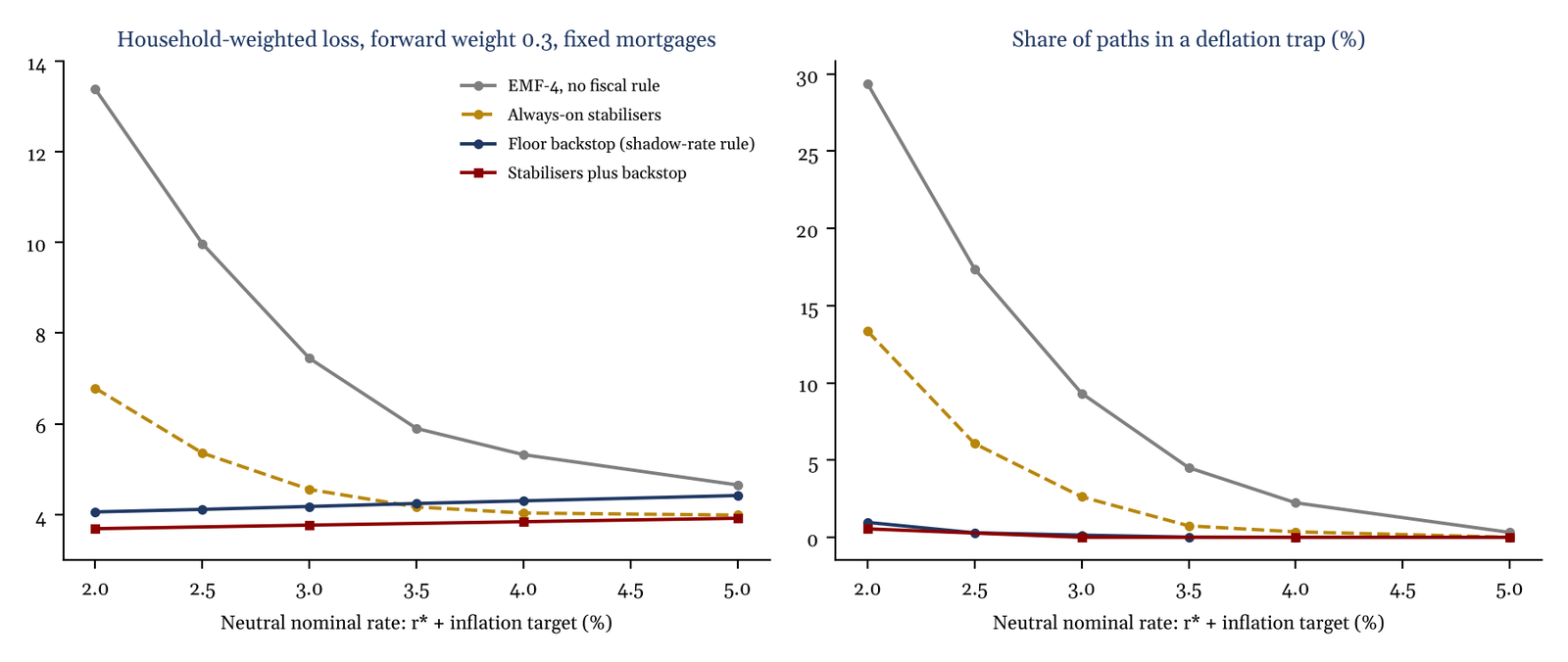
[Derived] A backstop that fills the cut the floor prevents flattens the loss and removes the trap. Ordinary stabilisers help, but do not stop the trap where room is short.
The tuned backstop is strong and brief. Its coefficient rose to the top of the range searched, so the best backstop is limited by its cap of 4 per cent of GDP rather than by its slope. At a neutral nominal rate of three it acts in 8 per cent of quarters, and when it acts it spends about 3 per cent of GDP. [Inference] The reason is the logic of the trap itself. A trap is a self-reinforcing fall in expected inflation, and it is cheaper to stop it at the start than to fight it once expectations have moved; a backstop that hesitates allows the fall it exists to prevent. The gap backstop works almost as well as the shadow-rate backstop, but it acts more often and leaves more debt, because the shortfall of output and inflation persists after the rate has left the floor, while the shortfall of the rate does not.
V. Targeting and its limits
The fifth test failed, and the failure is informative. Table 3 sets the designs side by side at a neutral nominal rate of three. Where expectations are partly forward-looking, a backstop beats ordinary stabilisers by 5 to 8 per cent, because the stabilisers do not act with enough force at the moment the trap begins. Where expectations look backward, the trap is rare, and stabilisers do as well as a backstop with fixed mortgages and about 2 per cent better with variable ones, because they work in every downturn while the backstop works only in those that reach the floor. Where expectations are largely forward-looking, the backstop never acts, and the stabilisers lower the loss by 8 per cent by smoothing ordinary downturns that monetary policy is already handling.
Table 3. Household-weighted loss at a neutral nominal rate of 3, by fiscal design and forward weight
| Forward weight and mortgages | No fiscal rule | Stabilisers | Gap backstop | Shadow-rate backstop | Stabilisers plus backstop |
|---|---|---|---|---|---|
| 0, fixed | 4.06 | 3.52 | 3.52 | 3.53 | 3.34 |
| 0, variable | 4.26 | 3.65 | 3.72 | 3.73 | 3.47 |
| 0.3, fixed | 7.45 | 4.55 | 4.28 | 4.18 | 3.77 |
| 0.3, variable | 7.35 | 4.58 | 4.35 | 4.26 | 3.82 |
| 0.6, fixed or variable | 1.68 | 1.55 | 1.68 | 1.68 | 1.55 |
[Derived] The combined design was added after the first results and uses untuned coefficients from its parts. At weight 0.6 the floor is not reached, so the backstops never act.
The stabilisers and the backstop are therefore complements, not rivals. The combined design is the best, or equal best, in every cell of Table 3 and of Table 2: 3.77 against 4.18 for the backstop alone at a forward weight of 0.3, and 3.34 against 3.52 for the stabilisers alone in the backward economy. The stabilisers deal with ordinary downturns; the backstop deals with the one kind of downturn that the stabilisers and the central bank together cannot stop.
Lags
There is one condition on that conclusion, and it is the one Friedman named. All the results so far assume that the fiscal response is spent in the quarter after it is decided. Table 4 shows what happens when the decision takes two or four quarters to reach the economy. The backstop survives: with a four-quarter lag it still cuts the share of trapped paths from 9.3 per cent to 1.4, though its loss rises from 4.18 to 5.08. The combined design does not survive in the same way: with lagged stabilisers its loss rises to 6.08, worse than the backstop alone, because a response to last year’s downturn often arrives in this year’s recovery. [Inference] The lesson is not that stabilisers fail but that they must be truly automatic, written into tax and transfer schedules that respond as incomes change, as most existing stabilisers are. The backstop must be automatic in the same sense: legislated in advance, with its trigger and its scale written down, so that it fires when the floor binds without waiting for a vote. A backstop that has to be voted is a backstop that arrives late.
VI. Debt that converges
A fiscal rule that spends in every crisis and never repays is not a rule but a ratchet. The house’s paper The Fiscal Eigenvalue argued that a debt path should be judged by the condition that governs it, whether it converges, rather than by its latest reading, and the backstop is a test of exactly that argument. Excess debt here evolves each quarter by a factor of one plus a quarter of the interest-growth differential, less a quarter of the consolidation rate scaled by the gate. With a differential of half a point and consolidation of 5 per cent a year, that factor is below one whenever the policy rate is more than a fifth of a point above the floor, which is to say almost always. The debt the backstop adds is then repaid in the recoveries that follow, and the stock converges to a level set by how often the backstop fires.
Figure 2. Excess public debt with and without consolidation, and the trade between room and debt
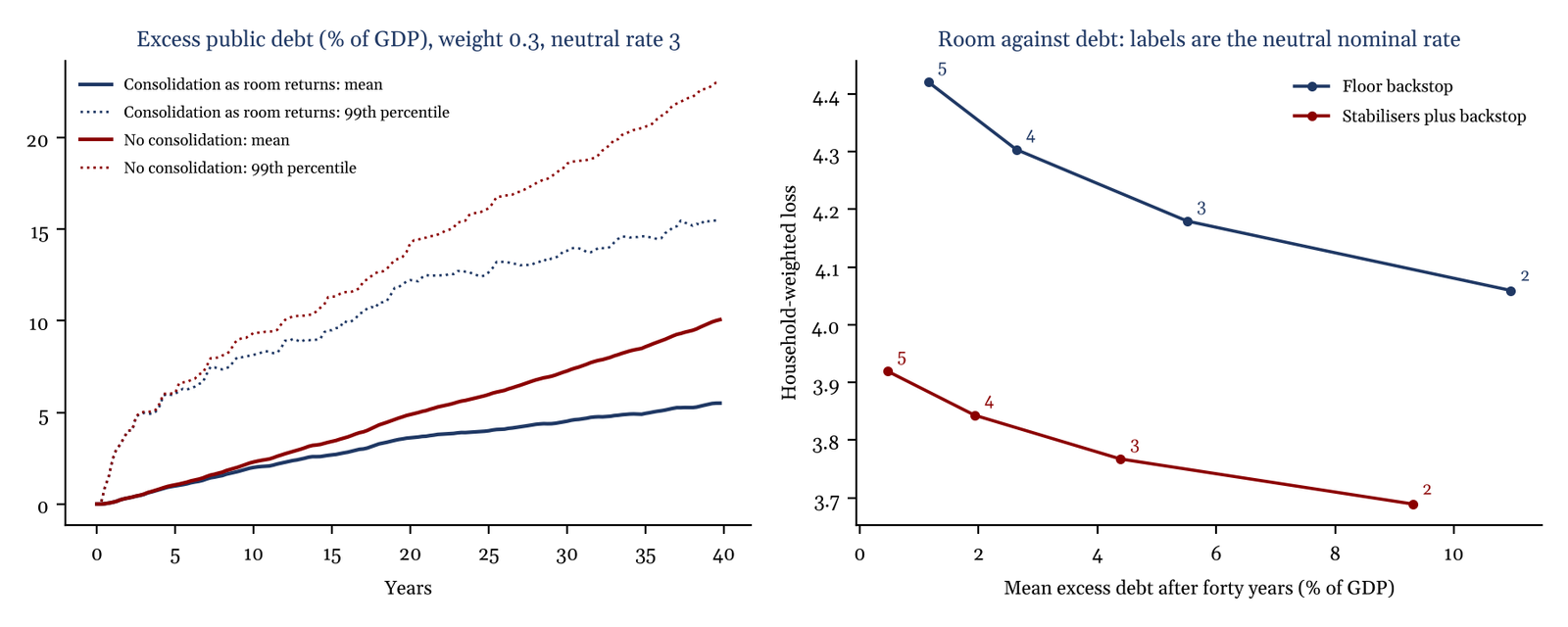
[Derived] Left: with consolidation as room returns, excess debt levels off; without it, it rises for forty years. Right: with a backstop, loss changes little with the neutral nominal rate, but the debt the backstop carries doubles with each point of room given up.
Figure 2 and Table 4 show the two cases. With consolidation, mean excess debt after forty years is 5.5 per cent of GDP and its 99th percentile 15.5, comfortably inside the bounds I set in advance, and still approaching a level of about 6 per cent. Without consolidation, the same backstop leaves a mean of 10.1 per cent and a 99th percentile of 23.0 after forty years, and both are still rising at the end, as an eigenvalue above one requires. The striking result is that consolidation costs nothing in household terms: the loss is 4.18 with it and 4.18 without. [Inference] Because it is applied only as monetary room returns, the central bank can offset its drag in the ordinary way, and the economy pays for the backstop in the years when paying is easiest. The condition is the one that matters: it is the consolidation, not the backstop, that decides whether the debt converges.
Table 4. The shadow-rate backstop at forward weight 0.3, neutral nominal rate 3, fixed mortgages: robustness
| Variant | Loss | Trapped paths (%) | Excess debt after 40 years, mean (% GDP) | 99th percentile (% GDP) | Quarters active (%) |
|---|---|---|---|---|---|
| No fiscal rule | 7.45 | 9.3 | — | — | — |
| Backstop, consolidation, multiplier 1, no lag | 4.18 | 0.1 | 5.5 | 15.5 | 8.1 |
| No consolidation | 4.18 | 0.1 | 10.1, rising | 23.0, rising | 7.5 |
| Multiplier 0.5 | 4.52 | 0.8 | 7.4 | 23.8 | 10.1 |
| Multiplier 1.5 | 4.05 | 0.0 | 4.6 | 11.9 | 7.1 |
| Two-quarter lag (added) | 4.73 | 0.4 | 7.4 | 20.4 | 10.4 |
| Four-quarter lag (added) | 5.08 | 1.4 | 8.2 | 23.9 | 11.5 |
| Stabilisers plus backstop, two-quarter lag (added) | 5.10 | 0.3 | 7.9 | 21.3 | — |
| Stabilisers plus backstop, four-quarter lag (added) | 6.08 | 1.3 | 10.0 | 27.8 | — |
[Derived] With a multiplier of a half the backstop must spend more to achieve less, and it leaves more debt, but it still cuts the share of trapped paths by more than nine-tenths.
The interest-growth differential of half a point is a cautious assumption. Blanchard (2019) showed that for long periods the interest rate on public debt in the advanced economies has been below their growth rate; where that holds, the factor is below one even without consolidation, and the debt the backstop leaves would shrink on its own. I do not rely on it, because the differential can turn, and a rule that converges only when it is favourable is a rule that fails exactly when it is tested.
VII. How much room now
The third test asked whether a backstop reduces the room an economy needs, and it does: with the backstop, loss is lowest at the bottom of the range tested. But the right-hand panel of Figure 2 shows that the question has changed its form. Without a backstop, too little room is paid for in deflation and lost output. With one, it is paid for in public debt, because the less room the central bank has, the more often the backstop fires. Between a neutral nominal rate of four and three, the shadow-rate backstop lowers the loss by 0.12 and doubles mean excess debt from 2.6 to 5.5 per cent of GDP; between three and two it lowers the loss by another 0.12 and doubles debt again, to 11.0. The combined design shows the same pattern.
As with the cost of inflation in Room Above the Floor, I report the cost of debt at which the choice would change rather than assume one. Moving from a neutral nominal rate of four to three pays if a percentage point of permanent excess debt costs less than about 0.03 to 0.04 in the units of the loss; moving from three to two pays only if it costs less than about 0.02. [Inference] A reader who takes the arithmetic of a favourable interest-growth differential at face value will find public debt cheap and go to the lower end; one who weighs the risk that the differential turns, and the political difficulty of consolidation, will stay at four. I take the middle: with a backstop written into law and consolidation enforced, an economy needs a neutral nominal rate of three to four, about one point less than the four to five that The Half-Credible Economy recommended for a central bank acting alone. The backstop is worth about a point of room.
VIII. The reset cap under forward-looking expectations
Room Above the Floor found that a cap of half a point a year on upward mortgage resets helps households when the interest the cap holds back is deferred and repaid on a schedule. The Half-Credible Economy did not re-test it. Table 5 does. The cap still helps under forward-looking expectations, but by less as expectations look further ahead, because the policy rate then moves so little that resets rarely approach the cap. At a forward weight of 0.6 the gain is negligible. Combined with the fiscal backstop the cap adds about as much as it does alone.
Table 5. Half-point reset cap as repaid deferral, variable mortgages, neutral nominal rate 4: household loss
| Forward weight | EMF-4, no cap | EMF-4, cap | Change | Stabilisers plus backstop, no cap | With cap | Change |
|---|---|---|---|---|---|---|
| 0 | 4.40 | 3.94 | −10% | 3.77 | 3.45 | −8% |
| 0.3 | 5.51 | 5.32 | −3.5% | 4.05 | 3.85 | −5% |
| 0.6 | 1.680 | 1.678 | −0.1% | 1.555 | 1.553 | −0.1% |
[Derived] Deferral with no premium: the interest the cap holds back is added to the balance and repaid over about twelve years.
IX. What this changes in the earlier papers
No claim of the earlier papers is reversed here, but two are qualified. The room rule of The Half-Credible Economy, a neutral nominal rate of four to five, holds for a central bank acting alone; with a fiscal backstop of the kind tested here, written into law and paired with consolidation, three to four is enough. The reset cap of Room Above the Floor, which the previous paper had left untested under forward-looking expectations, survives that test, with smaller gains where the policy rate moves less. The web edition of the previous paper carries a note pointing here. The engineered rate rule of The Better Ways, with the bound on its mortgage easing, is unchanged, as are the floor gate and the response to supply inflation.
X. Guidance
The framework of the series can now be stated whole, as ten rules for a central bank and a government acting together.
| Rule | Basis |
|---|---|
| 1. Legislate a fiscal backstop in advance: when the policy rate is at its floor and the monetary rule calls for a further cut, public spending or transfers rise in proportion to the missing cut, forcefully and briefly, up to a cap of about 4 per cent of GDP. The trigger and the scale are written into law, so the backstop fires without a vote. | Tables 2 and 4 |
| 2. Keep ordinary stabilisers on at all times, built into the tax and transfer system so that they act without delay. The backstop adds to them; it does not replace them. | Table 3; lags |
| 3. Make the backstop’s debt converge: consolidate as monetary room returns, never while at the floor, at a pace that exceeds the excess of the interest rate on public debt over the growth rate. | Section VI; The Fiscal Eigenvalue |
| 4. Set the inflation target from the room it buys: a neutral nominal rate of three to four with a backstop in law, four to five without one. The target is that figure minus the best estimate of the neutral real rate. | Section VII; The Half-Credible Economy |
| 5. Restore room, but do not go beyond it. | Room Above the Floor |
| 6. Treat credibility as an instrument: announce the rules, explain them and keep to them. Partial credibility is the most dangerous state. | The Half-Credible Economy |
| 7. Run the policy rate by the engineered rule, responding to supply-driven inflation rather than looking through it. | The Better Ways; The Half-Credible Economy |
| 8. Ease for mortgage stress by no more than one point of the policy rate. | The Half-Credible Economy |
| 9. Use the credit instrument and fast supply relief, and stand both down as the rate approaches the floor; prefer a point target, reviewed on a fixed schedule. | The Better Ways; Room Above the Floor |
| 10. Cap upward mortgage resets by deferral repaid on a schedule, or by insurance funded outside the banks; never let the cost fall on bank capital. | Table 5; Room Above the Floor |
The series began from a complaint that monetary policy is run to hit a number at the expense of the households that live with the result. Its answer has grown with each paper. The interest rate should be helped by instruments that act on credit and on supply; the target should follow the room the economy needs; the cost of fighting inflation should not land on mortgage payments; and the rule should be clear enough to be believed. This paper adds the last piece. At the floor, where the central bank has run out of room, the government should not have to decide in the middle of a crisis whether to act. It should have decided already, and it should have decided too how the debt it takes on will be repaid.
XI. Limits
The fiscal block is deliberately simple. It has one multiplier, constant over time and across the composition of spending, and it ignores the supply-side effects of public investment and the difference between transfers and purchases. The multiplier at the floor is plausibly larger than in normal times; I hold it fixed, which understates the backstop’s power at the floor and overstates the stabilisers’ power elsewhere. Public debt carries no risk premium, so the model cannot see the economies in which a backstop would raise the cost of borrowing; where that risk is real, the cap on the backstop should be lower and consolidation faster. Agents observe the fiscal impulse but do not anticipate it beyond the quarter, which understates what a credible backstop would achieve through expectations alone. Consolidation is assumed to happen; whether a legislature will in fact tighten in recoveries is a question of institutions, not of economics, and it is the assumption on which the convergence of the debt depends. Every number here is model-dependent; the orderings are more robust than the magnitudes.
Table 6. The seam: principal claims by evidential status
| Claim | Status |
|---|---|
| A shadow-rate backstop removes the deflation trap and costs nothing where traps are absent | Derived |
| Ordinary stabilisers and the backstop are complements; together they are the best design tested | Derived; combined design added after first results |
| Lags weaken the backstop modestly and lagged stabilisers severely | Derived; added after first results |
| The backstop’s debt converges if and only if consolidation outpaces the interest-growth differential | Derived |
| Consolidation as room returns costs households nothing | Derived |
| With a backstop, a neutral nominal rate of three to four suffices | Derived; inference as policy |
| A backstop must be legislated in advance to be effective | Inference |
| Fiscal multipliers are larger at the interest-rate floor; interest rates on public debt have often been below growth | Witnessed in the literature |
Method note
The model is that of The Half-Credible Economy with a fiscal block added; with the block switched off it reproduces that model to within a ten-billionth. The fiscal impulse enters output with a one-quarter lag; excess debt follows d′ = d(1 + 0.005/4) + q/4 − s/4, with consolidation s equal to 5 per cent a year of d times the floor gate. Backstop coefficients are tuned at each forward weight on twelve training economies, eighty training paths, at a neutral nominal rate of three with fixed mortgages; every design is then evaluated on fifty-four economies and two hundred unseen paths of 160 quarters after a burn-in of forty, with each path’s loss capped as in the previous paper. The seven tests were written down before any fiscal result was computed; the combined design and the lag test were added afterwards.
References
Blanchard, O. (2019), “Public Debt and Low Interest Rates”, American Economic Review 109.
Christiano, L., M. Eichenbaum and S. Rebelo (2011), “When Is the Government Spending Multiplier Large?”, Journal of Political Economy 119.
Eggertsson, G. (2011), “What Fiscal Policy Is Effective at Zero Interest Rates?”, NBER Macroeconomics Annual 2010, 25.
Friedman, M. (1948), “A Monetary and Fiscal Framework for Economic Stability”, American Economic Review 38.
Rudebusch, G. and L. Svensson (1999), “Policy Rules for Inflation Targeting”, in J. Taylor (ed.), Monetary Policy Rules, University of Chicago Press.
The Monetary Engineering series
The Better Ways: the engineered framework: a rate rule with a credit instrument and supply relief, tested against the best conventional rule.
Room Above the Floor: the inflation target as the room an economy needs above the floor, and a mortgage reset cap that pays for itself.
The Half-Credible Economy: the framework under forward-looking expectations: why partial credibility is the most dangerous state, the revised room rule, and the bound on mortgage easing.
The Backstop at the Floor: a fiscal rule written in advance that removes the deflation trap, the debt it leaves and the condition under which that debt converges.
Fiscal Space Is a Price: the backstop under a sovereign risk premium: the marginal cost of debt, the eigenvalue condition that separates convergence from a doom loop, and a fiscal rule that obeys it.
The Engineered Monetary Framework: the whole framework in one specification, with every rule, the conditions under which it holds and the evidence behind it; the place to start.
Download the PDF
About the Author
Dr. Glen Brown is President & CEO of Global Financial Engineering, Inc. and Global Accountancy Institute, Inc. He is the architect of the GCPIAUT framework and the broader GATS-native proprietary capital doctrine. His work focuses on sovereign capital governance, algorithmic trading architecture, reserve-first compounding systems, and institutional financial engineering within closed proprietary environments.
Business Model Clarification
Global Financial Engineering, Inc. and Global Accountancy Institute, Inc. operate as closed-loop proprietary institutions. They do not offer public investment products and do not invite retail participation into their proprietary capital architecture. This paper is policy research published for intellectual and institutional discussion.
Disclaimer
This paper is analysis, not advice. It takes no position on any particular decision of any central bank or government, and nothing in it constitutes investment advice, an offer, a solicitation, or a recommendation to buy or sell any financial instrument.