Public Doctrine Series
Monetary Engineering
The Engineered Monetary Framework
The whole framework in one specification: its rules, their parameters, the conditions under which each holds, and the evidence behind every one
Dr. Glen Brown · President & CEO, Global Financial Engineering, Inc. and Global Accountancy Institute, Inc.
GFE-PUB-EMF-20261031-D · 31 October 2026
Abstract
Over six working papers I built and tested an engineered monetary framework: a set of rules for a central bank and a government that serve the households who live with the consequences of policy, rather than hitting a number at their expense. Each paper wrote its tests down before computing any result and reported every verdict. Three later papers revised claims of earlier ones, and the revisions were made in place, with dated notes. The result is sound but scattered: a reader who wants the framework as it now stands must assemble it from five published papers, an unpublished first one, and the notes that link them. This paper assembles it. It reports no new results. Every number is taken from the result files of the papers it summarises.
The framework has five parts. The policy rate follows an engineered rule that responds to supply-driven inflation as well as demand, eases for household mortgage stress by no more than one point, and is helped by a targeted credit instrument and fast supply relief that both stand down as the rate nears its floor. The inflation target is set from the room it buys above that floor: a neutral nominal rate of four to five for a central bank acting alone, three to four with a fiscal backstop in law. Mortgage resets are capped, with the cost deferred or insured outside the banks. A fiscal backstop, legislated in advance, fires only at the floor, with ordinary stabilisers always on and consolidation set from the marginal cost of debt. And the rules are published and kept, because a central bank believed only in part is more exposed than one believed fully or not at all. Of twenty-nine tests written in advance across the series, twenty-two held and seven failed. Every failure is reported, and most of them changed the framework.
I. Why a synthesis
Research that tests its own claims produces a record of revisions, and a record of revisions is not a specification. The series began with an internal working paper, which built a first framework and was superseded by The Better Ways before publication; its findings are summarised there. Five papers followed in public. Room Above the Floor added the floor gate and the room rule. The Half-Credible Economy tested the framework under forward-looking expectations and revised both the room rule and the rule’s easing for mortgage stress. The Backstop at the Floor added the fiscal backstop and revised the room rule again. Fiscal Space Is a Price added the sovereign premium and revised the backstop’s consolidation. A central banker reading the third paper today would need the fourth, fifth and sixth to know which of its rules still stand. This paper removes that burden. Where the earlier papers disagree, the later one governs, and the specification below is the current one.
II. The problem and the standard
The problem the series set itself was a complaint often heard after the inflation of 2021 to 2023: that central banks raised rates hard enough to bring inflation down, but that the cost fell disproportionately on households whose mortgage payments reset, and that the instrument was blunt because it was the only one used. The engineering question was whether a framework could do better for those households without doing worse on inflation.
Every rule was judged in the same way. The economy is a quarterly model of the Rudebusch and Svensson (1999) family, extended across the series with a mortgage block, a household stress threshold of 10 per cent of income, an effective interest-rate floor of −1 per cent, forward-looking expectations with a chosen weight, a fiscal block and a sovereign risk premium. Rules are scored by a household-weighted loss: the squared gap of inflation from target, half the squared output gap, a quarter of the squared change in the policy rate, the squared debt service above the stress threshold, and small penalties for using each non-rate instrument. Rules are tuned on twelve economies and tested on fifty-four, which differ from the central bank’s own model in how strongly expectations are anchored, how hard the rate bites, how strong the cost channel of interest rates is and how steep the Phillips curve is, under shocks the tuning never saw. The benchmark throughout is not a textbook rule but the best conventional rule, tuned on the same data. Every test was written down before the results it judged were computed.
III. The specification
Figure 1 shows when each part of the framework acts. The sections that follow give each rule, its parameters and its basis.
Figure 1. The framework at a glance: which instrument acts in which state of the economy
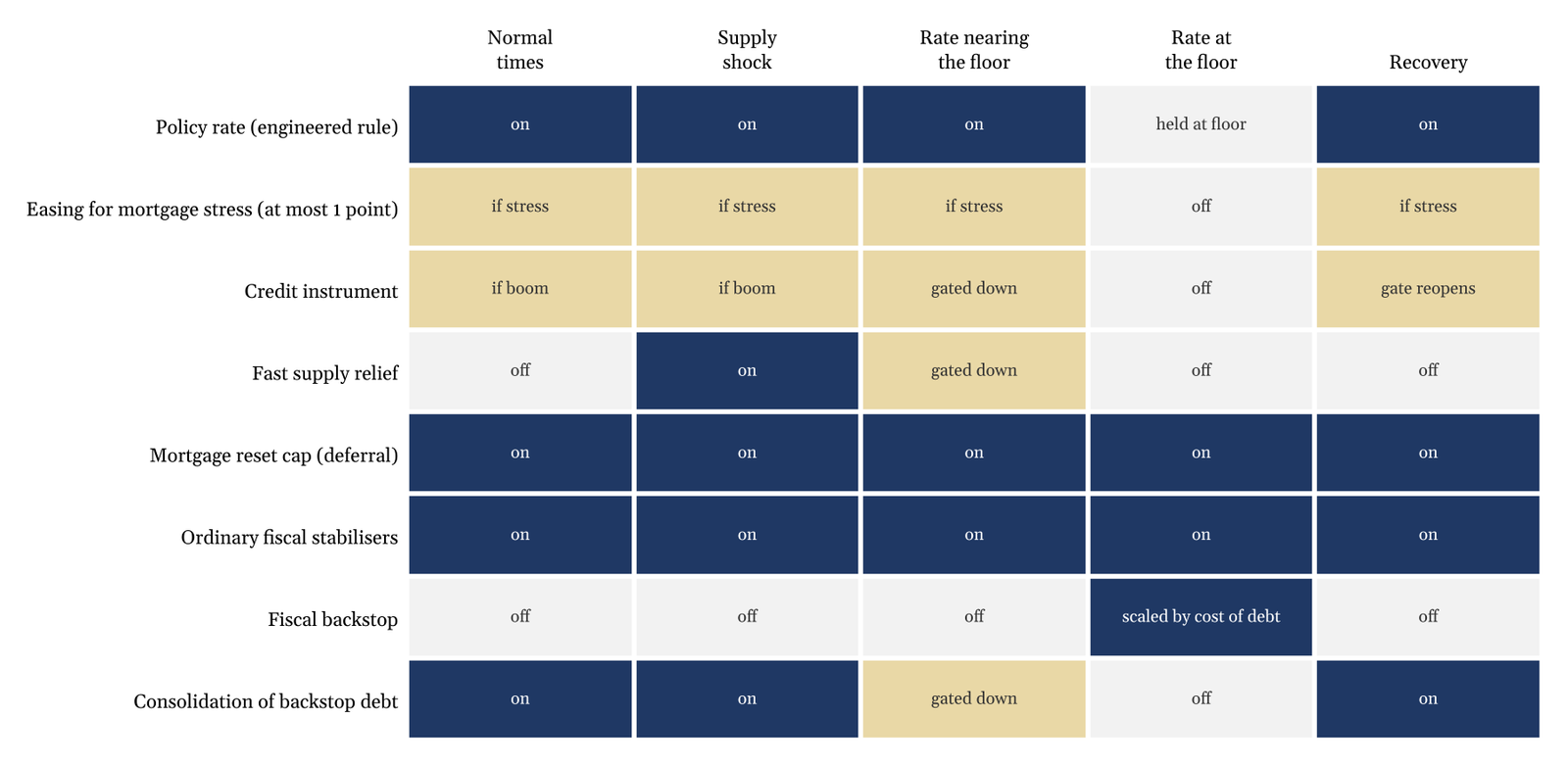
Each instrument is on, off, or conditional on the stated circumstance. “Gated down” means scaled down in proportion as the policy rate comes within two points of its floor.
1. The policy rate
The rate follows the rule below, smoothed with weight ρ on its last value. π̄ is four-quarter inflation, π* the target, r* the best estimate of the neutral real rate, y the output gap, Ŝ the estimate of supply-driven inflation and DSR household mortgage debt service in per cent of income.
i* = r* + π̄ + f_d (π̄ − π* − Ŝ) + f_s Ŝ + f_y y − min[ 1, f_D max(0, DSR − 10) ]
Three features distinguish it from a conventional rule. It responds to supply-driven inflation with its own coefficient, and the tuning, at every forward weight tested, declined to set that coefficient to zero: looking through supply inflation was worse by 4 to 18 per cent when tested directly. It eases for mortgage stress, which is where the household gains of the series begin. And that easing is bounded at one point, so that the rate always rises by more than inflation; without the bound, a rule tuned for a partly forward-looking economy pulled its response to inflation below one for one, and some paths exploded. The coefficients depend on how forward-looking the public is, and Table 1 gives them for the three weights tested.
Table 1. Coefficients of the policy rule by forward weight
| Forward weight | ρ | f_d | f_s | f_y | f_D | k_m | k_f |
|---|---|---|---|---|---|---|---|
| 0 (backward-looking) | 0.22 | 0.63 | 0.61 | 1.43 | 2.07 | 0.43 | 0.15 |
| 0.3 (partly forward-looking) | 0.02 | 0.63 | 0.68 | 1.17 | 3.11 | 0.61 | 0.10 |
| 0.6 (largely forward-looking) | 0.76 | 1.59 | 1.49 | 1.51 | 0.86 | 0.52 | 0.09 |
[Derived] Tuned on twelve training economies at each weight. The easing for mortgage stress is bounded at one point of the policy rate at every weight. k_m and k_f are the coefficients of the credit instrument and of supply relief.
2. Instruments beside the rate
Three instruments help the rate, and a gate governs two of them.
m = min(2, k_m · max(0, y)) · g f = min(1, k_f · max(0, Ŝ)) · g g = min(1, max(0, (i₋₁ − floor) / 2))
| Instrument | Rule | Basis |
|---|---|---|
| Supply-price signal | The central bank estimates supply-driven inflation Ŝ from observed energy, food, freight and import prices, run through its own inflation model and averaged over four quarters, and publishes it beside inflation. | The Better Ways; tested with noise as large as the shock itself |
| Credit instrument m | Loan-to-value and debt-to-income limits that tighten with a positive output gap, by formula; restrains new borrowing at half the potency of a rate rise. | The Better Ways; removing it raises the household loss |
| Fast supply relief f | Releases from strategic reserves, temporary duty and tariff cuts, triggered by the supply signal and delivered by the treasury on a published trigger. | The Better Ways; tested at half the assumed potency |
| Floor gate g | Both m and f are scaled down as last quarter’s policy rate comes within two points of the floor, and switched off at it, because near the floor lower inflation means a higher real rate. | Room Above the Floor |
3. The inflation target
The target is set from the room it buys above the floor. Outcomes depend on the neutral nominal rate, the neutral real rate plus the target, and the right value of that rate depends on two things the earlier papers measured: how far the public’s expectations are anchored on the central bank’s future conduct, and whether a fiscal backstop stands behind it.
| Circumstance | Neutral nominal rate to aim for | Target |
|---|---|---|
| Central bank acting alone | Four to five: five where mortgages are long and fixed and credibility is not secure, four where mortgages float | Four to five minus the neutral real rate |
| With a fiscal backstop in law, consolidation enforced, and fiscal space behind it | Three to four | Three to four minus the neutral real rate |
| Where fiscal space is exhausted | As for a central bank acting alone | Four to five minus the neutral real rate |
Four rules go with it. Restore room, but do not go beyond it: moving to the range is worth a great deal, moving past it almost nothing. Review the target on a fixed schedule against new estimates of the neutral real rate, and move it in steps of no more than a point. Prefer a point target to a band, which changed nothing measurable. And where mortgages float and a higher target is needed, pair it with inflation-indexed mortgages, which remove the cost a higher target otherwise imposes on every borrower.
4. Mortgage structure
Upward resets of variable-rate mortgages are capped at half a point a year. The interest the cap holds back is either deferred, added to the balance and repaid over about twelve years, or insured by a fund outside the banking system at an actuarially fair premium. Its cost must never fall on bank capital: absorbed by the banks, the forgone interest becomes a capital shortfall that raises credit spreads, deepens the recession and drives the economy toward the floor. As deferral, the cap lowered the household loss by 6 per cent in the backward economy of Room Above the Floor and by 3.5 per cent in the partly forward-looking economy of The Backstop at the Floor; its gains fall as expectations look further ahead, because the policy rate then moves less.
5. The fiscal arm
The fiscal arm has three parts, written into law in advance so that none of them waits for a vote.
Backstop: q = min[ k_S · max(0, floor − i_u), cap ] cap = 4 · min(1, max(0.25, (14 − mc) / 10))
Stabilisers: −0.5 y Consolidation: s = τ · g · d, τ = max(0.05, 1.5 · mc / 100)
Marginal cost of debt: mc = (r − γ) + ρ_s + κ · B (per cent a year; the last term only above the premium threshold)
The backstop spends, in per cent of GDP, in proportion to the cut in the policy rate that the rule calls for but the floor prevents, i_u being the rate the rule would set without the floor. Tuned, it is strong and brief: its coefficient k_S reached the top of the range searched, about 6, so that it is limited by its cap rather than its slope. Its cap is 4 per cent of GDP where debt is cheap and shrinks toward 1 per cent as the marginal cost of debt rises. Ordinary stabilisers, built into taxes and transfers, lean against the output gap at all times. The debt the backstop adds is consolidated at a rate τ that always exceeds its marginal cost by half, but only in the time when monetary room exists, as measured by the same gate g; never while the rate is at the floor. The marginal cost of a point of debt is the interest-growth differential, plus the sovereign premium ρ_s, plus the slope of the premium κ times the debt stock B, because one more point of debt raises the premium on everything already owed. Fiscal space, in this framework, is that price.
6. Credibility
The rules are published, explained and kept. This is not a courtesy but part of the machinery. The Half-Credible Economy found that an economy whose public looks ahead only partly is more exposed to a deflation trap than one that looks only at the past or one that trusts the central bank’s future conduct: at a neutral nominal rate of three, the share of paths that ended in a trap rose from 2 per cent to 9 before falling to none. Partial credibility brings the deflationary pull of expectations without the anchoring that full credibility provides. [Inference] The remedy is not a cleverer rule but a clearer one, kept long enough to be believed.
IV. The evidence ledger
Table 2 lists every test the series wrote down in advance, by paper, with its verdict. Of twenty-nine tests with a pass mark, twenty-two held and seven failed. The decision questions of Room Above the Floor, which set criteria for recommendations rather than pass marks, are listed separately.
Table 2. Every test written in advance, and its verdict
| Paper | Test | Verdict |
|---|---|---|
| First working paper (unpublished) | Beats the best conventional rule out of sample; inflation no worse; robust to blind identification | Held (three tests) |
| Every component earns its place; wins the motivating supply case; wins historical replays | Failed (three tests): the supply devices did not work, and the framework was rebuilt | |
| The Better Ways | Beats the conventional rule by at least 5% on both losses; inflation no worse; robust to a noisy signal and to weak relief; wins the supply case with variable and with fixed mortgages; every part earns its place | Held (seven of seven) |
| Room Above the Floor | Decision questions: target level, band, indexation, reset cap | Target from room; no band; indexation removes the tilt; cap as deferral or outside insurance |
| The Half-Credible Economy | Beats the conventional rule under forward-looking expectations; room rule an upper estimate where expectations look ahead; look-through does not do better; gate does no harm | Held (four), with the room rule held only where credibility is high |
| Time at the floor and loss fall as expectations look further ahead | Failed: both rise first; partial credibility is the dangerous state | |
| The Backstop at the Floor | Halves trapped paths; costs nothing where traps are absent; lowers the room needed; debt converges with consolidation; reset cap holds under forward-looking expectations | Held (five) |
| A backstop beats ordinary stabilisers | Failed where expectations look backward; the two are complements | |
| Fiscal Space Is a Price | Fiscal space shrinks with debt; a crisis without consolidation set from marginal cost; the eigenvalue condition classifies convergence | Held (three) |
| EMF-6 keeps crises below 1% everywhere; the doom loop runs through private credit | Failed: crises about 4% at 120% debt with a steep premium; the loop runs through compounding |
[Derived] Tests with a pass mark: 6, 7, 5, 6 and 5 in the five papers that set them; 22 held. One further test in The Backstop at the Floor, on the size of the fiscal multiplier, was reported without a pass mark.
The headline results
| Claim | Result | Source |
|---|---|---|
| The engineered rule beats the best conventional rule | −5.5% on the conventional loss and −5.2% on the household loss across 54 economies; −47% in a supply episode with variable-rate mortgages | The Better Ways |
| It keeps its advantage under forward-looking expectations | Beats the conventional rule in all 24 combinations of forward weight, neutral rate and mortgage type tested, by 3% to 17% at a neutral nominal rate of four | The Half-Credible Economy |
| A fiscal backstop removes the deflation trap | Trapped paths from 9.3% to 0.1% at forward weight 0.3, neutral nominal rate 3; household loss −44% | The Backstop at the Floor |
| The eigenvalue condition decides whether its debt converges | Classifies 26 of 27 economies correctly | Fiscal Space Is a Price |
| A rule that obeys it prevents the doom loop | Sovereign crises from 75% to about 4% at 120% debt with a steep premium; none elsewhere | Fiscal Space Is a Price |
V. What changed along the way
A specification that has been revised is only trustworthy if its revisions are visible. Table 3 records every claim that a later paper changed, what changed it, and the rule that now stands. None was reversed silently.
Table 3. The revision record
| Claim as first made | What changed it | The rule now |
|---|---|---|
| Supply inflation is inferred from surprises in inflation and output, and answered by investment in capacity (first working paper) | Both devices failed their tests | A supply-price signal from observed prices, answered by fast relief (The Better Ways) |
| The credit instrument and supply relief act at all times (The Better Ways) | Near the floor they deepened the slump | Both stand down near the floor (Room Above the Floor) |
| Easing for mortgage stress is proportional and unbounded (The Better Ways) | Under partly forward-looking expectations it broke the Taylor principle | Bounded at one point (The Half-Credible Economy) |
| A neutral nominal rate of about four, an upper estimate (Room Above the Floor) | Partial credibility makes the floor more dangerous | Four to five alone; three to four with a backstop (The Half-Credible Economy; The Backstop at the Floor) |
| Losses at very low room reported as means (Room Above the Floor) | Means dominated by trapped paths | Per-path losses capped; trap share reported (The Half-Credible Economy) |
| A backstop or stabilisers (planned comparison, The Backstop at the Floor) | Neither dominates; together they are best | Both, the stabilisers automatic and the backstop legislated in advance |
| Consolidation faster than the interest-growth differential; a fixed 4% cap (The Backstop at the Floor) | Under a premium, the marginal cost of debt is several times the average | Consolidation faster than the marginal cost; cap scaled by it (Fiscal Space Is a Price) |
VI. When each rule holds
No rule in the framework holds everywhere, and a specification that did not say where each one weakens would invite its misuse. Table 4 states the conditions.
Table 4. Conditions of validity
| Rule | Holds where | Weakens or fails where |
|---|---|---|
| Engineered policy rule | Every forward weight, neutral rate from 3 to 6 and mortgage structure tested, once its mortgage easing is bounded | Its advantage narrows to 3–4% where expectations are largely forward-looking and the rate moves little |
| Credit instrument and relief | Away from the floor | Near the floor, which is why they are gated |
| Room rule | As stated in Section III, by circumstance | Its numbers depend on the floor of −1% and on the estimate of the neutral real rate, which is uncertain |
| Reset cap | As deferral or outside insurance at a fair premium | When its cost falls on bank capital; its gains are small where expectations look far ahead |
| Fiscal backstop | Wherever fiscal space exists, legislated in advance, with consolidation | With implementation lags of a year it loses part of its force; at high debt with a steep premium no debt-financed backstop is safe |
| Ordinary stabilisers | When automatic | When they act with a delay, which can make them destabilising |
| Consolidation rule | When it outpaces the marginal cost of debt in the time room exists | When it is set against the average cost, or applied at the floor |
VII. The framework as an institution
A framework is only useful if it can be run, and this one asks more of institutions than a committee that sets one rate. Table 5 lists what each authority publishes and does.
Table 5. What is published, and who acts
| Element | What is published or done | Who acts |
|---|---|---|
| Policy rate | The rule, its coefficients and the rate it prescribes at each meeting; any departure explained | Central bank |
| Household stress | Mortgage debt service against the 10% threshold, beside inflation | Central bank |
| Supply-price signal | The estimate of supply-driven inflation and the relief trigger | Central bank |
| Credit instrument | Loan-to-value and debt-to-income limits set by formula from the output gap, gated near the floor | Central bank or macroprudential authority |
| Fast supply relief | Reserve releases and temporary duty cuts on the published trigger | Treasury |
| Target and room | The estimate of the neutral real rate and the target it implies, reviewed on a fixed schedule | Central bank with government |
| Mortgage reset cap | A statutory limit on upward resets, with deferral or an insurance fund outside the banks | Legislature, once |
| Fiscal backstop and consolidation | The trigger, the scale, the cap and the consolidation rule, in law; the marginal cost of debt published beside the debt ratio | Legislature, once; treasury thereafter |
Read as a whole, the framework is an argument about time. The central bank must have room before the downturn; the government must have its backstop in law before the floor; the backstop must have fiscal space behind it before the crisis tests it; and the public must have reason to believe the rules before they are needed. Each is cheap to provide in advance and expensive or impossible to provide in the moment. [Inference] That is the sense in which the framework serves households: it does its work in the good years, so that the bad ones are shorter, shallower and less costly to the people who carry the mortgages.
VIII. What remains open
Five questions are open, and the series’ own method says how each should be answered: with tests written before the results. The first is the role of central bank purchases of government debt. A central bank willing to cap the sovereign premium removes the slope that drives the doom loop, and might make safe the economy that Fiscal Space Is a Price found no fiscal rule could protect, at a cost to its balance sheet and independence that a model would have to price. The second is estimation: the forward weight, the potency of supply relief and the slope of the sovereign premium are chosen, not estimated, and the framework’s numbers depend on them. The third is the open economy, where the exchange rate carries both shocks and policy. The fourth is the cost of inflation itself, which the series treated as a break-even rather than a number. The fifth is whether a fiscal backstop that the public anticipates would do even more through expectations than the series credited it with.
IX. Limits
Everything in this paper inherits the limits of the papers it summarises. The model is a small one, calibrated rather than estimated in several of its parts, and every number in it is model-dependent. Its fifty-four economies vary the parameters that matter most for monetary policy but not every one; its shocks are those of a single history. The forward-looking expectations are model-consistent, which overstates what anyone knows. The fiscal block has one multiplier and no composition, and its sovereign premium is a simple function of debt. Several choices were made after the first results of a paper and are reported in that paper as such. The orderings of rules are more robust than the magnitudes, and the framework should be read as a design whose structure the evidence supports and whose parameters a central bank would set from its own estimates.
Table 6. The seam: the framework’s principal claims by evidential status
| Claim | Status |
|---|---|
| The engineered rule beats the best conventional rule across the economies, expectations and mortgage structures tested | Derived |
| The rule should respond to supply-driven inflation, not look through it | Derived |
| Room above the floor, not a conventional number, should set the inflation target | Derived; inference as policy |
| Partial credibility is the most dangerous state | Derived; inference as mechanism |
| A fiscal backstop legislated in advance removes the deflation trap | Derived |
| Fiscal space is the marginal cost of debt, and consolidation must outpace it | Derived |
| The framework serves households by doing its work in advance | Inference |
Method note
This paper reports no new results. Every number in it is taken from the result files of the paper cited beside it, and every rule from the latest paper that states it. Where papers disagree, the later governs. The first working paper of the series was internal and is not published; its tests and the reasons they failed are summarised in The Better Ways.
References
Rudebusch, G. and L. Svensson (1999), “Policy Rules for Inflation Targeting”, in J. Taylor (ed.), Monetary Policy Rules, University of Chicago Press. Further references are given in each paper of the series.
The Monetary Engineering series
The Better Ways: the engineered framework: a rate rule with a credit instrument and supply relief, tested against the best conventional rule.
Room Above the Floor: the inflation target as the room an economy needs above the floor, and a mortgage reset cap that pays for itself.
The Half-Credible Economy: the framework under forward-looking expectations: why partial credibility is the most dangerous state, the revised room rule, and the bound on mortgage easing.
The Backstop at the Floor: a fiscal rule written in advance that removes the deflation trap, the debt it leaves and the condition under which that debt converges.
Fiscal Space Is a Price: the backstop under a sovereign risk premium: the marginal cost of debt, the eigenvalue condition that separates convergence from a doom loop, and a fiscal rule that obeys it.
The Engineered Monetary Framework: the whole framework in one specification, with every rule, the conditions under which it holds and the evidence behind it; the place to start.
Download the PDF
About the Author
Dr. Glen Brown is President & CEO of Global Financial Engineering, Inc. and Global Accountancy Institute, Inc. He is the architect of the GCPIAUT framework and the broader GATS-native proprietary capital doctrine. His work focuses on sovereign capital governance, algorithmic trading architecture, reserve-first compounding systems, and institutional financial engineering within closed proprietary environments.
Business Model Clarification
Global Financial Engineering, Inc. and Global Accountancy Institute, Inc. operate as closed-loop proprietary institutions. They do not offer public investment products and do not invite retail participation into their proprietary capital architecture. This paper is policy research published for intellectual and institutional discussion.
Disclaimer
This paper is analysis, not advice. It takes no position on any particular decision of any central bank or government, and nothing in it constitutes investment advice, an offer, a solicitation, or a recommendation to buy or sell any financial instrument.