The Machine Readings · Paper IV
A sub-series of the Public Doctrine Series
A Deposit Is Not a Recovery
One book, one evening, seven measures of the same loss: why every return must be read against the capital of its own moment, and what an instrument must never call healing
Dr. Glen Brown · President & CEO, Global Financial Engineering, Inc. and Global Accountancy Institute, Inc.
GFE-PUB-MR-20261028-D-CS · 28 October 2026
How to read this paper. The Machine Readings reason from a trading machine’s own records rather than from commentary on markets. Every claim of fact carries one of three marks. [W] Witnessed: read directly from a ledger or journal the machine wrote. [D] Derived: computed from witnessed figures, or from stated mathematics, by a method this paper gives. [I] Inferred: an interpretation the evidence supports but does not compel. A sentence without a mark is argument, not evidence.
About the case. The case in this paper is an illustration built from operating data. Figures have been altered so that no account, venue or period can be identified, and nothing here reports the results of any account. Capital is expressed as a share of the book rather than in money. The mathematics, the design and the reasoning are unaltered.
I. The Reading
Early on a Friday the instrument that reports the book’s condition read −18.9 per cent: equity stood that far below the highest it had reached since the period under review began. [W] By Saturday evening it read −9.6 per cent. [W] Over the same hours the book’s trading lost a further 0.8 per cent of the book. [D] Between the two readings the firm had placed one of about 10 per cent of capital into the account, a day after an injection of about 3 per cent of the book, and the instrument, measuring equity against its own past peak, had read the capital as recovery. [W]
The same evening, the same book’s loss over the same period can be stated in seven ways, and they range from −7.0% to −27.0%. [D] None of the seven is a mistake of arithmetic. Each answers a different question, and the difficulty is that an instrument which prints one of them without saying which question it answers invites its reader to hear the answer to another. In money the readings agree: the book’s trading over the period lost about 27 per cent of starting equity. [D] In percentages they disagree, because a percentage is a choice of denominator, and a deposit changes the denominator without changing the trading.
This paper is about that choice. It is the least glamorous subject in the series and, for a firm whose books are periodically recapitalised by design, perhaps the most consequential, because the instrument that misreads a deposit misreads the one thing a deposit cannot change: how the machine has performed.
II. The Mechanism
Three ledgers, not one
A book’s equity is the sum of two quantities that the account statement does not separate: the capital that has been placed in it and the result of trading that capital. [D] Every measure of performance is a statement about the second; every deposit changes only the first. An instrument that reads equity alone, and compares it with its own past maximum, therefore treats each deposit as a gain and each withdrawal as a loss, and a book that is recapitalised while losing can be shown to be recovering while its trading deteriorates. [D] The correction is to keep three ledgers where the statement keeps one: equity, capital, and the trading result that is their difference. [I]
Capital is known by its deal, not by its effect
The second ledger is only as good as the record of what entered it. In the case, the instrument that recorded capital once decided what was new by the time at which it looked, and it missed a deposit of about 4 per cent of the book, which was recorded only three days later when the scan was rebuilt to identify each capital movement by the deal that carried it. [W] For three days every measure built on the capital ledger counted that deposit as trading profit. [D] A balance change is the effect of a deal, and an effect can have more than one cause; the deal is the cause, and only the deal can be classified. [I]
Every ratio needs the denominator of its own moment
The same error has a quieter form. In the case, a line that reported the risk each closed position had carried, as a share of equity, divided every past close by the equity of the moment the instrument was started; each restart therefore restated history, and the line moved from 0.99 to 0.93 per cent between two starts with no close in between. [W] Measured against the equity of each close’s own moment, it is 0.95 per cent. [D] A ratio whose denominator is taken from today restates the past whenever today changes. A deposit is one way today changes. [I]
Seven measures and the questions they answer
Table 1. One book, one evening, seven readings of the same loss
| Measure | Reading | What it answers | How a deposit moves it |
|---|---|---|---|
| Change in equity since the start of the period | −7.0% | Nothing about trading | Counts it in full as gain |
| Drawdown from the raw equity peak | −9.6% | Nothing about trading | Counts it in full as recovery |
| Loss on the money in the book | −22.1% | Loss as a share of all capital, as if it had all been there from the start | Dilutes the percentage as if the capital had always been present |
| Drawdown from the capital-adjusted high-water mark | −22.5% | How far equity must rise to regain the mark that the capital now in the book has to reach | Raises the mark by the deposit; the distance in money is unchanged |
| Time-weighted return | −25.3% | How the trading performed, each sub-period weighted equally | None |
| Money-weighted return (Modified Dietz) | −25.4% | How the money performed, each deposit weighted by the time it was at risk | Small, through timing alone |
| Trading result against its own peak | −27.0% | How far the trading result has fallen from its best | None, but its denominator omits the capital that is now at risk |
Derived from the book’s equity path and capital register at the moment of the gauge’s last reading of the period, except the second and third rows, which are the gauge’s own printed figures. [W][D] Figures altered for the case.
Read down the table and the seven fall into two families. The first three are diluted or distorted by the timing of capital: they treat a deposit as gain, as recovery or as though it had been in the book from the first day. The last three are not: they measure the trading, or the money weighted by its time at risk, and they agree to within two points. [D] The fourth stands between: it lifts the high-water mark by the capital deposited, so it never reads a deposit as recovery, and it states honestly how far the book must climb. [D] That is the measure the machine’s gauge adopted, and the right one for the question the gauge exists to answer, which is distance, not performance. [I]
Figure 1. The same period, read with and without its capital
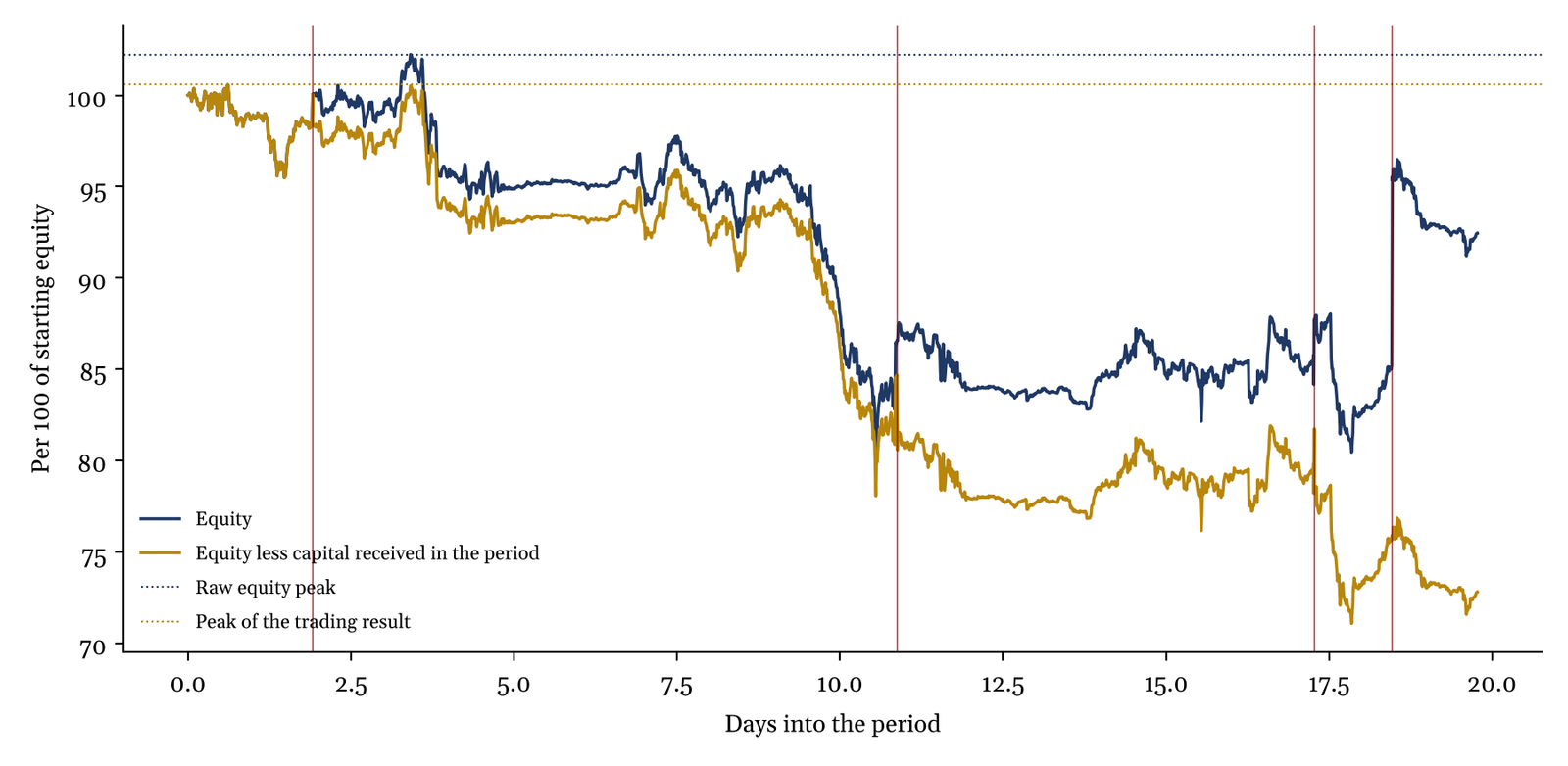
Witnessed equity path of the book over the period (navy), the equity path with capital removed (gold), and the two peaks against which each is read. The vertical rules mark the deposits. Derived from the equity-path ledger and the capital register. Figures altered for the case.
III. The Argument
First proposition: a deposit is not a recovery
The first principle is negative and absolute: no instrument that reports a book’s condition may move on a deposit. [I] A deposit changes what the book owns and leaves unchanged everything the book has done. An instrument that moves on it has stopped measuring the machine and started measuring the owner. In the case the reading improved by more than nine points in a day and a half during which the trading lost money. [W][D]
Second proposition: the cure is for capacity, not for performance
The firm recapitalises books on purpose. A book bound by a commitment ceiling (the constraint The Occupied Book priced by the day) cannot open a new position once the risk it carries reaches the ceiling, and a deposit restores the room. The two deposits in the case did exactly that: the first took the book’s commitment from 98.5 to 95.5 per cent of its ceiling, the second from 99.7 to 91.5 per cent. [W] That is the cure working as designed. The discipline this paper asks for is that the instruments show the cure where it acts, in capacity, and show nothing where it does not, in performance. A gauge that reports the cure as recovery tells its reader that the patient is well when only the bed has been made larger. [I]
Third proposition: in money the measures agree; in percentages the question chooses
The seven readings disagree only in their denominators. [D] The house therefore needs one rule for which denominator answers which question, and the rule follows the questions. For the distance a book stands below the point it must regain, the capital-adjusted high-water mark: here a fall of 22.5%, which requires a rise of 29 per cent to recover. [D] For how the machine performed, the time-weighted return, which removes the effect of when capital arrived and is the measure the Global Investment Performance Standards require of investment firms for that reason. For how the owner’s money fared, the money-weighted return. No instrument should print a percentage without saying which of the three it is. [I]
The same logic is old in fund administration. A fund that charges a performance fee above a high-water mark must not charge an investor who subscribes late for gains made before he arrived, nor let him escape the fee on gains made after; the practice of equalisation adjusts each investor’s mark to his own entry for exactly that reason. The high-water mark adjusted for capital is equalisation applied to a single book. [I]
Fourth proposition: late capital flatters the simple measures most
The diluted measures and the undiluted ones are not merely different; they diverge in a predictable direction. When capital arrives after the loss, a measure that divides by all the capital as though it had always been present understates the loss, because the late money was never exposed to it. In the case most of the period’s capital arrived in its last three days, after most of the loss, and the simple money measure read −22.1% against a time-weighted −25.3%. [W][D] The more a book is recapitalised after it has lost, the more the simple measures flatter it, which means that the measures are kindest precisely when the book most needs to be read without kindness. [I] Even the corrected measure is not wholly immune. Because it divides by a mark that the capital has raised, its percentage improved by about a point between the two readings of Section I while the trading lost money; the shortfall in money, from 26.6 to 27.4 per cent of starting equity, moved the right way. [D] The only readings a deposit cannot flatter at all are the shortfall in money and the time-weighted return. [D]
A deposit changes what the book owns. It never changes what the book has done.
IV. What Would Falsify This Reading
The deposit test. The corrected instrument should not move on the next deposit by more than the rounding of its last digit. If it does, either a capital deal has been missed or the high-water mark is not being lifted by the capital it should be, and the first proposition’s remedy has failed. [I]
The reconciliation. In money, the shortfall from the capital-adjusted mark must equal the cumulative trading result since the trading peak, and that result must reconcile to the deal history to the cent. If it does not, some movement of money has been classified as trading or as capital when it was the other. [I]
The agreement of the undiluted measures. The time-weighted and money-weighted returns agreed here to a tenth of a point because the deposits were small relative to the book and close together. If, over periods with large or early capital, they diverge widely while the trading result is unchanged, the claim that the money-weighted measure suffices for the owner’s question must be qualified. [I]
The cure. The second proposition predicts that a deposit lowers the commitment reading and leaves every performance reading where it was. If a deposit is followed by a change in the performance readings that the subsequent trading cannot explain, the separation of the ledgers is incomplete. [I]
V. The Case
The case is a small multi-asset book operated by a governed portfolio controller, over a period of about three weeks in which it lost in trading and was recapitalised twice near the end. Equity is read from the book’s own equity path and capital from its capital register; the gauge’s figures are its own printed lines. [W]
Table 2. The capital the period received
| When | Kind | Share of starting equity | Commitment before → after |
|---|---|---|---|
| Week 1 | capital deposit | 1.7% | 99.3% → 97.6% |
| Week 1 | small injection | 0.2% | — |
| Week 2 | deposit missed by the scan, recorded three days later | 4.1% | — |
| Week 3 | injection | 3.4% | 98.5% → 95.5% |
| Week 3 | injection | 10.2% | 99.7% → 91.5% |
| Period, with small adjustments | about 20% |
Witnessed. Figures altered for the case.
References
CFA Institute (2020). Global Investment Performance Standards (GIPS) for Firms. Time-weighted returns required for portfolios except where the firm controls external cash flows.
Dietz, P. O. (1966). Pension Funds: Measuring Investment Performance. New York: Free Press.
Dr. Glen Brown (2026). The Occupied Book. The Machine Readings, Paper II. Public Doctrine Series.
Earlier in The Machine Readings
The Seven-Day Horizon: Paper I, on why a ledger reports its successes in hours and its failures in weeks.
The Occupied Book: Paper II, on the Fair Walk Triad and why edge must be priced by the day.
Scheduled Gaps: Paper III, on why a known event kills the positions born a week or two before it.
Download the PDF
About the Author
Dr. Glen Brown is President & CEO of Global Financial Engineering, Inc. and Global Accountancy Institute, Inc. He is the architect of the GCPIAUT framework and the broader GATS-native proprietary capital doctrine. His work focuses on sovereign capital governance, algorithmic trading architecture, reserve-first compounding systems, and institutional financial engineering within closed proprietary environments.
Business Model Clarification
Global Financial Engineering, Inc. and Global Accountancy Institute, Inc. operate as closed-loop proprietary institutions. They do not offer public investment products through the doctrines described herein, do not invite retail participation into their proprietary capital architecture, and do not present the GCPIAUT framework as a public collective investment scheme. The concepts discussed in this article are part of the firms’ internal intellectual and operating doctrine.
Risk Disclaimer
Trading and investment activity across foreign exchange, equities, futures, commodities, and digital assets involves substantial risk. Market conditions may change rapidly, and losses may occur. This article is provided for intellectual, institutional, and educational discussion only and does not constitute investment advice, an offer, a solicitation, or a recommendation to buy or sell any financial instrument or to participate in any investment structure.