The Machine Readings · Paper III
A sub-series of the Public Doctrine Series
Scheduled Gaps
Why a known event kills the positions born a week or two before it, not those born on its eve, and what a calendar can and cannot do
Dr. Glen Brown · President & CEO, Global Financial Engineering, Inc. and Global Accountancy Institute, Inc.
GFE-PUB-MR-20261027-C-CS · 27 October 2026
How to read this paper. The Machine Readings reason from a trading machine’s own records rather than from commentary on markets. Every claim of fact carries one of three marks. [W] Witnessed: read directly from a ledger or journal the machine wrote, or from a company’s own published announcement. [D] Derived: computed from witnessed figures, or from stated mathematics, by a method this paper gives. [I] Inferred: an interpretation the evidence supports but does not compel. A sentence without a mark is argument, not evidence.
About the case. The case in this paper is an illustration built from operating data. Figures and the identities of the companies have been altered so that no account, venue, issuer or period can be identified, and nothing here reports the results of any account. The mathematics, the design and the reasoning are unaltered.
I. The Reading
In two consecutive sessions of a reporting season the book in this case lost eight positions to news published by the companies whose shares it held: six to scheduled quarterly results and two to an unscheduled revision of guidance. [W] Every position still open on those five names when the news reached the market died, and none of them banked on it. [W] The eight deaths were half of the money the book lost to its stops over the fortnight. [D]
The machine is not blind to scheduled events. It carries a calendar that refuses new births for a short window around each timestamped macro release, half an hour before to between half an hour and an hour and a half after. [W] None of the eight positions was born inside such a window, and none could have been. On the day the news arrived they were between seven and fifteen days, and in one case thirty old. [W] The calendar guarded the hour of the event. The event killed the positions that had been born one to two weeks before it.
That is the reading of this paper: a scheduled gap is a problem of horizon, not of timing. The first two papers in this series, The Seven-Day Horizon and The Occupied Book, established that a position with a near bank and a far stop banks in hours and dies in weeks, and that the open book is therefore made disproportionately of positions that are drifting, slowly, toward their stops. This paper adds the third element. When a discontinuity arrives at a known moment, it does not strike the births made on its eve. It strikes the resident book, and the resident book was born a week or more earlier.
II. The Mechanism
What the calendar does
The calendar in the case is a gate that refuses new positions for a short window around each timestamped release, half an hour before to between half an hour and an hour and a half after. It matches events to instruments by a tag, and in the case it carried macro releases only: national data and central-bank decisions. It refuses births and closes nothing, which is the firm’s doctrine: no position is closed because time has passed, and none is closed because a clock says an event is coming. [W]
A gap on a fair walk is fair, and fast
Represent a scheduled release as a jump in price of size g, in daily ranges, at a known moment, equally likely to go either way. A fair walk remains fair through a symmetric jump: the expected price after the release is the price before it, and no position’s expectation changes. [D] What the jump changes is the clock. A position that diffusion would have resolved over weeks, by drifting to its bank or to its stop, is resolved in one print. The slow clock of Paper I is compressed into a single minute, and the compression falls on whoever is in the book when the minute comes.
Who is in the book when it comes
The Occupied Book showed that the open book is a length-biased sample: the positions that bank leave within hours, and the positions that stay are those that have not banked. On a fair walk this has a stark consequence for a scheduled gap. Of positions still open one day after birth, 94 to 95 per cent stand below their entry; of those open a week after birth, 99 per cent do. [D] And the older they are, the nearer their stops: the median resident stands 4.3 to 4.4 daily ranges from its stop at one day, 2.9 to 3.2 at a week and about 2.6 after three weeks. [D] A gap that runs toward the bank closes a resident at a modest profit. A gap of the same size that runs toward the stop meets a stop that has been drawing nearer every day.
The Event Horizon
Put the two facts together. For a birth made d days before a scheduled release, the chance that it dies on the release is the chance that it is still resident when the release comes, multiplied by the chance that an adverse gap of size g reaches its stop from where it then stands. I call this product the position’s exposure to the event, and the range of lead times over which it exceeds half its maximum the Event Horizon. [D]
Table 1. Exposure to a scheduled gap by the age of the position when it arrives: deaths per 1,000 births from an adverse gap
| Age at the event | Still resident | Adverse 1-ATR gap | Adverse 2-ATR gap | Adverse 3-ATR gap |
|---|---|---|---|---|
| 1 day | 25–29% | 0.0 | 0.0 | 1–8 |
| 3 days | 15–17% | 0.3–2 | 4–12 | 28–44 |
| 7 days | 9–11% | 4–6 | 19–22 | 46–50 |
| 14 days | 4–6% | 3–5 | 11–19 | 21–37 |
| 21 days | 2–4% | 1–3 | 5–12 | 9–22 |
| 30 days | 0.5–2% | 0.5–2 | 2–6 | 3–11 |
Derived. Fastest-lane geometry (bank 0.203, stop 5.00 daily ranges) under a fair walk calibrated at c = 0.8 to 1.0, 150,000 to 200,000 simulated paths; ranges span the two calibrations. Exposure counts only adverse gaps; a favourable gap of any size banks a resident.
The shape of the table is the finding. A birth made on the eve of a release is almost immune to it: its stop is still five daily ranges away, and a gap of two ranges cannot reach it. [D] Exposure rises steeply over the following days as the births that will bank leave and the residents drift toward their stops, peaks between the sixth and ninth day, and falls away slowly as the residents themselves resolve. For a two-range gap the Event Horizon runs from about the third day to the fourteenth on one calibration and from about the fifth to the twenty-second on the other. [D] The calendar’s window, measured in minutes, lies entirely outside it.
Figure 1. The Event Horizon
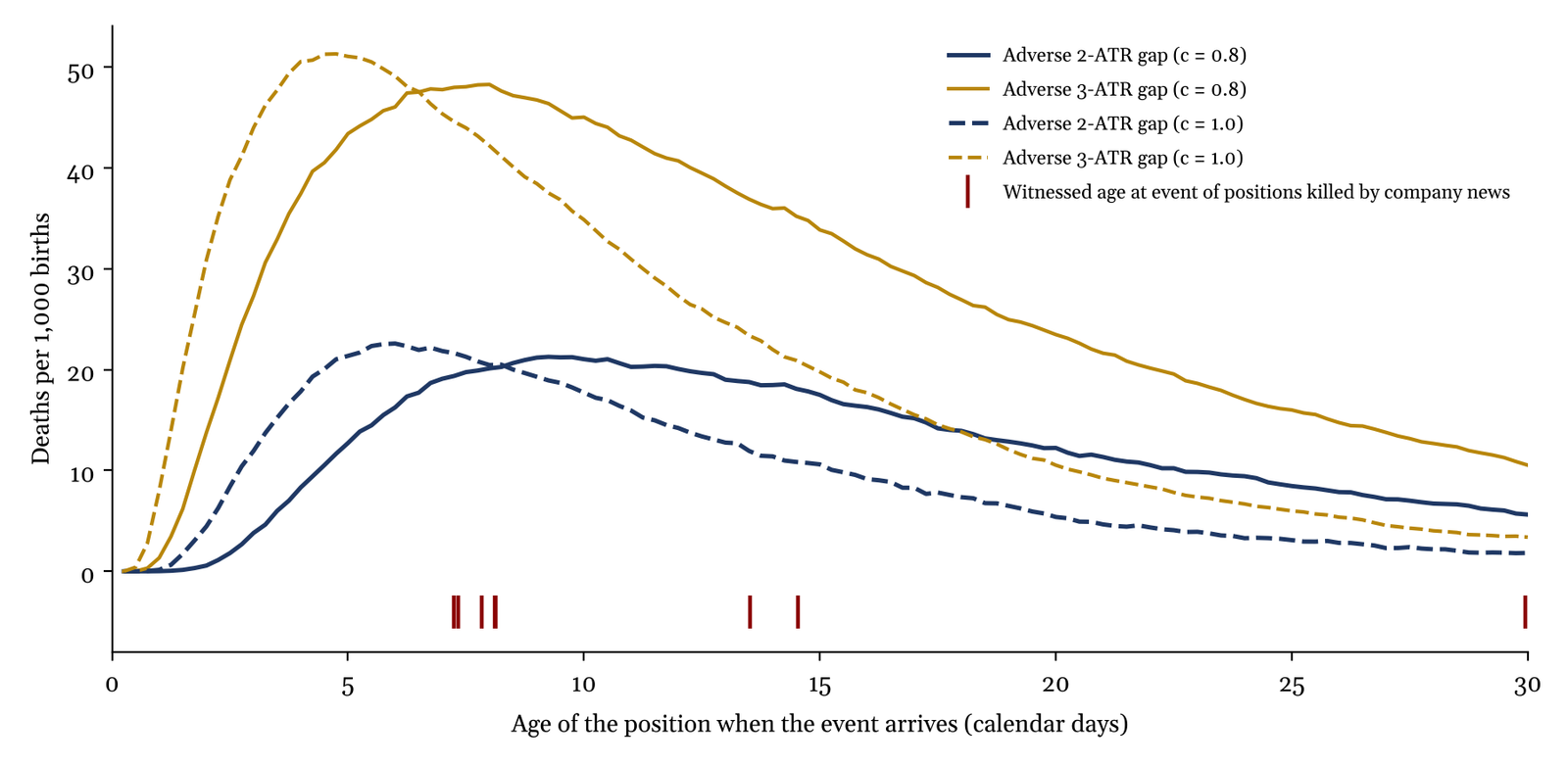
Deaths per 1,000 births from an adverse gap of two (navy) and three (gold) daily ranges, by the age of the position when the gap arrives, under a fair walk at two calibrations. Red ticks mark the ages at which the eight positions killed by company news met it. Figures and identities altered for the case.
Ladders die whole
The machine is built to hold more than one position in an instrument: an anchor and pullback rungs in the direction of the trend, often in more than one lane. [W] A diffusion move takes such a ladder down rung by rung over days, and some rungs bank on the way. A gap takes it in one print. Of the eight positions killed by company news, six died in pairs on the same name within hours of each other. [W] For the purpose of evidence the unit is therefore the event, not the position: the eight deaths are five observations, not eight. [I]
III. The Argument
First proposition: a calendar measured in minutes guards the wrong births
A blackout that refuses births for an hour around a release protects the one class of position that the release cannot harm. The positions a scheduled gap kills were born days earlier and are already in the book; the gate that guards the entrance cannot reach them. [D] The eight witnessed deaths confirm the arithmetic: the youngest was 6.8 days old when its event arrived, and seven of the eight fell inside the Event Horizon on the slower calibration, six on the faster. [W][D] Any calendar of single-company events that is to do work must therefore look forward by the length of the horizon, roughly one to three weeks, not by the length of the release. [I]
Second proposition: the gap is fair; what makes it costly is selection
Under a fair walk a scheduled gap neither adds nor subtracts expectation. It would cost the book nothing if the residents it found stood on the right side of the news as often as on the wrong. In the case they did not. At all five events the news moved the shares against every resident position on the name, and over the same events no resident banked on the news. [W] If the direction of each event were a fair coin with respect to the book’s positions, five adverse events in five would occur about one time in thirty-two. [D] Two readings remain open. The first is chance, which one season cannot rule out. The second is selection: a resident is, by construction, a position the market has been moving against since birth, and if the move that kept it from banking is the market’s early reading of the news to come, the release does not reverse that move but completes it. [I] The two readings make different predictions about the next reporting season, and Section IV states how they will be told apart.
Third proposition: the stop does not hold through a gap
A stop resting at the venue is a promise about price only while price moves continuously. In the case, three of the positions that died at an opening print after company news were filled well beyond their stops, two at 1.1 and 1.2 times their risk unit and one at 1.2; the fourth filled within one per cent of its stop. [W] None of the deaths that came without news over the same fortnight filled more than five per cent beyond its stop, and on average they cost 0.95 of the risk unit. [W][D] This is the one part of a gap that is unfair by construction: the loss side overshoots and the size of the overshoot is the size of the jump past the stop. Whether a favourable gap through the bank is filled at the bank or at the better opening price depends on the venue and the order type, and this paper does not assume either. [I]
Fourth proposition: unscheduled news behaves the same and no calendar can carry it
Two of the eight deaths followed a revision of guidance that the company published before the market opened, unscheduled and labelled as inside information. [W] It killed both resident positions on the name, born on the same day eight days earlier, at the opening print. [W] A calendar of scheduled events, however far forward it looks, cannot see such news. The instruments that address both kinds of discontinuity are the ones that bear on what the book holds rather than on what it admits: how deep a ladder on a single name may stand inside the period in which news about that name is likely, and how much of the book’s commitment single names may carry at once. [I]
Fifth proposition: what a calendar should do, and what it must not
The house’s doctrine forecloses one remedy at once. Closing resident positions before a release, however attractive it looks after a bad week, is a close keyed on a clock, and the register of retired mechanisms exists precisely so that such closes do not return under a new name. [W] What remains are rules that key on a scheduled event and act only at admission, as the existing calendar does, but at the right horizon. A single-company birth would be refused when that company’s next scheduled release falls inside the Event Horizon of the lane it is born into. [I] The cost of such a rule is the banks it forgoes: a birth made a week before a release resolves before the release about nine times in ten, almost always as a bank. [D] Under a fair walk the banks forgone and the deaths avoided are worth the same, and the rule would be pure friction. It earns its keep only if the second proposition’s selection is real, or if the overshoot of the third is material. Both are measurable, and the measurement is the next instrument to build: a ledger that records, at every scheduled release on every name the book holds, each resident position’s side, its distance from its stop and its outcome. [I]
Silence the births a gap will find, not the births it will miss.
IV. What Would Falsify This Reading
The horizon. The argument holds that scheduled gaps kill residents born days before the release, not births made on its eve. If, over the next reporting season, the positions killed by company results are found to have been born mostly within a day or two of the release, the horizon claim fails and a blackout measured in hours would have been enough. [I]
Selection. The second proposition predicts nothing under chance and something definite under selection: under selection, residents at company releases stand on the wrong side of the news more often than half the time, event after event. If, across the next season’s events, counted by event and not by position, the share of adverse events is indistinguishable from one half, the selection reading fails and the case for any results rule rests on the overshoot alone. [I]
Overshoot. If the fills on results gaps prove, over a larger sample, to lie no further beyond the stop than the fills on ordinary deaths, the third proposition fails. [I]
The calibration. The Event Horizon scales with the inverse square of daily dispersion, as every clock in this series does. If single equities, which move only in their sessions, prove to diffuse more slowly per calendar day than the calibration assumes, the band moves later, and the horizon quoted here must be restated on each instrument’s own session clock. [D]
V. The Case
The case is a small multi-asset book operated by a governed portfolio controller, read over a fortnight from its own ledgers and set against the announcements of the companies whose shares it held. Companies are identified by letter. Ages are measured from birth to death; fills against the stop are the realised loss divided by the position’s risk unit at birth. [W]
Table 2. The positions killed by company news
| Company | Lane | Side | Age (days) | Event | Loss (× risk unit) |
|---|---|---|---|---|---|
| Company A | Stream | short | 30 | quarterly revenue, before the open (sched.) | 0.97 |
| Company A | Spark | short | 7 | same day, intraday | 0.98 |
| Company B | Spark | short | 13 | results after the close (sched.) | 1.01 |
| Company C | Spark | short | 8 | guidance revision before the open (unsched.) | 1.2 |
| Company C | Pulse | short | 8 | same release | 1.1 |
| Company D | Pulse | long | 8 | results the previous evening (sched.) | 1.01 |
| Company E | Spark | short | 15 | results before the open (sched.) | 1.2 |
| Company D | Stream | long | 8 | same session, afternoon | 1.00 |
Witnessed. Figures and identities altered for the case.
The remaining deaths of the fortnight came without news from the company itself, and two of them are instructive. Two long positions in semiconductor names died within two minutes of each other at a New York open, and two short positions in consumer names, one of them an hour before its own results release, died in the same minute on a day when the technology-heavy index fell 2.6 per cent and consumer staples rose 2.6 per cent. [W] Those are common factors, not company events, and they belong to a later reading. Of the eighteen deaths in all, sixteen were single equities. [W]
References
Dr. Glen Brown (2026). The Seven-Day Horizon. The Machine Readings, Paper I. Public Doctrine Series.
Dr. Glen Brown (2026). The Occupied Book. The Machine Readings, Paper II. Public Doctrine Series.
Next in The Machine Readings
A Deposit Is Not a Recovery: Paper IV, on why every return must be read against the capital of its own moment, and what an instrument must never call healing.
Earlier in The Machine Readings
The Seven-Day Horizon: Paper I, on why a ledger reports its successes in hours and its failures in weeks.
The Occupied Book: Paper II, on the Fair Walk Triad and why edge must be priced by the day.
Download the PDF
About the Author
Dr. Glen Brown is President & CEO of Global Financial Engineering, Inc. and Global Accountancy Institute, Inc. He is the architect of the GCPIAUT framework and the broader GATS-native proprietary capital doctrine. His work focuses on sovereign capital governance, algorithmic trading architecture, reserve-first compounding systems, and institutional financial engineering within closed proprietary environments.
Business Model Clarification
Global Financial Engineering, Inc. and Global Accountancy Institute, Inc. operate as closed-loop proprietary institutions. They do not offer public investment products through the doctrines described herein, do not invite retail participation into their proprietary capital architecture, and do not present the GCPIAUT framework as a public collective investment scheme. The concepts discussed in this article are part of the firms’ internal intellectual and operating doctrine.
Risk Disclaimer
Trading and investment activity across foreign exchange, equities, futures, commodities, and digital assets involves substantial risk. Market conditions may change rapidly, and losses may occur. This article is provided for intellectual, institutional, and educational discussion only and does not constitute investment advice, an offer, a solicitation, or a recommendation to buy or sell any financial instrument or to participate in any investment structure.