The Instruments of Capital · Paper V
Equities
The residual claim: paid last, open above, without a maturity, and tradable for six and a half hours in twenty-four.
Dr. Glen Brown · Global Financial Engineering, Inc. · Global Accountancy Institute, Inc. · 14 November 2026 · GFE-PUB-IOC-20261114-C
About this series
The Instruments of Capital is a sub-series of the Public Doctrine Series. It sets out, one class at a time, every kind of asset a proprietary firm could trade, whether or not the firm trades it today. Each paper puts its subject through the six questions set in Paper I: claim, structure, return, carry, ending and risk unit. The case in Section VIII is an illustration built from operating data. Its figures have been altered and it reports no account’s results.
I. The other side of the line
Paper IV ended with a diagram. When a firm’s debts fall due, the creditors are paid first and in full if the assets allow it, and whatever remains belongs to the owners. The creditor’s line in that diagram is capped. The owner’s line begins at nothing and has no upper limit. This paper is about the owner’s line.
The world’s listed shares were worth about $157.8 trillion at the end of 2025, a sum of the same order as all the bonds outstanding. The two totals describe opposite arrangements. The bondholder is promised an amount and a date. The shareholder is promised neither. A share is a claim on what is left after everyone with a promise has been satisfied, for as long as the company exists, and its price is the market’s running estimate of a remainder that no one has undertaken to deliver.
A share is the only major claim that promises nothing. Everything it pays is what was left over.
II. The claim
The holder of a share owns a fraction of a company’s equity. Three features define that ownership. It is residual: in a liquidation the shareholder ranks behind every lender, supplier, employee and tax authority, and usually receives nothing. It is limited: the shareholder can lose what was paid for the share and no more, which is the reason the owner’s line in the diagram stops at zero and does not go below it. And it is perpetual: a share has no maturity, and the company is under no obligation ever to return the capital.
Ownership also carries a vote, and with it a claim on control that a creditor lacks while the company is solvent. In practice the dispersed holder of a listed share exercises almost none, and the holder of a share obtained through a dealer’s contract has none at all. The fraction owned is itself not fixed. A company that issues new shares reduces every existing holder’s fraction, and a company that buys its shares back increases it. The claim is on a share of a quantity whose divisor the company controls.
III. The structure
Of all the classes in this series, listed shares have the most formal market. They trade on exchanges, through a central order book in which buyers and sellers post prices and the best of each meet. A clearing house stands between the two sides of every trade, and in the United States settlement has followed one business day after the trade since May 2024. Counterparty risk in the exchange-traded share is as low as it is anywhere.
The cost of that formality is the clock. The principal American session runs from half past nine to four in New York, six and a half hours in twenty-four, five days in seven. Trading is possible before and after, but in thin markets with wide prices. The day’s business is concentrated at its edges, in an opening auction that sets the first price and a closing auction that sets the last. Between one close and the next open the world continues to produce news, and the share’s price adjusts to all of it in a single step. American shares traded a record 17.6 billion a day in 2025, nearly all of it inside those hours.
Two further features follow from the exchange. Trading in a share can be halted, by rule when the price moves too far too quickly and by the exchange’s decision when news is pending, and a holder cannot trade a halted share at any price. And the price history of a share is periodically rewritten by the company’s own actions. On the day a dividend is detached the price falls by about its amount; a share split divides it. These are not losses, but any system that reads prices has to know that they are not.
IV. The return
A share’s return has three sources: the cash paid out as dividends, the growth of the profits behind them, and any change in the price the market will pay for a unit of profit. The first two come from the company. The third comes from the discount rate examined in Paper III and from sentiment, and over short periods it dominates.
Over long periods shares have returned more than government debt. Elroy Dimson, Paul Marsh and Mike Staunton, working from records for many countries across more than a century, put the excess over short-term government bills at between four and five per cent a year. Rajnish Mehra and Edward Prescott observed in 1985 that an excess of that size is far larger than standard theory can account for, given how smooth consumption is, and the question they posed has not been closed. The practical reading is that the premium is payment for holding an asset that falls furthest in the periods when losses hurt most, the same argument that Paper IV applied to credit, with the cap removed.
That is the return of the class. The return of a share is a different matter. Hendrik Bessembinder examined every common share listed in the United States from 1926 to 2016 and found that more than half had returned less than Treasury bills over their listed lives. The whole of the market’s gain over bills in that period was attributable to about four per cent of the companies. The owner’s line in the diagram has no upper limit, and the consequence is a distribution in which a few shares rise many hundredfold and the typical share disappoints. An index holds the few by construction. A holder of a handful of shares holds them only by selection, and should not expect the class’s return as a matter of course.
One further regularity belongs here because it joins the return to the structure. Studies of American shares have found that a large part of the long-run return accrued between the close and the following open, and comparatively little during the session itself. A holder who is present only while the market is open has been present for the trading and absent for much of the return.
V. The carry
The carry of a share is its dividend less the cost of the money used to hold it. For most shares at most times the dividend is a low single-digit percentage of the price, and for a position financed at the short-term interest rate the difference is small and often negative. A short position carries the other way and worse: the short seller pays the dividend to the lender of the share, pays a fee for the loan, and receives interest on the proceeds only if the broker passes it on.
The contrast with the earlier papers is the point. Currencies and credit are carry instruments, in which the daily income is the return and price changes are small beside it. A share is a price instrument. Its daily movement is many times its daily carry, and a holder is paid, when paid at all, by a change in price. This reverses the usual weakness. In a carry instrument the danger is the rare large loss that takes back years of income. In a price instrument the danger is impatience: the cost of holding is small enough to be ignored and the wait for the price to move can be long.
VI. The ending
A share has no date on which it ends. It ends when the company does, and companies end in three ways. They are acquired, and the holder receives cash or the acquirer’s shares at a price the holder did not choose, usually above the market and occasionally far below what the holder had hoped for. They fail, and the holder receives nothing. Or they are taken off the exchange, by their owners or for breach of its rules, and the holder is left with a claim that can no longer be sold in a public market.
These endings are more common than the permanence of the largest companies suggests. Craig Doidge, Andrew Karolyi and René Stulz documented that the number of companies listed in the United States fell by about half between its peak in 1996 and 2012, through mergers more than through failure. The population of shares turns over continuously, and a long price history is itself evidence of having survived.
For the holder who uses borrowed money there is the further ending common to every class in this series, the closing of the position by the lender when the margin is exhausted. In shares it has a particular edge, because the margin can be exhausted between a close and an open, at a moment when the holder can do nothing.
VII. The risk unit
The unit of risk in a share is, in the first instance, its own volatility. William Sharpe showed in 1964 why that is not sufficient. The movement of a share has two parts: one it shares with the market as a whole, and one that is its own. The second can be diluted by holding many shares. The first cannot, because every share has it. A book of twenty long positions in twenty companies has twenty specific risks, which largely cancel, and one market risk, which is held twenty times.
The same arithmetic makes long and short positions different in kind from their count. A book that is long ten shares and short ten has little of the market risk and all twenty specific risks. Its exposure is not described by the number of positions or by their total value, and has to be read as Paper II read a currency book: by netting what the positions have in common before counting what remains.
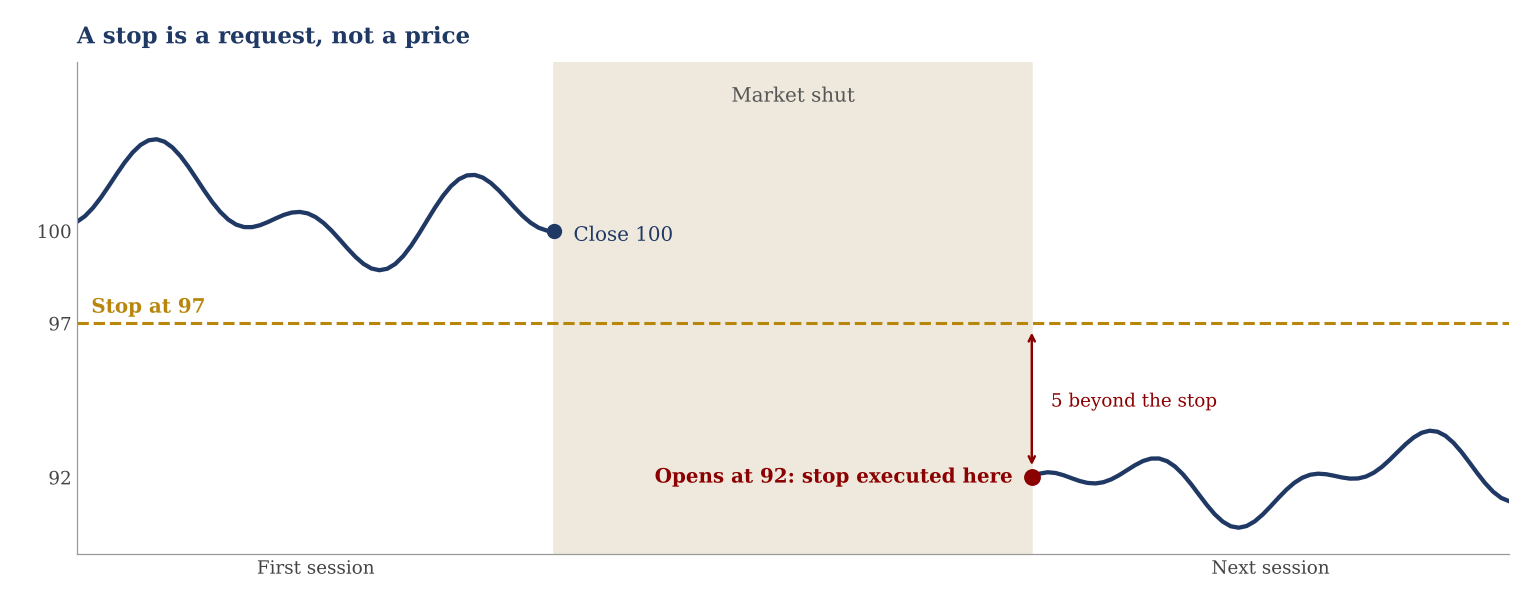
Figure 1. Illustration, not data. A share closes at 100 with a protective stop resting at 97. News arrives while the market is shut and the next session opens at 92. The stop is executed at the first available price, not at 97.
Volatility also understates one thing that the structure makes certain. A share’s price can move between sessions by more than it normally moves within one, and on scheduled dates, such as the announcement of results, it often does. A protective stop is an instruction to sell if the price reaches a level. If the price passes through the level while the market is shut, the instruction is carried out at the next price there is. Figure 1 shows the case. The loss on a position sized to a stop is therefore the distance to the stop only on the assumption that the market is open when the stop is reached. For an instrument that is shut for seventeen and a half hours of every day and all of every weekend, the assumption fails often enough to belong in the unit itself.
Table 1. The six questions answered for equities
| Question | Answer |
|---|---|
| Claim | A residual, limited and perpetual share in a company, ranking after every creditor; the fraction owned can be diluted or concentrated by the company |
| Structure | Exchange order book with central clearing; six and a half hours a day in the main session, with auctions at each end; halts; prices adjusted by corporate actions |
| Return | Dividends, growth in profits and changes in valuation; a premium over bills for the class, concentrated in a small minority of shares |
| Carry | Dividend less financing, small beside the daily movement; a short position pays the dividend and a borrowing fee |
| Ending | No maturity; ended by acquisition, failure or delisting, and for leveraged holders by a margin call that can arrive while the market is shut |
| Risk unit | Volatility, divided into a market part that does not diversify and a specific part that does, with allowance for gaps between sessions |
The answers describe the listed ordinary share. Shares held through a dealer’s contract differ in the first, second and fourth rows.
VIII. The case
The following illustration is drawn from a multi-asset book that admitted a fixed list of fewer than thirty large American companies and traded them long or short under the same rules it applied to every other class.
The first observation concerns direction. At a weekly close the book held positions in about fifteen companies, a little over half of them long and the rest short. Each had been opened on its own evidence, with no rule aiming at balance. The result was nonetheless a book whose exposure to the market as a whole was a fraction of what its count implied, for the reason given in Section VII: the long and short positions shared the market’s movement with opposite signs. What the book actually held was mostly the specific risk of each company. A reader who counted fifteen share positions and inferred a large stake in the direction of the stock market would have been wrong by most of the amount.
The second concerns the ledger. Over the period of record roughly forty share positions had been closed. The great majority ended at their profit targets, each for a small gain. A very few ended at their stops, each for a loss about twenty times the size of a typical gain. The class needed more than twenty targets for each stop to break even and had achieved slightly fewer, so that its net result over the period was a small loss, where the currency positions described in Paper II, run under identical rules, had shown a small gain. The figures are too few to carry a conclusion and the paper does not draw one. It records that the rules were the same and the classes were not.
The third concerns the venue. During one session the book’s rules called for an order in a large company’s shares of a size the venue’s published limits permitted. The venue refused it, and refused it again each time it was sent. The published limit and the working limit were different numbers, and the working one can be found only by reducing the request until an order is accepted. This is the second question in an unglamorous form: how much of a share can be bought at one time is a property of the place it is bought, and it is discovered by trading and not by reading.
IX. What would falsify this reading
The paper claims that the return to shares as a class is a premium for bearing losses at bad times, and that it is delivered through a small minority of companies. The first claim would be weakened by a long period, across many countries, in which shares returned no more than bills without any change in their risk. Individual countries have had such periods lasting decades, which is why the claim is made for the class across markets and not for any one of them. The second would fail if the concentration found in the American record were shown to be an accident of that market and absent elsewhere; the evidence so far is that it is general.
The claim about gaps is arithmetical where it concerns stops and empirical where it concerns returns. If the overnight share of the return were shown to have disappeared as trading hours lengthened, Section IV would need revision, and the lengthening of hours now under way in several markets makes this a live question.
The paper has treated the share as held singly. Most equity exposure is now held in baskets, through indices and the funds that track them, and the basket has properties its members lack. That is the subject of Paper VI.
References
Bessembinder, H. (2018). Do stocks outperform Treasury bills? Journal of Financial Economics 129(3), 440–457.
Cliff, M., Cooper, M. J. and Gulen, H. (2008). Return differences between trading and non-trading hours: like night and day. Working paper.
Dimson, E., Marsh, P. and Staunton, M. (2002). Triumph of the Optimists: 101 Years of Global Investment Returns. Princeton University Press.
Doidge, C., Karolyi, G. A. and Stulz, R. M. (2017). The U.S. listing gap. Journal of Financial Economics 123(3), 464–487.
Dr. Glen Brown (2026). Money and Foreign Exchange; Credit: Corporate Bonds, Loans and Securitised Debt. The Instruments of Capital, Papers II and IV. Public Doctrine Series.
Mehra, R. and Prescott, E. C. (1985). The equity premium: a puzzle. Journal of Monetary Economics 15(2), 145–161.
Securities Industry and Financial Markets Association (2026). Capital Markets Fact Book, 2026 Edition.
Sharpe, W. F. (1964). Capital asset prices: a theory of market equilibrium under conditions of risk. Journal of Finance 19(3), 425–442.
Related in the Public Doctrine Series
What an Asset Class Is: The Instruments of Capital, Paper I, which sets the six questions used here.
Credit: Corporate Bonds, Loans and Securitised Debt: The Instruments of Capital, Paper IV, on the capped claim that ranks ahead of the share.
Scheduled Gaps: The Machine Readings, Paper III, on the hours when a market cannot be acted in.
Download the PDF
About the Author
Dr. Glen Brown is President & CEO of Global Financial Engineering, Inc. and Global Accountancy Institute, Inc. He is the architect of the GCPIAUT framework and the broader GATS-native proprietary capital doctrine. His work focuses on sovereign capital governance, algorithmic trading architecture, reserve-first compounding systems, and institutional financial engineering within closed proprietary environments.
Business Model Clarification
Global Financial Engineering, Inc. and Global Accountancy Institute, Inc. operate as closed-loop proprietary institutions. They do not offer public investment products through the doctrines described herein, do not invite retail participation into their proprietary capital architecture, and do not present the GCPIAUT framework as a public collective investment scheme. The concepts discussed in this article are part of the firms’ internal intellectual and operating doctrine.
Risk Disclaimer
Trading and investment activity across foreign exchange, equities, futures, commodities, and digital assets involves substantial risk. Market conditions may change rapidly, and losses may occur. This article is provided for intellectual, institutional, and educational discussion only and does not constitute investment advice, an offer, a solicitation, or a recommendation to buy or sell any financial instrument or to participate in any investment structure.