The Instruments of Capital · Paper I
What an Asset Class Is
Six questions that sort every instrument a firm could ever trade, and the map of the series that follows.
Dr. Glen Brown · Global Financial Engineering, Inc. · Global Accountancy Institute, Inc. · 13 November 2026 · GFE-PUB-IOC-20261113-A
About this series
The Instruments of Capital is a sub-series of the Public Doctrine Series. It sets out, one class at a time, every kind of asset a proprietary firm could trade, whether or not the firm trades it today. The case in Section VI is an illustration built from operating data. Its figures have been altered and it reports no account’s results.
I. Four numbers that cannot be added
At the end of 2025 the listed shares of the world’s companies were worth about $157.8 trillion, and the bonds outstanding against the world’s governments and companies came to about $160.7 trillion. Over-the-counter derivatives stood at $844.6 trillion of notional amount. Seven months earlier, in April 2025, currencies changed hands at a rate of $9.6 trillion a day.
A reader who adds these figures has made an error of kind, not of arithmetic. The first is the market value of ownership. The second is the face amount of debt. The third is a reference quantity on which payments are calculated: the same derivatives had a gross market value of $22.8 trillion, under three per cent of their notional. The fourth is not a stock at all but a flow, a volume passing through in a day. Four markets, four units, and no common scale until one asks what, in each case, is actually held.
That question is the subject of this series. The phrase “asset class” is used in practice as a filing label: equities in one drawer, bonds in another, “alternatives” in a third for whatever is left. A label tells the holder where an instrument is filed. It does not say what the holder owns, who owes it, what it pays, what it costs to keep, or how it can be taken away. Those are the properties that decide how an instrument behaves inside a portfolio, and they are the properties this series examines.
An asset class is a kind of claim. The name on the drawer comes afterwards.
II. The six questions
Every paper in the series puts its subject through the same six questions, in the same order. They are stated here once so that later papers can be read against one another.
The first is the claim. What does the holder own or what is the holder owed, and against whom? A share is a residual claim on a company after everyone else has been paid. A bond is a promise of fixed payments, ranked ahead of the share. A futures contract is neither: it is an agreement to exchange at a later date, and until that date it conveys no ownership of anything. A barrel of oil is a thing. A currency is a claim on a central bank or a commercial bank. A bitcoin is an entry on a ledger that no institution stands behind. The legal nature of the claim fixes most of what follows.
The second is the structure. Where does the instrument trade, during which hours, and who is on the other side? An exchange with a central clearing house, a dealer quoting from its own inventory and a venue that internalises its clients’ orders are three different counterparties, and they fail in three different ways. Hours matter as much as counterparties. An instrument that trades for six and a half hours a day carries a risk that a twenty-four-hour instrument does not: the price can move while the holder is unable to act.
The third is the return. Where does the money come from? A share pays out of profits; a bond out of contractual coupons; a commodity pays nothing and returns only what a later buyer will give for it. Derivative contracts in aggregate pay nothing either, since each gain is another party’s loss, and their return to any one holder is a transfer of risk that someone else wished to shed. An instrument whose source of return cannot be named is being held on the hope of resale alone.
The fourth is the carry: what it costs, or pays, to hold the position for one more day when the price does not move. Dividends and coupons are positive carry. Financing charges, storage, insurance and the decay of an option’s time value are negative carry. In foreign exchange the carry is the difference between two interest rates and can run either way. Carry is the most neglected of the six, because it is small on any one day and decisive over a year.
The fifth is the ending. How can the position end without the holder’s decision? Contracts expire. Bonds mature, are called, or default. Companies are acquired or delisted. Leveraged positions are closed by the venue when margin runs out. Each class has its own involuntary endings, and a holder who has not listed them is exposed to an event the instrument’s own documents announced in advance.
The sixth is the risk unit. How is one unit of risk in this instrument to be defined so that it can be compared with one unit in another? A thousand dollars of a short-dated government bill and a thousand dollars of a small company’s shares are equal in money and unequal in everything that matters. Until a common unit exists, typically some multiple of the instrument’s own typical movement, a portfolio that spans classes is a list, not a design.
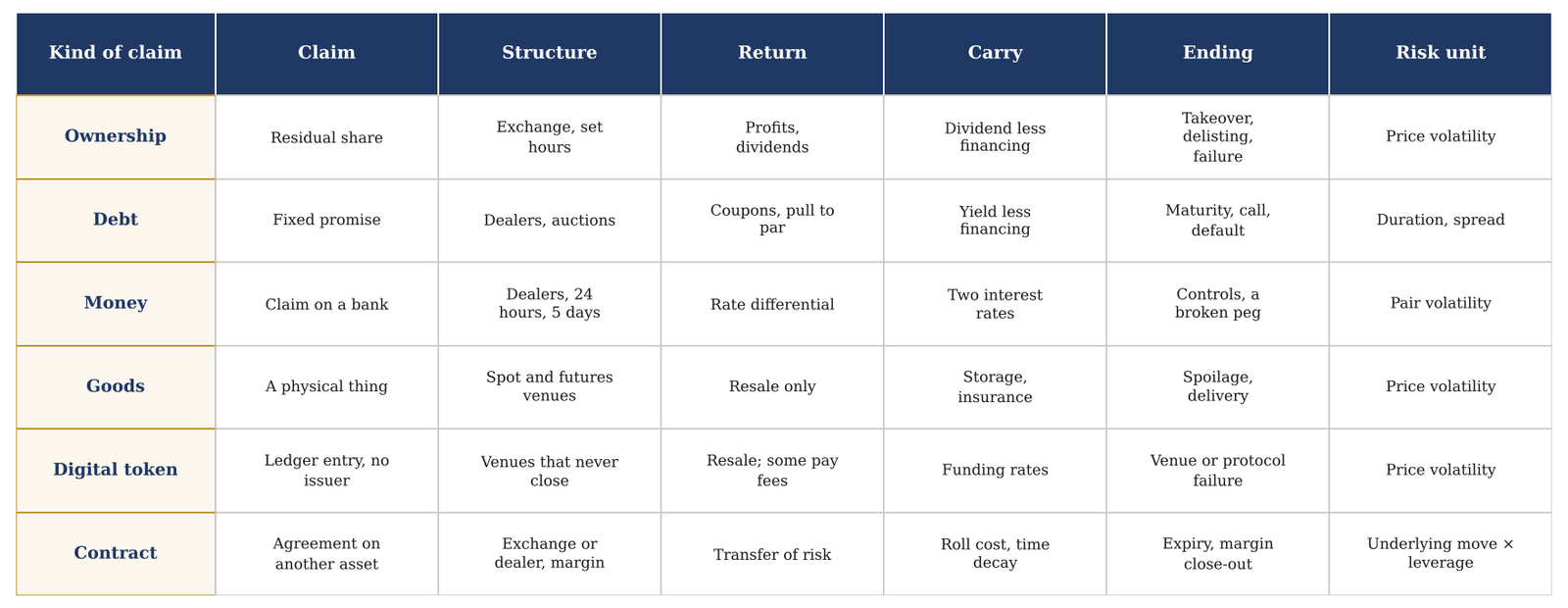
Figure 1. The six questions applied to six kinds of claim. Each cell gives the shortest honest answer; later papers take one row at a time.
III. Six kinds of claim
Applied across everything that trades, the first question yields a short list. Robert Greer, in a 1997 paper that asked the question in this paper’s title, divided assets into three: capital assets that produce income, assets that are consumed or transformed, and assets held as stores of value. His division remains the best starting point. For a trading firm it needs one extension, because much of what a trading firm holds is none of the three: it is a contract that refers to an asset without being one.
Table 1. Six kinds of claim
| Kind of claim | What is held | Examples | Covered in |
|---|---|---|---|
| Ownership | A residual share in an enterprise or a property | Listed shares, private equity, property, infrastructure | Papers V, VI, XV, XVI |
| Debt | A promise of fixed payments, ranked ahead of ownership | Government bonds, bills, corporate bonds, loans, securitised debt | Papers III, IV |
| Money | A claim on a central or commercial bank, held against another | Currency pairs, deposits, money-market instruments | Paper II |
| Goods | A physical thing that is consumed or transformed | Energy, metals, grains, softs, livestock | Papers XI, XII, XIII |
| Bearer digital token | A ledger entry with no issuer standing behind it | Bitcoin, ether and similar; stablecoins are a hybrid with debt | Paper XIV |
| Contract | An agreement that refers to one of the above without conveying it | Futures, forwards, options, swaps, volatility and event contracts | Papers VII to X, XVII |
A contract inherits its return from what it refers to and its structure, carry and ending from its own terms.
The last row explains why the customary labels mislead. “Futures” is filed as an asset class beside “equities” and “commodities”, yet a futures contract on a share index and a futures contract on wheat share a legal form and almost nothing else. The form governs margin, expiry and the cost of rolling from one contract to the next. The underlying governs why the price moves. A sound classification has to carry both, which is why the series treats the contract forms in their own papers and the underlying claims in theirs.
IV. The class and the wrapper
The same economic exposure can be held in several legal forms. Exposure to gold may be taken as metal in a vault, as a futures contract, as a share in a fund that holds the metal, or as a contract for difference with a dealer. The price of gold drives all four. The answers to the six questions differ in every one. The bar has storage cost and no counterparty. The future has no storage cost, a clearing house, a margin call and an expiry date. The fund has a management fee and trades only when its exchange is open. The dealer’s contract has a financing charge each night and a counterparty whose solvency is the holder’s concern.
This paper calls the legal form the wrapper. The class determines the first and third questions, the claim and the return. The wrapper determines most of the second, fourth and fifth: structure, carry and ending. Much of what is experienced as the behaviour of an asset is in fact the behaviour of its wrapper, and a holder who changes wrapper without noticing has changed instrument. The subject is large enough to have its own paper near the end of the series.
V. Why study what one does not yet trade
A firm’s present book is a poor guide to the instruments it should understand. There are three reasons to survey the whole field first.
The first is that the classes price one another. The yield on a government bond is an input to the value of every share, the carry on every currency pair and the cost of holding every futures contract. A firm that trades shares and has never studied the bond is trading a derivative of something it has not examined.
The second is that a system built on questions admits new classes without being rebuilt. If the machinery that sizes a position asks only for the instrument’s typical movement, its hours, its carry and its endings, then a class the firm has never traded can be admitted by answering those questions for it. If the machinery was instead built around the habits of one class, every new class is an exception to be patched. The six questions are therefore also a design specification.
The third is that the relationships between classes are not constant, so that breadth has to be understood rather than assumed. Harry Markowitz showed in 1952 that the risk of a portfolio depends on how its holdings move together as well as on how each moves alone. The inputs to that result are estimates, and they change. In 2022 shares and government bonds in the United States fell in the same year, and portfolios built on the expectation that one would cushion the other were cushioned by neither. A firm that knows why two classes usually diverge is better placed to notice when the reason has lapsed.
VI. The case
The following illustration is drawn from the operation of multi-asset books across one weekly close. Each admitted more than a hundred instruments in eight classes: currencies, shares, exchange-traded funds, share indices, agricultural goods, metals, energy and digital tokens. All ran under a single set of rules that made no distinction between the classes.
At the weekly close seven of the eight classes stopped trading. The eighth, digital tokens, did not. Within a few hours three things had happened, and each belonged to a different one of the six questions.
A request to move the protective stop on a share was refused by the venue for want of a quote. The share’s session was listed as open, but no price was being made. The request was repeated and refused several times over a few minutes until a quote arrived, at which point it was accepted. Nothing about the company had changed. The event was a property of the structure: a share has hours, and at the edge of those hours it may have a session without a market.
In the digital class the sizing rules called for a position many times larger than the venue would accept in a single order; the largest permitted order reached less than a tenth of the intended size. The system declined to open a position that small, since a fraction of the intent is a different position with the same costs of attention. This too was structure: the capacity of a venue is part of the instrument as it can actually be held, and it binds differently in a young market than in an old one.
Later the same evening two digital positions reached their profit targets and were closed by resting orders, and new positions were opened within two hours. Every other class was shut. This was the fifth question answered in the holder’s favour: an ending that had been arranged in advance, in a class with no closing bell to interrupt it.
None of the three events could have been anticipated from the labels on the drawers, and all three follow at once from the questions. A share has a session, and so its edge cases arise at the session’s boundary. A young market has limited depth, and so capacity binds there first. A market that never closes pays and charges at hours when no other does. The rules were the same for every class. The classes were not the same, and the differences appeared exactly where the six questions said to look.
VII. What would falsify this reading
The claim of this paper is that six questions are sufficient to sort instruments by how they behave when held. The claim fails in either of two ways. It fails if two instruments that return the same six answers behave persistently differently in a portfolio, which would mean a seventh question exists. It fails equally if one of the six never separates any two instruments in practice, which would mean it is decoration. Each later paper is a test: where a class shows a behaviour the six questions did not predict, the paper will say so, and the list will be amended in public.
One weakness is admitted now. The questions describe an instrument as held by one party. They say little about how a market as a whole behaves when many holders give the same answers at once and act on them together. Crowding of that kind is a property of the population of holders and not of the instrument, and it will need separate treatment.
VIII. The map of the series
The papers that follow take the field one class at a time. Titles are working titles. The order runs from the claims on which everything else is priced, money and government debt, through ownership and the contract forms, to the newer and less liquid classes, and closes with the two papers that bring the classes back into one book.
Table 2. The Instruments of Capital
| Paper | Working title | Kind of claim |
|---|---|---|
| I | What an Asset Class Is | The six questions |
| II | Money and Foreign Exchange | Money |
| III | Government Debt and the Price of Time | Debt |
| IV | Credit: Corporate Bonds, Loans and Securitised Debt | Debt |
| V | Equities | Ownership |
| VI | Indices, Funds and Exchange-Traded Products | Ownership, held as a basket |
| VII | Futures and Forwards | Contract |
| VIII | Options | Contract |
| IX | Swaps and the Over-the-Counter Contract | Contract |
| X | Volatility as an Asset | Contract |
| XI | Energy | Goods |
| XII | Metals | Goods |
| XIII | Agricultural Commodities and Livestock | Goods |
| XIV | Digital Assets | Bearer digital token |
| XV | Real Assets: Property and Infrastructure | Ownership |
| XVI | Private Markets: Private Equity, Venture and Private Credit | Ownership and debt, unlisted |
| XVII | Newer Markets of Risk: Carbon, Power, Freight, Weather and Event Contracts | Contract |
| XVIII | The Wrapper | The legal form across all classes |
| XIX | One Book, Many Classes | The portfolio |
Several of these classes are not traded by the firm today. Where a paper has no case to report, it will say so and reason from the public record.
The series is written from the position of a firm that expects its field of operation to widen. It is easier to understand a class before capital is committed to it than afterwards.
References
Bank for International Settlements (2025). Triennial Central Bank Survey: OTC foreign exchange turnover in April 2025. Basel, 30 September 2025.
Bank for International Settlements (2026). OTC derivatives statistics at end-December 2025, as summarised in International Swaps and Derivatives Association, Key Trends in the Size and Composition of OTC Derivatives Markets in the Second Half of 2025.
Greer, R. J. (1997). What is an asset class, anyway? Journal of Portfolio Management 23(2), 86–91.
Ilmanen, A. (2011). Expected Returns: An Investor’s Guide to Harvesting Market Rewards. Wiley.
Markowitz, H. (1952). Portfolio selection. Journal of Finance 7(1), 77–91.
Securities Industry and Financial Markets Association (2026). Capital Markets Fact Book, 2026 Edition.
Sharpe, W. F. (1992). Asset allocation: management style and performance measurement. Journal of Portfolio Management 18(2), 7–19.
Related in the Public Doctrine Series
The Measurement Canon: sixteen instruments for reading a trading system as a population of positions.
Scheduled Gaps: The Machine Readings, Paper III, on the hours when a market cannot be acted in.
The Toll and the Clock: The Machine Readings, Paper VII, on the cost of crossing a market measured against what the crossing can earn.
Download the PDF
About the Author
Dr. Glen Brown is President & CEO of Global Financial Engineering, Inc. and Global Accountancy Institute, Inc. He is the architect of the GCPIAUT framework and the broader GATS-native proprietary capital doctrine. His work focuses on sovereign capital governance, algorithmic trading architecture, reserve-first compounding systems, and institutional financial engineering within closed proprietary environments.
Business Model Clarification
Global Financial Engineering, Inc. and Global Accountancy Institute, Inc. operate as closed-loop proprietary institutions. They do not offer public investment products through the doctrines described herein, do not invite retail participation into their proprietary capital architecture, and do not present the GCPIAUT framework as a public collective investment scheme. The concepts discussed in this article are part of the firms’ internal intellectual and operating doctrine.
Risk Disclaimer
Trading and investment activity across foreign exchange, equities, futures, commodities, and digital assets involves substantial risk. Market conditions may change rapidly, and losses may occur. This article is provided for intellectual, institutional, and educational discussion only and does not constitute investment advice, an offer, a solicitation, or a recommendation to buy or sell any financial instrument or to participate in any investment structure.