The Instruments of Capital · Paper II
Money and Foreign Exchange
A currency pair is a price with no asset behind it. What is held, who owes it, what it pays, and how a position in money can end.
Dr. Glen Brown · Global Financial Engineering, Inc. · Global Accountancy Institute, Inc. · 13 November 2026 · GFE-PUB-IOC-20261113-B
About this series
The Instruments of Capital is a sub-series of the Public Doctrine Series. It sets out, one class at a time, every kind of asset a proprietary firm could trade, whether or not the firm trades it today. Each paper puts its subject through the six questions set in Paper I: claim, structure, return, carry, ending and risk unit. The case in Section VIII is an illustration built from operating data. Its figures have been altered and it reports no account’s results.
I. The largest market has nothing in it
Foreign exchange is the largest market in the world by a wide margin. In April 2025 it turned over $9.6 trillion a day, according to the triennial survey of the Bank for International Settlements. It is also the only major market in which nothing is owned at the end of a trade that was not owned, in another form, at the start. A buyer of shares gives up money and holds a company. A buyer of euros against dollars gives up one money and holds another. The transaction is an exchange of like for like, and the quoted price, the exchange rate, is the price of one money stated in units of a second.
This is why the class sits first in the series after the introduction. Every other instrument is priced in a currency, so every other position is also a currency position whether its holder has noticed or not. And the peculiarities of foreign exchange, which trouble those who arrive from the share market expecting an asset, are exactly the things the six questions were built to expose.
No one is ever long foreign exchange. One is long a currency and, by the same act, short another.
II. The claim
Money is a claim on a bank. Notes and the reserves that banks hold are claims on a central bank; the balance in an account is a claim on a commercial bank, which is why it can be lost if that bank fails. A currency is the unit in which those claims are counted, and its standing rests on the central bank that issues it and the state that taxes in it.
A trading position in a currency pair is one step further removed. The holder of a spot position at a dealer rarely takes delivery of either currency. What is held is a claim on the dealer for the change in the rate, secured by a margin deposit. In the language of Paper I the class is money and the wrapper is a contract with a dealer, and the holder’s first counterparty risk is the dealer, not either central bank. The distinction is easy to forget in quiet markets and decisive in disorderly ones.
III. The structure
There is no foreign exchange. There is no building, no opening bell and no single price. The market is a network of dealers, chiefly large banks, who quote to one another and to their clients, joined by electronic platforms. Dealing among dealers was 46 per cent of turnover in April 2025, and other financial institutions accounted for a further 50 per cent. Companies that need currency to trade goods, the customers for whom the market nominally exists, were 5 per cent.
Two features of this structure shape every position. The first is concentration. The United States dollar was on one side of 89.2 per cent of all trades, so that most exchanges between two other currencies are, underneath, two trades through the dollar. Four centres, the United Kingdom, the United States, Singapore and Hong Kong, handled three quarters of the volume. The second is the clock. The market follows the sun from Wellington through Asia and London to New York and is open continuously from Monday morning in the Pacific to Friday evening in America. It then closes for two days. A position held on Friday is held, without the possibility of action, until the first price on Monday, and that price may be far from the last.
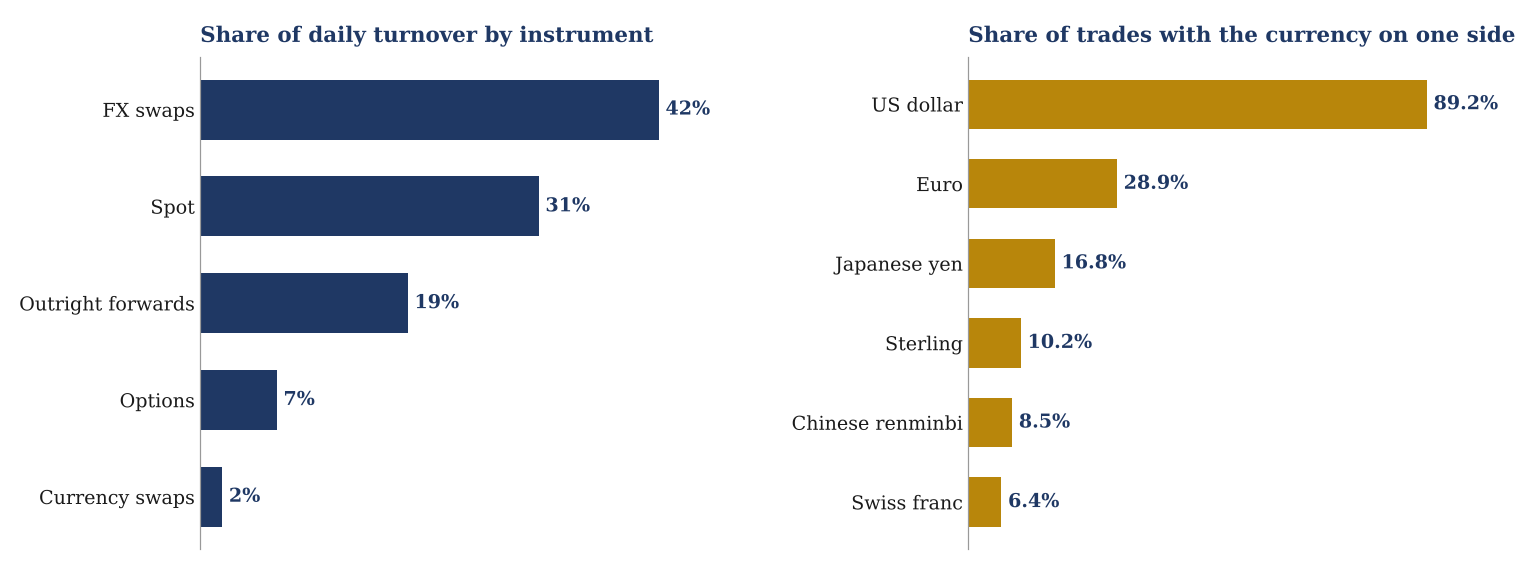
Figure 1. Foreign exchange turnover in April 2025: share by instrument, and the share of trades with each currency on one side (shares sum to 200 per cent because every trade has two currencies). Source: Bank for International Settlements, Triennial Central Bank Survey, 2025.
Figure 1 shows a further point about structure. Spot trading, the instrument most people have in mind, was 31 per cent of turnover. Foreign exchange swaps were 42 per cent. A swap of this kind is a pair of trades, one now and one later in the opposite direction, and it is in substance a secured loan of one currency against another. The greater part of the market’s volume is therefore funding, the borrowing and lending of currencies, and the part that expresses a view on the rate is the minority.
IV. The return
A share is expected to earn something because companies make profits. No such argument exists for a currency pair. A rise in the euro against the dollar is, to the same decimal place, a fall in the dollar against the euro, and the gains of those who held one are the losses of those who held the other. Before costs the market in exchange rates is a transfer among its participants; after the dealer’s spread it is a small net loss.
Nor has the rate proved forecastable from the quantities that ought to drive it. Richard Meese and Kenneth Rogoff showed in 1983 that the leading economic models of the exchange rate could not, at horizons up to a year, outperform the assumption that tomorrow’s rate will equal today’s. Four decades of later work have qualified that finding without overturning it. A holder of a currency position is therefore not collecting a return that the instrument produces. The holder is taking one side of a transfer, and the only income the position generates of itself is the subject of the next question.
V. The carry
Each currency has an interest rate, and a position that is long one currency and short another earns the first rate and pays the second. For a spot position at a dealer this difference is charged or credited each night when the position is rolled forward a day. Because spot trades settle two business days after the trade, the roll in the middle of the week carries the position across the weekend and is charged for three days in one.
The forward market expresses the same thing in price. A forward rate, the rate agreed today for exchange at a later date, differs from the spot rate by an amount that offsets the interest differential. If it did not, a trader could borrow one currency, lend the other and lock in the exchange rate for a certain profit. This relation, covered interest parity, held almost exactly until 2008. Since then persistent gaps have opened, which Wenxin Du, Alexander Tepper and Adrien Verdelhan trace to the balance-sheet costs that regulation now imposes on the banks that would close them. The gaps are a reminder that even an arbitrage relation depends on someone having the capacity to enforce it.
The uncovered version of the relation says that a high-interest currency should fall by enough to cancel its extra interest. On average it has not. Eugene Fama documented in 1984 that currencies with higher interest rates have tended, if anything, to rise. Holding them has therefore paid, and the practice has a name, the carry trade. The payment is not free. Markus Brunnermeier, Stefan Nagel and Lasse Pedersen showed that carry positions lose abruptly and together when funding becomes scarce, so that the steady income is compensation for an occasional crash. Carry in foreign exchange is the one return the class offers of itself, and it comes with its own way of ending.
VI. The ending
A spot currency position has no expiry. It can be rolled indefinitely, and in that sense it is the most patient of instruments. The endings that matter are the involuntary ones, and there are three.
The first is the margin call. Currency positions are customarily held with borrowed money in large multiples of the deposit, and a dealer will close a position when the deposit no longer covers the loss. The position is ended by the venue at the worst available moment, which is the moment the rule was written for.
The second is the break of a regime. Many exchange rates are managed, and a managed rate moves little until the day the management stops. Sterling left the European Exchange Rate Mechanism on 16 September 1992. On 15 January 2015 the Swiss National Bank abandoned without notice the ceiling it had held on the franc for more than three years, and the franc rose against the euro by more than fifteen per cent that day; dealers failed and positions were closed at prices far beyond their stops. Robert Mundell’s work of the early 1960s explains why such breaks recur: a country cannot at once fix its exchange rate, allow capital to move freely and set its own interest rates, and when the three collide it is usually the fixed rate that gives way.
The third is the law. A state may restrict the conversion or transfer of its currency, and a position in that currency then cannot be closed at any price. This ending is rare among the major currencies and ordinary outside them.
VII. The risk unit
The natural unit of risk for a pair is its own typical movement, and on that measure the major pairs are among the quietest instruments that trade. The quiet is the reason for the leverage, and the leverage is the reason the first ending is so common.
The harder problem is that pairs are not independent. Eight major currencies form twenty-eight pairs. A book holding positions in many of those pairs does not hold many exposures. It holds exposures to eight currencies, and since every position is long one and short another the eight must sum to zero, which leaves seven. Twenty-eight prices, seven things that can move. A position that is long the euro against the dollar and another that is long the dollar against the yen are, taken together, long the euro against the yen with nothing left in the dollar at all.
The risk unit in foreign exchange is therefore set at two levels. Each position is sized against the movement of its own pair. The book is then read currency by currency, by adding up, for each currency, everything held long and short across all the pairs that contain it. Only the second reading shows what the book would lose if one central bank surprised the market.
Table 1. The six questions answered for foreign exchange
| Question | Answer |
|---|---|
| Claim | A claim on one bank’s money held against a debt in another’s; in practice, for a trading position, a claim on a dealer |
| Structure | Dealers and electronic platforms, no central exchange; open twenty-four hours for five days, closed for two |
| Return | None produced by the instrument; a transfer among holders, less the spread |
| Carry | The difference between two interest rates, charged or credited nightly; can run either way |
| Ending | No expiry; ended involuntarily by margin, by the break of a managed rate, or by controls |
| Risk unit | The pair’s own movement for the position; net exposure by currency for the book |
The answers describe the major, freely traded currencies. Managed and restricted currencies differ chiefly in the fifth row.
VIII. The case
The following illustration is drawn from the operation of a multi-asset book that admitted the twenty-eight pairs formed by eight major currencies and no others. The restriction was deliberate: outside the majors the spread is wide relative to the movement, and the fifth question has worse answers.
At a weekly close the book held about twenty currency positions in fourteen different pairs. Read as a list, that is fourteen opinions. Three of the pairs were held in both directions at once, by positions opened on different horizons under the same rules, and those cancelled in currency terms, in whole or in part, whatever they might each go on to earn. Netted currency by currency and counted by position, the remainder came to this: the book was long the dollar, the yen and to a lesser degree the Canadian dollar, short the Swiss franc and the two antipodean currencies, and close to flat in the euro and sterling. Fourteen pairs had reduced to a handful of exposures, and the dollar, one of the two largest, appeared by name in fewer than a quarter of the positions. The count is by position and not by size, and is offered as a reading of direction only.
The record of closed positions in the class made a second point. The great majority had ended at their profit targets, each for a small gain, and very few had ended at their stops. By count the losing positions were fewer than one in twenty-five. By time they were about one-seventh of all the days the class had been held, because a position that is going to lose takes far longer to do so than a position that is going to win takes to win. In a class where time is charged nightly, the losing positions were therefore the main payers of carry as well as the only payers of loss.
Both observations follow from the six questions and from nothing else. The netting follows from the sixth: pairs are prices, currencies are exposures. The weight of the losing positions in time follows from the fourth: carry is paid by the day, and the days are not evenly distributed between winners and losers. Neither is visible on a list of pairs with their profits and losses beside them. At the close the whole class stopped for two days, and every one of those positions passed to the second question, to be held through a weekend in which it could not be touched.
IX. What would falsify this reading
Three claims here can be checked. The first is that the exchange rate itself yields no return, so that a holder’s income from the class is carry and whatever skill extracts from the transfer. A currency whose spot rate rose against all others for decades by more than its interest disadvantage, for reasons that could have been known in advance, would refute it. The second is that carry is paid for bearing crash risk. If carry positions were shown to lose no more abruptly than other positions of equal movement, the income would be unexplained and this paper’s account of it wrong. The third is the arithmetic of exposures, which is not empirical and cannot fail; what can fail is its usefulness, if in practice the pairs moved so independently that the netted reading told the holder nothing the list did not.
The paper has also left something out. It treats the major currencies as a group with one set of answers. The dollar’s place on one side of nearly nine trades in ten means that it is not one currency among eight, and a later paper in the series will have to consider what a book’s exposure to the dollar really is when most of its other holdings are priced in it.
Paper III turns to the instrument that sets the interest rates on which this paper’s carry depends: government debt.
References
Bank for International Settlements (2025). Triennial Central Bank Survey: OTC foreign exchange turnover in April 2025. Basel, 30 September 2025.
Brunnermeier, M. K., Nagel, S. and Pedersen, L. H. (2008). Carry trades and currency crashes. NBER Macroeconomics Annual 23, 313–347.
Dr. Glen Brown (2026). What an Asset Class Is. The Instruments of Capital, Paper I. Public Doctrine Series.
Du, W., Tepper, A. and Verdelhan, A. (2018). Deviations from covered interest rate parity. Journal of Finance 73(3), 915–957.
Fama, E. F. (1984). Forward and spot exchange rates. Journal of Monetary Economics 14(3), 319–338.
Meese, R. A. and Rogoff, K. (1983). Empirical exchange rate models of the seventies: do they fit out of sample? Journal of International Economics 14(1–2), 3–24.
Mundell, R. A. (1963). Capital mobility and stabilization policy under fixed and flexible exchange rates. Canadian Journal of Economics and Political Science 29(4), 475–485.
Related in the Public Doctrine Series
What an Asset Class Is: The Instruments of Capital, Paper I, which sets the six questions used here.
Scheduled Gaps: The Machine Readings, Paper III, on the hours when a market cannot be acted in.
The Toll and the Clock: The Machine Readings, Paper VII, on the cost of crossing a market measured against what the crossing can earn.
Download the PDF
About the Author
Dr. Glen Brown is President & CEO of Global Financial Engineering, Inc. and Global Accountancy Institute, Inc. He is the architect of the GCPIAUT framework and the broader GATS-native proprietary capital doctrine. His work focuses on sovereign capital governance, algorithmic trading architecture, reserve-first compounding systems, and institutional financial engineering within closed proprietary environments.
Business Model Clarification
Global Financial Engineering, Inc. and Global Accountancy Institute, Inc. operate as closed-loop proprietary institutions. They do not offer public investment products through the doctrines described herein, do not invite retail participation into their proprietary capital architecture, and do not present the GCPIAUT framework as a public collective investment scheme. The concepts discussed in this article are part of the firms’ internal intellectual and operating doctrine.
Risk Disclaimer
Trading and investment activity across foreign exchange, equities, futures, commodities, and digital assets involves substantial risk. Market conditions may change rapidly, and losses may occur. This article is provided for intellectual, institutional, and educational discussion only and does not constitute investment advice, an offer, a solicitation, or a recommendation to buy or sell any financial instrument or to participate in any investment structure.