The Self-Judging Machine · Paper IV
A sub-series of the Public Doctrine Series
Engineered Defaults
Why a trading system should neither wait for evidence nor fit to it, and what to do instead
Dr. Glen Brown · President & CEO, Global Financial Engineering, Inc. and Global Accountancy Institute, Inc.
GFE-PUB-DOC-20261106-B · 6 November 2026
I. Every parameter has a first value
Every mechanism in an automated trading system takes some value before it has learned anything. A strategy risks some fraction of capital on its first trade; a concentration limit admits some exposure before the first correlated loss; a performance report issues some verdict on its first day. Those first values are rarely discussed, because they are usually thought of as placeholders, to be replaced once the data arrives. They are not placeholders. In a system that trades continuously, the first values govern the very period in which the system knows least, and that is the period in which mistakes are cheapest to make and hardest to see.
This paper argues for a specific discipline in setting them, which we call the engineered default, and sets it against the three ways in which first values are usually set. It is the fourth paper of this series by number and the second to be published, because unlike its neighbours it requires no new operating evidence to make its argument.
II. Three common errors
Waiting. The most common counsel, when evidence is thin, is to let the system run until the data speaks. Waiting is presented as caution. In a system that trades every minute, it is a concealed decision: the system keeps acting on whatever value it was last given, and it does so through exactly the period in which its own results are least reliable. The first paper of this series showed that a ledger of closed trades can flatter a system for weeks while its losses wait in the open book. Waiting leaves that flattery free to set policy.
Fitting. The second counsel is to set each parameter to whatever value the available evidence best supports. On thin evidence this converts noise into policy. A short run of wins justifies more risk; a short run of losses justifies less, or none. Each response is confident; each is wrong in expectation; and a fitted value carries no memory of how little it rests on.
Choosing. The third counsel is to let experienced judgement pick the number. Judgement has its place, but a chosen number cannot be audited. No one can later say whether it was right for the reasons given, and it carries no instruction for how it should change when the world does.
III. The engineered default
The alternative has five properties, and a mechanism that lacks any one of them is unfinished.
Derived. The value follows from the structure of the problem rather than from preference. Consider a trade that banks a small gain b or loses a larger amount d. If nothing is known about its edge, the variance of its outcome under no edge is exactly b·d. That number is not estimated or chosen; it is implied by the geometry, and it is the right prior uncertainty for a decision about which nothing is yet known.
Prudent or neutral. When evidence is absent, the default sits either where it presumes nothing, as when a strategy’s risk starts at its designed allocation and is neither raised for presumed skill nor cut for presumed failure, or where it presumes the worst that the design must survive, as when a concentration limit assumes that every position on a common factor will fail together. Ignorance never reads as permission.
Governed by a law fixed in advance. Before any evidence arrives, the system already knows how evidence will move the default. The natural law is credibility weighting, used by actuaries for a century and known to statisticians as shrinkage: evidence from N observations carries weight N/(N+n₀) against a prior worth n₀ observations. For a strategy’s risk, the evidence can be summarised as a signal-to-noise ratio t, the shrunk estimate of edge divided by its honest standard error, and mapped to a multiplier on the default:
m = clamp( exp( κ · t ), 1/C, C ) , κ = ln C / z
Here C is the ceiling and z the one-sided confidence at which a strategy is allowed to reach it. The map is symmetric in logarithm, so evidence for and against a strategy moves its risk by equal proportions, and a strategy is never switched off, only reduced.
Bounded. No amount of evidence moves a default outside limits set before the evidence existed. Bounds are not a lack of faith in the mathematics. They acknowledge that the mathematics rests on a model, and that models fail in ways their own error bars do not reveal.
Witnessed. The system prints the state of every engineered default, the evidence behind it and its current value, where its owner can read it. A default whose movement cannot be seen cannot be governed.
IV. The Case
This case is an illustration built from operating data; its figures have been altered, and it reports no account’s results. It describes a multi-asset system that, in a single day, replaced three placeholder values with engineered defaults.
The first was its performance verdict. The default was the hypothesis of no edge. The adjustment law counted open positions at their marks, as the first paper of this series derived, and clustered the error so that positions sharing a day and an asset class counted partly as one. The bound was a refusal to issue any verdict on fewer than thirty positions. On the first evening, every book with enough positions read neither positive nor negative, which was the truth.
The second was the risk carried by each of nine strategies running at different speeds. The default was each strategy’s designed allocation. The prior was thirty observations at zero edge with variance b·d, and the multiplier was bounded between two-thirds and one and a half. On the first evening, the fastest strategy, with about a hundred and twenty observations and a slightly negative estimate, moved to about 0.89 of its allocation; every other strategy stayed within four percent of its own. Figure 1 shows how the same law would move a strategy over time under three true edges.
Figure 1. How the law moves a strategy’s risk as evidence accumulates
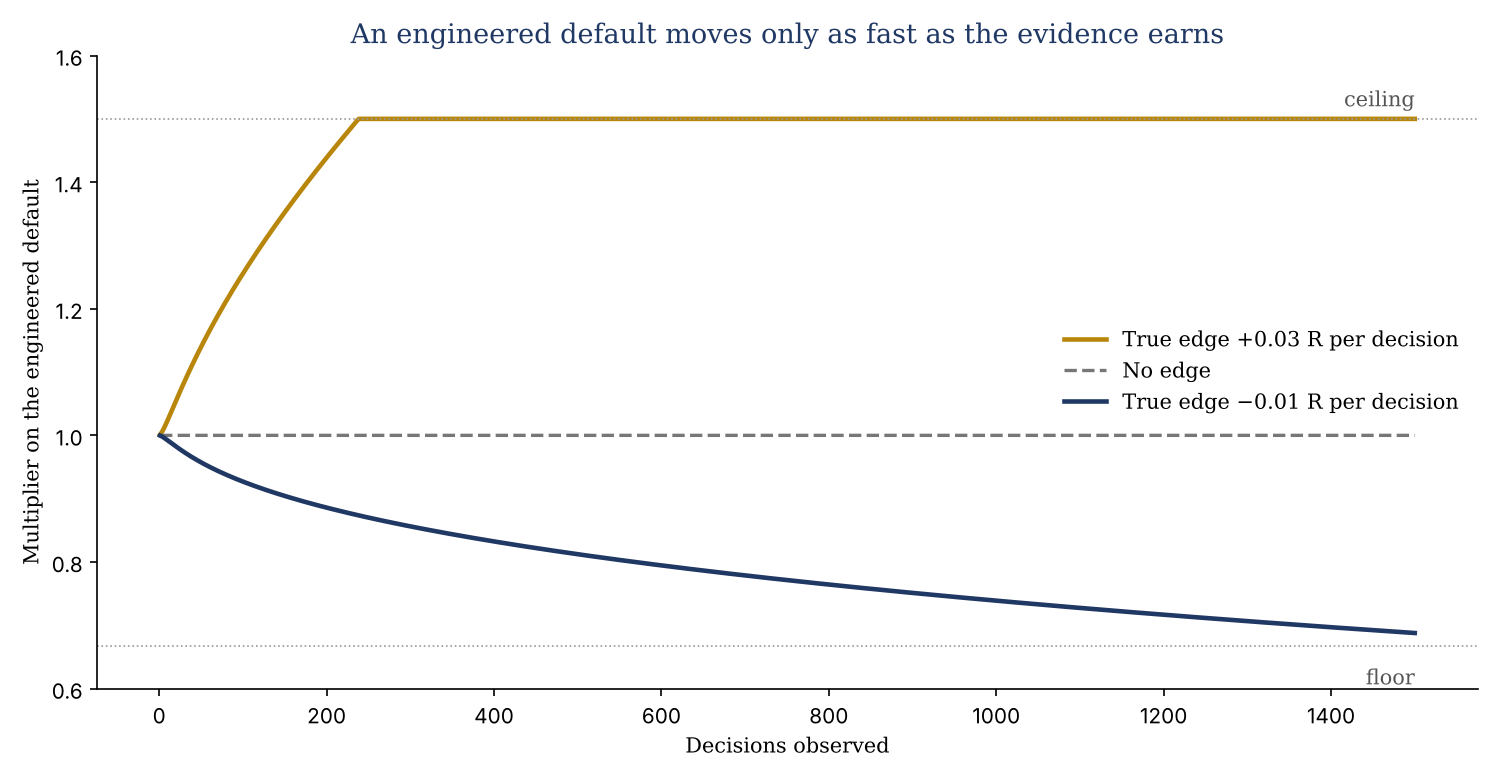
Expected path of the multiplier when the observed edge equals the true edge, with a prior of thirty observations at zero edge, variance b·d, ceiling 1.5 and floor two-thirds reached at one-sided 95% confidence. Illustrative values.
The third was a limit on the exposure that positions sharing a common market factor may carry. The default assumed that every position on a factor fails together and set the limit so that such a failure could not, on its own, trip the circuit breaker of the asset class concerned. The learned adjustment reads, day by day, how far the factor’s positions actually fall together. Because the circuit-breaker thresholds tighten as the system’s capital grows, the limit tightens with it, without any number being reset by hand. On its first reading, one factor in one book already stood well above its limit, and the system began to hold new positions on that factor.
The same day also produced two lessons about evidence. A factor’s learning counted every calendar day on which the factor carried exposure, including weekend days on which its markets were closed; those days would have entered the evidence as copies of Friday, adding no information while narrowing the error. The unit was redefined so that only a day on which the factor’s reading moved counts. Separately, a single trade recorded at more than twenty units of risk for a trivial gain in money was enough to tilt one strategy’s evidence materially. An adjustment law is only as honest as the evidence it consumes, and engineering a default includes engineering the unit of its evidence.
V. What would falsify this approach
The engineered default makes three claims that can fail. The first is that the structure supplies the right prior: if the geometry of the trade is mismeasured, the derived prior is wrong, and the law will start from the wrong place. The second is that credibility weighting moves the default at the right speed: if the system’s environment changes faster than evidence accumulates, the law will always be catching up, and bounds become the only protection. The third is that the evidence unit is honest, which the case shows cannot be assumed. Each claim can be checked against the system’s own record, and each check should be built into the system rather than performed occasionally by hand.
VI. The residue of judgement
Engineered defaults do not remove judgement. They concentrate it into a few named numbers: the weight of the prior, the ceiling and floor, the confidence at which the ceiling is reached. Each has a stated reason, each is printed beside its effect, and each can be revisited without disturbing the derivations that rest on it. That is the difference between a system whose values were chosen and a system whose values were engineered: in the second, judgement is spent on principles rather than on numbers, and every number can say where it came from.
References
Bühlmann, H. (1967). Experience rating and credibility. ASTIN Bulletin 4(3), 199–207.
James, W. and Stein, C. (1961). Estimation with quadratic loss. Proceedings of the Fourth Berkeley Symposium on Mathematical Statistics and Probability, Vol. 1, 361–379.
Wald, A. (1950). Statistical Decision Functions. Wiley.
Hansen, L. P. and Sargent, T. J. (2008). Robustness. Princeton University Press.
Kelly, J. L. (1956). A new interpretation of information rate. Bell System Technical Journal 35(4), 917–926.
Dr. Glen Brown (2026). The Martingale Ledger. The Self-Judging Machine, Paper I. Public Doctrine Series.
Related in the Public Doctrine Series
The Martingale Ledger: The Self-Judging Machine, Paper I, on judging a system honestly before its positions close.
The Seven-Day Horizon: The Machine Readings, Paper I, on why early verdicts on a new rule are flattered.
The Clock Is Not a Protector: The Machine Readings, Paper V, on a threshold measured from the system’s own readings rather than chosen.
Download the PDF
About the Author
Dr. Glen Brown is President & CEO of Global Financial Engineering, Inc. and Global Accountancy Institute, Inc. He is the architect of the GCPIAUT framework and the broader GATS-native proprietary capital doctrine. His work focuses on sovereign capital governance, algorithmic trading architecture, reserve-first compounding systems, and institutional financial engineering within closed proprietary environments.
Business Model Clarification
Global Financial Engineering, Inc. and Global Accountancy Institute, Inc. operate as closed-loop proprietary institutions. They do not offer public investment products through the doctrines described herein, do not invite retail participation into their proprietary capital architecture, and do not present the GCPIAUT framework as a public collective investment scheme. The concepts discussed in this article are part of the firms’ internal intellectual and operating doctrine.
Risk Disclaimer
Trading and investment activity across foreign exchange, equities, futures, commodities, and digital assets involves substantial risk. Market conditions may change rapidly, and losses may occur. This article is provided for intellectual, institutional, and educational discussion only and does not constitute investment advice, an offer, a solicitation, or a recommendation to buy or sell any financial instrument or to participate in any investment structure.