The Machine Readings · Paper V
A sub-series of the Public Doctrine Series
The Clock Is Not a Protector
Why a drawdown circuit must be opened by recovery and not by midnight, and how far below its trip level the door should open: a number measured from the circuits’ own readings rather than chosen
Dr. Glen Brown · President & CEO, Global Financial Engineering, Inc. and Global Accountancy Institute, Inc.
GFE-PUB-MR-20261028-E-CS · 28 October 2026
How to read this paper. The Machine Readings reason from a trading machine’s own records rather than from commentary on markets. Every claim of fact carries one of three marks. [W] Witnessed: read directly from a ledger or journal the machine wrote. [D] Derived: computed from witnessed figures, or from stated mathematics, by a method this paper gives. [I] Inferred: an interpretation the evidence supports but does not compel. A sentence without a mark is argument, not evidence.
About the case. The case in this paper is an illustration built from operating data. Figures have been altered so that no account, venue or period can be identified, and nothing here reports the results of any account. The mathematics, the design and the reasoning are unaltered.
I. The Reading
At broker midnight on an ordinary weekday the drawdown circuit of one of the futures books cleared itself, as it had every night. [W] The circuit exists to stop a book adding new positions in a class whose open positions have already lost more than the book allows, and at that moment the class it governed stood at 1.6 times its threshold. [W] Nothing about the class had changed at midnight. Its positions were the same, its loss was the same, and the reason the circuit had closed was still there. For about three minutes the class was open to new births all the same, until the circuit noticed the breach again and closed. [W]
No birth happened to fall inside those minutes. But the window opened every night on every book that carried a deep circuit: eleven times in nine days across six books, each time for three to five minutes, and each time with the reading above its threshold, the worst of them one class at twice its threshold. [W] And the clock failed in the other direction as well. Of the minutes in which the books’ portfolio circuits were held shut, 63 per cent were minutes in which the reading had already recovered below the level that tripped them; they stayed shut because it was not yet midnight. [W][D]
A protector that opens the door to a danger that is still present, and keeps it shut against a danger that has passed, is not protecting anything. It is keeping time. This paper is about what should open a circuit instead, and about how far below its trip level that should be: a number the house did not choose but measured.
II. The Mechanism
What the circuit measures
The circuit reads one quantity: the floating loss of a class, or of the whole book, as a share of the balance. It sums the profit and carrying cost of the book’s open positions in the class and divides by the balance. [W] It trips when that share has stood at or above the class threshold for three minutes, and it halts new entries only; it never closes a position. [W] Everything that can make the reading fall is a fact about money: a position recovers, a position banks or dies and leaves the class, or the balance grows. Nothing that happens at midnight is among them. [D]
What the clock did
Until this build the circuit was cleared at the first tick of each broker day, whatever the reading. [W] It could then close again only after the breach had lasted the three-minute debounce that guards against a single bad print, and the debounce, built to protect against false trips, became the length of a nightly opening. [D] Between midnights the circuit had no way to open at all: a reading that fell to half its threshold at nine in the morning was held until the next day. [W] The clock therefore governed both doors, and the reading governed neither. [D]
Why the release cannot sit at the trip level
The obvious remedy is to open the circuit when the reading falls back below the level that closed it. The house’s own readings show why that fails. About sixteen thousand minute readings of nine circuits on six books were replayed under a release on recovery: open when the reading has held at or below a fraction f of its threshold for three minutes, close again when it has held at or above the threshold for three minutes. With no gap, 40 of 46 releases closed again within a day, the fastest within three minutes. [D] A reading that wanders around its threshold will cross it in both directions many times an hour, and a circuit that follows it will flap.
Table 1. The replay: release on recovery at different fractions of the threshold
| Release fraction | Releases | Re-trips within 24 hours | Fastest re-trip |
|---|---|---|---|
| 1.00 (no gap) | 46 | 40 | 3 minutes |
| 0.98 | 13 | 7 | 30 minutes |
| 0.95 | 9 | 3 | 25 minutes |
| 0.94 to 0.90 | 5 to 7 | 1 | 16 to 20 hours |
| 0.88 | 3 | 1 | 16 hours |
| 0.80 | 0 | 0 | no release in the period |
Derived. Each circuit’s minute readings, expressed as a multiple of its own threshold, replayed under the rule stated in the text. Figures altered for the case.
The flapping ends at about 0.94. Below that the only re-trip in the data comes sixteen hours or more after release, which is no longer a circuit flapping but a fresh breach, the circuit doing its work. At 0.80 nothing reopens at all in the period. [D] The answer lies between, and the replay alone cannot fix it, because the circuits that fall the fastest are the ones that never came near release.
Figure 1. One portfolio circuit over six trading days
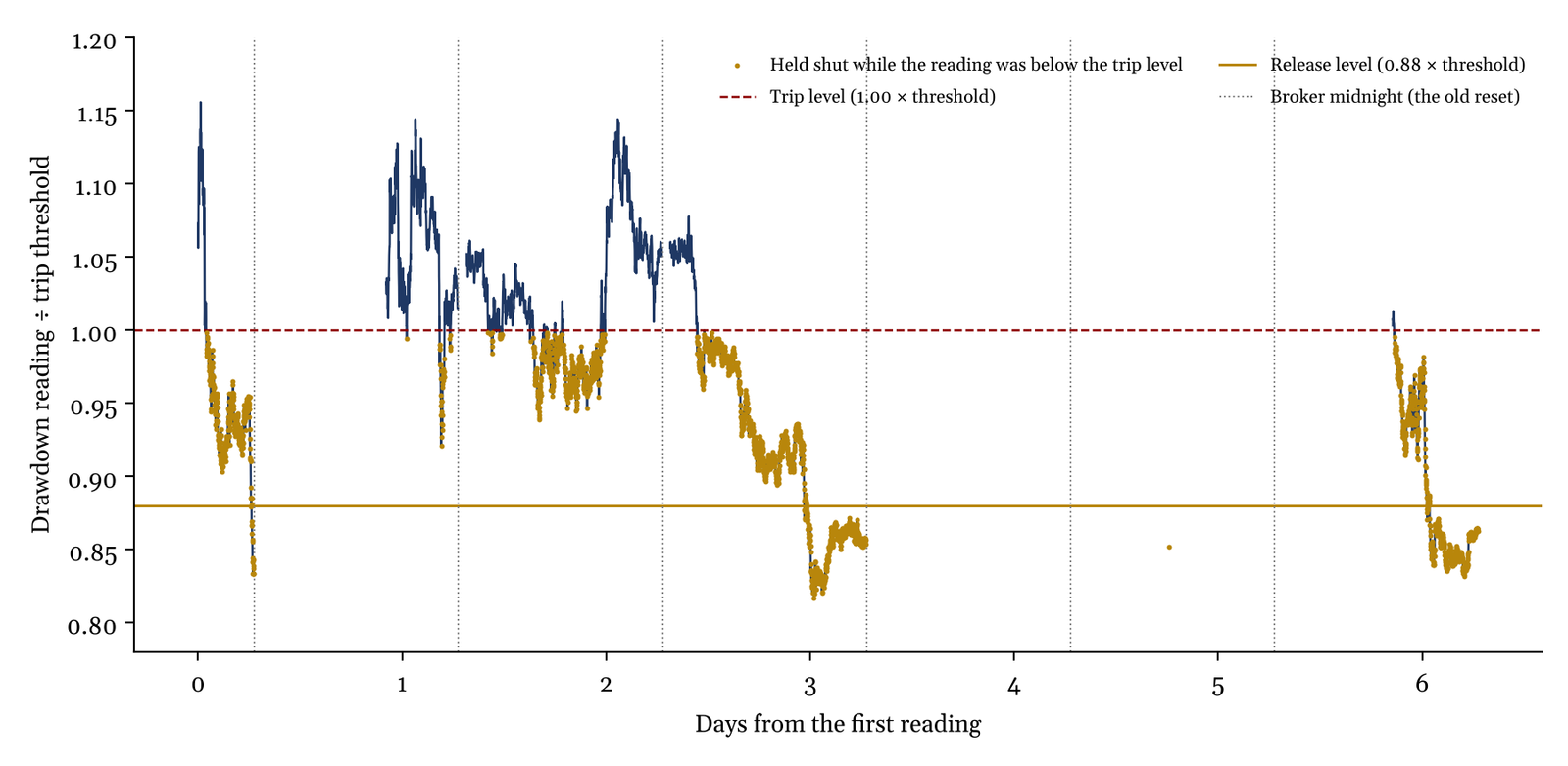
The drawdown reading divided by its trip threshold (navy), marked in gold wherever the circuit was held shut while the reading stood below the trip level. The dashed line is the trip level; the solid gold line the release level of 0.88; the dotted lines the broker midnights at which the old circuit cleared regardless of the reading. Derived from the circuit’s block lines in the journal. Figures altered for the case.
III. The Argument
First proposition: a protector keyed on time protects nothing that time does not cause
A safety mechanism is defined by the danger it watches. The drawdown circuit watches a loss, and a loss is changed by prices, by closes and by capital, never by the calendar. A rule that releases it at midnight is therefore a rule about something the circuit does not measure, and it will be wrong in both directions as often as the loss and the clock disagree, which, for a loss measured in weeks and a clock measured in days, is most of the time. [I] The house has applied this principle before to closing positions: no position is closed because time has passed, except where a venue imposes a time it cannot control. The circuit is the same principle applied to opening them. [I]
Second proposition: the door must close at one level and open at another
Any switch driven by a noisy reading needs two thresholds, one to close and a lower one to open, or it will chatter at the boundary. Engineers have built switches this way since the trigger circuits of the 1930s, and the reason is the one Table 1 shows: with a single level the circuit re-trips within minutes of most of its releases. [D] The gap between the two levels is not a margin of comfort. It is the distance the reading must travel against the direction of its recovery before the circuit closes again, and its size should be set by how fast the reading moves. [I]
Third proposition: the gap is a property of the reading, and can be measured
The circuit readings behave as a random walk: the spread of their hourly changes is about √60 times that of their minute changes, close to one for seven of the nine series. [D] For a walk without drift there is an exact result, the reflection principle: the chance that the reading rises by a distance g within a time T is twice the chance that it ends above that distance, 2(1 − Φ(g / σ√T)). [D] The fastest reading in the data, a futures class, moves 0.0069 of its threshold per root-minute; the next, 0.0058; the portfolio circuits, 0.002 to 0.005. [D] On the fastest reading a release at 0.90 is re-crossed within an hour about 5.9 per cent of the time; at 0.88, about 2.3 per cent, roughly one time in forty-four. [D] On the second-fastest the figure at 0.88 is 0.7 per cent. [D] Pooled across all the readings, the largest rise within an hour exceeds 0.08 of the threshold only one time in twenty, consistent with the walk. [D]
That fixes the release fraction at 0.88: the largest fraction that passes both tests, showing no re-trip inside fifteen hours in the replay and giving a one-in-forty guard over one hour on every reading the fleet produced. [D] The margin over the one-in-twenty line at 0.90 is deliberate. The replay holds the open book fixed after a release; in operation the machine will begin to give birth in the reopened class at once, and every birth adds exposure to the very reading being guarded. [I]
A circuit should open when the danger has passed, not when the day has.
Fourth proposition: the new rule is stricter where the old one was lax, and costs nothing where it was right
For a deep circuit, one whose reading has stood far above its threshold for days, the change is only that the nightly opening disappears; such a circuit was going to close again within minutes anyway. The deep circuits in the data never fell below 1.3 times their threshold. [W] For a shallow circuit, one whose reading oscillates near its threshold, the change is real and it runs the strict way: under the clock such a circuit reopened every midnight if its reading stood anywhere below 1.00; it now waits for 0.88. [D] The house accepts that price. A book whose loss hovers at its limit is the book the limit exists for, and an opening it has not earned by recovering is an opening the calendar gave it. [I]
On the futures book of the case the class now reopens at 0.88 of its threshold, which asks for about 40 per cent more recovery than the bare threshold would ask. [D]
IV. What Would Falsify This Reading
The flap test. On the fastest readings, a released circuit should close again within an hour of its release no more than about one time in forty. If released circuits re-trip within the hour materially more often, either the readings are not the random walk the third proposition assumes or the births that follow a release move them faster than the replay could see, and the fraction must be measured again. [I]
The birth effect. The replay held the open book fixed after each release. If circuits released in operation re-trip within a day at a rate well above the replay’s, the cause will be the births that follow the release, and the gap must be widened to account for them. [I]
The clock test. After the change, no circuit should clear at broker midnight and no class in breach should admit a birth at any hour. A single birth in a class whose reading stands above its threshold falsifies the implementation, whatever the paper says. [I]
The cost test. The fourth proposition predicts that shallow portfolio circuits will now spend longer closed. If that extra time is followed by recoveries the circuit would have allowed the book to profit from, and by no deterioration it would have prevented, over enough cases to be read, the strictness has a price that should be stated in money and weighed again. [I]
V. The Case
The case is the drawdown circuits of six books run by one governed portfolio controller over nine days in which nine circuits tripped: two class circuits on futures books, five portfolio circuits, and two class circuits on a multi-asset book. Every reading is the circuit’s own journal line. [W]
Table 2. The nine circuits
| Circuit | Minutes read | Lowest and highest reading (× threshold) | Movement per root-minute (× threshold) |
|---|---|---|---|
| Futures book A, class | about 3,900 | 1.3 to 1.9 | 0.0058 |
| Futures book A, portfolio | about 4,200 | 0.8 to 1.2 | 0.0054 |
| Futures book B, class | about 1,800 | 1.6 to 2.0 | 0.0069 |
| Multi-asset book, portfolio | about 2,100 | 0.9 to 1.0 | 0.0017 |
| Multi-asset book, class 1 | about 450 | 1.9 to 2.1 | 0.0050 |
| Multi-asset book, class 2 | about 110 | about 1.0 | 0.0019 |
| Small book C, portfolio | about 840 | 0.9 to 1.0 | 0.0021 |
| Small book D, portfolio | about 1,300 | 0.9 to 1.0 | 0.0020 |
| Mixed book E, portfolio | about 1,300 | 0.9 to 1.0 | 0.0020 |
Witnessed readings; movement derived as the standard deviation of minute-to-minute changes. Figures altered for the case.
References
Feller, W. (1971). An Introduction to Probability Theory and Its Applications, Vol. II, 2nd ed. New York: Wiley. The reflection principle for the maximum of a driftless walk.
Schmitt, O. H. (1938). A thermionic trigger. Journal of Scientific Instruments, 15(1), 24–26. The switch with separate closing and opening thresholds.
Dr. Glen Brown (2026). A Deposit Is Not a Recovery. The Machine Readings, Paper IV. Public Doctrine Series.
Next in The Machine Readings
A Rebate Is Not a Deposit: Paper VI, on why income booked as capital is as wrong as capital booked as income, and why a classification error is measured by what it triggers.
Earlier in The Machine Readings
The Seven-Day Horizon: Paper I, on why a ledger reports its successes in hours and its failures in weeks.
The Occupied Book: Paper II, on the Fair Walk Triad and why edge must be priced by the day.
Scheduled Gaps: Paper III, on why a known event kills the positions born a week or two before it.
A Deposit Is Not a Recovery: Paper IV, on why every return must be read against the capital of its own moment.
Download the PDF
About the Author
Dr. Glen Brown is President & CEO of Global Financial Engineering, Inc. and Global Accountancy Institute, Inc. He is the architect of the GCPIAUT framework and the broader GATS-native proprietary capital doctrine. His work focuses on sovereign capital governance, algorithmic trading architecture, reserve-first compounding systems, and institutional financial engineering within closed proprietary environments.
Business Model Clarification
Global Financial Engineering, Inc. and Global Accountancy Institute, Inc. operate as closed-loop proprietary institutions. They do not offer public investment products through the doctrines described herein, do not invite retail participation into their proprietary capital architecture, and do not present the GCPIAUT framework as a public collective investment scheme. The concepts discussed in this article are part of the firms’ internal intellectual and operating doctrine.
Risk Disclaimer
Trading and investment activity across foreign exchange, equities, futures, commodities, and digital assets involves substantial risk. Market conditions may change rapidly, and losses may occur. This article is provided for intellectual, institutional, and educational discussion only and does not constitute investment advice, an offer, a solicitation, or a recommendation to buy or sell any financial instrument or to participate in any investment structure.