The Instruments of Capital · Paper VIII
Options
A right without a duty. What the buyer of an option pays for, what the seller is paid for, and why a stop is not one.
Dr. Glen Brown · Global Financial Engineering, Inc. · Global Accountancy Institute, Inc. · 14 November 2026 · GFE-PUB-IOC-20261114-F
About this series
The Instruments of Capital is a sub-series of the Public Doctrine Series. It sets out, one class at a time, every kind of asset a proprietary firm could trade, whether or not the firm trades it today. Each paper puts its subject through the six questions set in Paper I: claim, structure, return, carry, ending and risk unit. The case in Section VIII is an illustration built from operating data. Its figures have been altered and it reports no account’s results.
I. The right to choose later
Aristotle tells of the philosopher Thales, who foresaw a large olive harvest and, months ahead, paid the owners of the presses of Miletus and Chios a small sum for the right to use them at the season. When the harvest came he let the presses at whatever rate he pleased. Had the harvest failed he would have lost his deposits and nothing more. The story is twenty-five centuries old and contains the whole of the instrument: a payment now, a right later, and no obligation to use it.
For most of their history options were private bargains, each one different and none easily sold on. On 26 April 1973 an exchange opened in Chicago to trade standard call options on sixteen shares. A few weeks later Fischer Black and Myron Scholes published a formula for what such an option should cost. The exchange supplied a market and the formula supplied a price that strangers could agree on, and the two together made options into an instrument that could be traded in volume.
The volume is now greater than that of any other listed instrument. In the first nine months of 2026 some 82.9 billion option contracts were traded on the world’s exchanges, against 29.2 billion futures. More and more of that trading is in contracts with very little life left. In July 2026 options on the leading American share index that expired on the day they were traded made up 66 per cent of all trading in options on that index.
Paper VII described a contract that binds both sides. This paper describes the contract that binds only one.
The buyer of an option pays for the right to be wrong at a known cost. The seller is paid for accepting the loss the buyer has declined.
II. The claim
An option is a contract giving its holder the right, and not the obligation, to buy or to sell a stated quantity of something at a stated price, on or before a stated date. The right to buy is a call and the right to sell is a put. The stated price is the strike, and the sum the buyer pays for the right is the premium.
The claim is unequal by design. The buyer has paid in full and owes nothing further, whatever happens. The seller, called the writer, has been paid and now owes performance if the buyer demands it. All the obligation in the contract sits on one side.
Table 1. The four basic positions
| Position | Premium | Gains when | Most that can be lost |
|---|---|---|---|
| Buy a call | Paid | The price rises above the strike by more than the premium | The premium |
| Buy a put | Paid | The price falls below the strike by more than the premium | The premium |
| Write a call | Received | The price stays below the strike plus the premium | Without limit, unless the asset is already owned |
| Write a put | Received | The price stays above the strike less the premium | The strike less the premium, on every unit |
Every option position, however elaborate, is a combination of these four and a holding of the underlying asset.
For an option listed on an exchange, the buyer’s claim is on the clearing house, which collects margin from writers and from no one else, since the buyer has nothing left to pay. For an option agreed privately, the claim is on the writer. As in every earlier paper, who stands behind the promise is part of what is being bought.
III. The structure
A share has one price. An option on that share is not one instrument but a grid of them, a separate contract for every combination of strike and expiry date, calls and puts, each with its own price. A heavily traded share may have several thousand listed options at once. The first decision in trading options is which contract, and it has no counterpart in the instruments described so far.
Three further terms matter. An option may be exercisable at any time up to expiry or only at expiry; the two kinds are called American and European for historical reasons that have nothing to do with where they trade. It may be settled by delivery of the asset or in cash. And each contract covers a fixed quantity, one hundred shares in the case of American share options, so that a premium quoted at three dollars costs three hundred.
The prices across the grid are not independent. A call, a put with the same strike and date, and the asset itself are tied by an identity: owning the call and writing the put is the same position as owning the asset with the purchase price deferred. Any departure from it can be captured without risk, and it holds closely in every liquid market.
IV. The return
The insight of Black, Scholes and Merton was that an option can be imitated. A holding of the underlying asset, adjusted continuously as the price moves, will reproduce the option’s payoff exactly, provided the price moves smoothly and the adjustment can always be made. The option must then cost what the imitation costs. Remarkably, that cost does not depend on whether the asset is expected to rise or fall. It depends on how much the asset moves, which is to say on its volatility.
The consequence governs everything about the class. The buyer of an option is buying movement. A call bought and hedged makes money if the asset moves more than the price of the option assumed, and loses if it moves less, whichever way the movement goes. The volatility assumed by an option’s price is called implied volatility, and it is the only term in the formula that cannot be looked up. An option’s price is, in effect, a quotation of volatility.
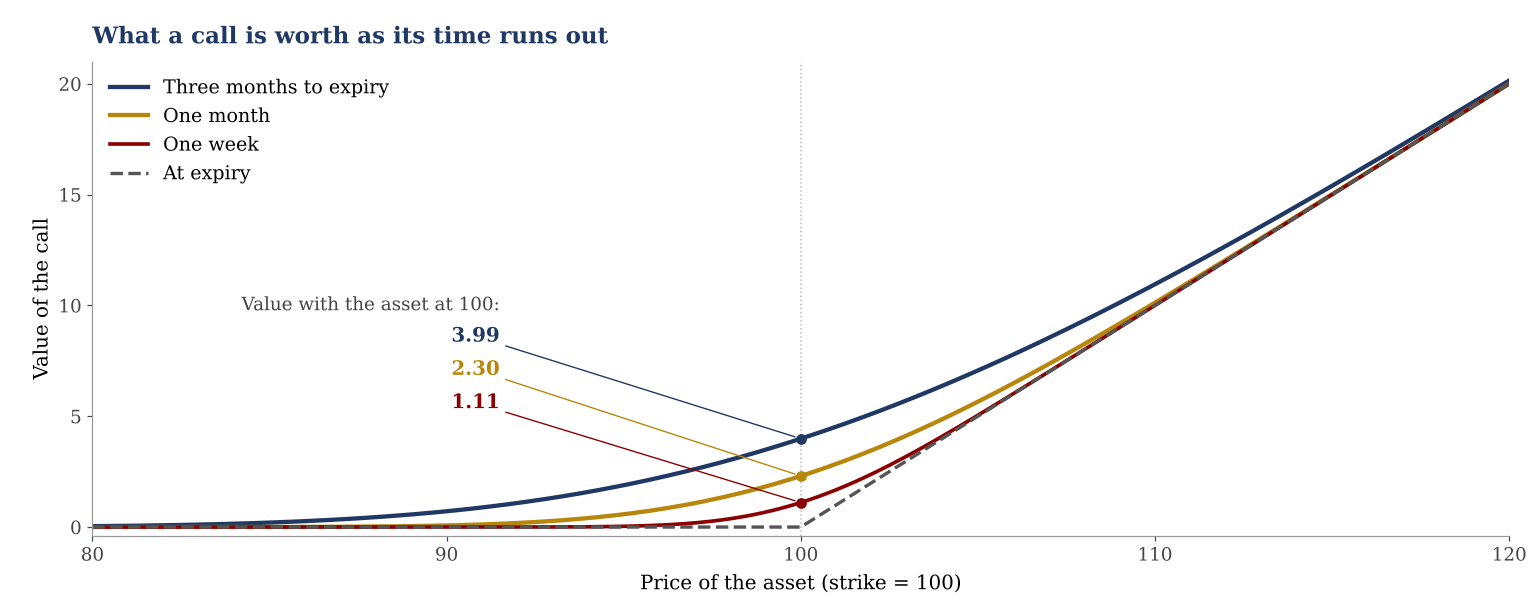
Figure 1. Illustration. The value of a call option with a strike of 100 on an asset with volatility of 20 per cent a year, at three months, one month and one week before expiry and at expiry, by the Black-Scholes formula with interest at zero. With the asset at 100 the option is worth 3.99, 2.30, 1.11 and nothing. Calculated; no market data.
Whether buying options has paid is an empirical matter, and the answer has been fairly consistent. Implied volatility has on average stood above the volatility that followed, so that buyers have on average overpaid and writers have collected the difference. Coval and Shumway found that positions designed to profit from movement alone in American index options lost about three per cent a week between 1990 and 1995. Carr and Wu measured the gap across indices and individual shares and found it large for indices. The usual reading is that options are insurance, that insurance is worth more than its expected payout to those who need it, and that writers are paid for bearing losses that arrive together and at the worst times.
That reading has a history. Before October 1987 options at different strikes on the American index were priced at much the same implied volatility. After it, puts far below the market came to cost a good deal more than the formula implied, and have done so since. The market had learned that prices do not always move smoothly, and it began to charge for the days when they do not.
V. The carry
An option loses value as time passes. Figure 1 shows it: with the asset unmoved at 100, the call is worth 3.99 with three months to run, 2.30 with one month, 1.11 with a week, and nothing at expiry. This erosion is the buyer’s carry, and it is always negative. It also accelerates. More is lost in the last week than in the first month.
What the buyer receives in return is the curvature visible in the same figure. The option gains more from a rise than it loses from an equal fall, and the buyer therefore profits from movement in either direction once the position is hedged. The buyer pays in time and is paid in movement, and the writer has the reverse. The implied volatility is the rate at which the two are exchanged.
Paper VI described leveraged funds that pay a hidden cost in volatility. The option buyer is in the opposite position: volatility is what the buyer is paid in, and the cost is charged by the calendar. Anyone holding an option should know how much it loses each day if nothing happens, as a bondholder knows the coupon.
VI. The ending
Every option has an expiry date, and what happens there is simple. An option whose strike is worse than the market price expires worthless. One whose strike is better is worth exactly the difference. All the value that came from time and from the possibility of movement is gone, and the grid of prices collapses onto a single broken line.
The approach to that date is the least stable period of an option’s life. Near expiry and near the strike, a small move in the asset turns an option from worthless to valuable or back, and anyone hedging it must trade the asset in size and in a hurry. The growth of options that expire on the day they are traded has made this a daily condition and not a monthly one.
The ending that matters most in the history of the class was not the expiry of any contract. By 1987 between sixty and ninety billion dollars of American share portfolios were being run under a technique called portfolio insurance, which did not buy put options but imitated them, selling index futures as the market fell in the manner the formula prescribes. On 19 October the index fell by more than a fifth in a day. The selling that the technique required could not be done at the prices it assumed, and the imitation failed precisely when the real thing would have paid. The official inquiry gave the technique a prominent place among the causes of the fall.
The writer’s ending is of a different kind. A writer collects small premiums for long periods and then meets a single move large enough to return all of them. The record of the class includes many funds that reported years of steady income from writing options and closed within days. The income was real, and so was the liability it had been paid for.
VII. The risk unit
For the buyer the risk unit is the simplest in the series. The most that can be lost is the premium, it is known on the day of purchase, and no gap in the market or failure to trade can increase it. No other instrument offers a maximum loss that is a term of the contract.
For any other purpose an option has no single risk unit, and the practice of the market is to describe it by several numbers. The first, delta, is the holding of the underlying asset to which the option is presently equivalent. The second, gamma, is the rate at which that equivalence changes as the price moves. The third, vega, is the sensitivity of the option’s value to a change in implied volatility, and the fourth, theta, is the carry described above. A position may have no exposure by the first measure and a large one by the others.
The difficulty for a book that sizes positions by volatility is that an option’s exposure does not stay where it was put. A call far above the market is equivalent to a small holding of the asset. If the market rises to the strike it becomes equivalent to a large one. The position has grown without a trade. A sizing rule that measures the position once, at entry, has measured something that no longer exists.
For the writer the true risk unit is none of these numbers. It is the loss in the worst plausible move, and the difficulty is that the worst move in the available data is always smaller than the one that eventually arrives.
Table 2. The six questions answered for options
| Question | Answer |
|---|---|
| Claim | A right without a duty for the buyer, who has paid in full; a duty without a right for the writer, who has been paid. On a clearing house if listed, on the writer if not |
| Structure | A grid of contracts by strike, date and type on each underlying asset; exercise at or before expiry; calls, puts and the asset tied by an identity |
| Return | Paid in movement: the buyer gains when the asset moves more than the price assumed. On average the price has assumed more than occurred, and writers have collected the difference |
| Carry | Always negative for the buyer and accelerating towards expiry; the mirror for the writer |
| Ending | Expiry, at which only the difference between strike and price remains. For the writer, the single move that returns the premiums |
| Risk unit | The premium, for a buyer who holds to expiry, fixed by contract. Otherwise several numbers that change as the price moves. For the writer, the worst case |
The answers hold for options on shares, indices, currencies, bonds, futures and commodities. They differ chiefly in whether exercise delivers the asset, a future or cash.
VIII. The case
The following illustration is drawn from books that held no options. The paper states this plainly, since the series covers every class a firm could trade and not only those it does. What the books did hold was the arrangement most often described as a substitute for an option, and the case concerns the difference.
Every position in these books was opened with a protective stop: an instruction to the venue to close the position if the price reached a stated level. The position was sized so that a close at that level would cost a fixed fraction of capital. Once the position had gained by a set amount, the stop was moved to the entry price and afterwards trailed behind the market. On paper the result has the shape of a bought call. The loss is limited to a known sum, the gain is open, and nothing has been paid for the privilege.
The third statement is the one to examine. On one morning, shortly after a share’s exchange had opened, a book sent the instruction to move the stop on a position in that share. The venue refused it, reporting that it had no price to act on. The book sent the instruction again on its next cycle and was refused again, seven times in about three minutes. No further refusal was recorded after the seventh. On other days the same refusal met stop instructions on currency positions in the minute following the venue’s daily break. In each instance the price was moving and the stop could not be changed.
Nothing was lost on those occasions. They show what the stop is. A put option’s floor is a term of a contract, and it holds whether or not there is a market at the moment it is needed. A stop’s floor is an instruction that takes effect only when the venue is quoting and only at the price then available. If the market opens beyond the level, the position is closed where the market is, and the loss is whatever that turns out to be. The books had long treated that possibility as an accepted hazard. The mornings in question showed it on a small scale. The stop already resting at the venue was not removed, but for an interval measured in minutes it could not be moved, and a venue with no price to act on can no more execute a stop than amend one. For that interval the protection was a request and not a right.
The cost of the arrangement can now be stated. The holder of a call pays a premium in advance and is then certain of the floor. The holder of a stopped position pays nothing in advance and pays afterwards in two ways: in positions closed by a passing move that then reverses, each one a small premium paid at the worst price of the move, and in the rare gap that carries the loss beyond the level. This is the arrangement that failed on the largest scale in October 1987. Carr and Jarrow showed in 1990 that the apparent free lunch in a stop-and-re-enter strategy disappears once the cost of each crossing is counted.
The books’ response was not to pretend the stop was a contract. A rule was added under which a refusal of that kind suspends every further instruction on the instrument until the venue has published a new price, so that the book stops repeating a request the venue cannot hear. The floor remains what it was: a level the book intends to act at, dependent on a market being there.
The lesson is the first question of Paper I turned on a position that is not an instrument at all. A stop is not a claim on anyone. An option is. The two have the same diagram and are different things, and the difference is exactly what the option’s premium buys.
IX. What would falsify this reading
The claim that option buyers have on average overpaid rests on index options in developed markets over a few decades, a period containing a limited number of severe falls. It is a statement about an average and is compatible with long periods in which buyers are well rewarded. It would be overturned by evidence that, over a span including several crises, implied volatility had not exceeded what followed.
The claim that an option can be imitated holds only as far as the price moves without gaps and the hedge can be traded. The paper has argued from 1987 that this fails when it matters. A reader may fairly answer that markets, clearing and circuit-breakers have changed since, and that one event is a thin basis. The persistence of the higher price of protective puts since that date is the market’s own evidence on the point.
The case reports minutes in which a stop could not be moved and no loss resulted. It illustrates the difference between a stop and an option; it does not measure it. The measurement would be the full record of what stopped positions cost in reversals and gaps against what the equivalent options would have cost in premium, and the paper has not made it.
An option is the simplest contract whose value depends on volatility. The next paper turns to the contracts agreed privately between two parties, of which the swap is the chief.
References
Black, F. and Scholes, M. (1973). The pricing of options and corporate liabilities. Journal of Political Economy 81(3), 637–654.
Carr, P. and Jarrow, R. (1990). The stop-loss start-gain paradox and option valuation: a new decomposition into intrinsic and time value. Review of Financial Studies 3(3), 469–492.
Carr, P. and Wu, L. (2009). Variance risk premiums. Review of Financial Studies 22(3), 1311–1341.
Cboe Global Markets (2026). Cboe Global Markets Reports Trading Volume for July 2026. 5 August 2026.
Coval, J. D. and Shumway, T. (2001). Expected option returns. Journal of Finance 56(3), 983–1009.
Dr. Glen Brown (2026). What an Asset Class Is; Indices, Funds and Exchange-Traded Products; Futures and Forwards. The Instruments of Capital, Papers I, VI and VII. Public Doctrine Series.
FIA (2026). Trends in ETD Trading, Q3 2026: global options and futures volume, January to September 2026.
Merton, R. C. (1973). Theory of rational option pricing. Bell Journal of Economics and Management Science 4(1), 141–183.
Presidential Task Force on Market Mechanisms (1988). Report of the Presidential Task Force on Market Mechanisms. Washington: U.S. Government Printing Office.
Rubinstein, M. (1994). Implied binomial trees. Journal of Finance 49(3), 771–818.
Related in the Public Doctrine Series
What an Asset Class Is: The Instruments of Capital, Paper I, which sets the six questions and names the contract as the sixth kind of claim.
Futures and Forwards: The Instruments of Capital, Paper VII, on the contract that binds both sides.
Indices, Funds and Exchange-Traded Products: The Instruments of Capital, Paper VI, where leveraged funds pay a hidden cost in volatility.
Download the PDF
About the Author
Dr. Glen Brown is President & CEO of Global Financial Engineering, Inc. and Global Accountancy Institute, Inc. He is the architect of the GCPIAUT framework and the broader GATS-native proprietary capital doctrine. His work focuses on sovereign capital governance, algorithmic trading architecture, reserve-first compounding systems, and institutional financial engineering within closed proprietary environments.
Business Model Clarification
Global Financial Engineering, Inc. and Global Accountancy Institute, Inc. operate as closed-loop proprietary institutions. They do not offer public investment products through the doctrines described herein, do not invite retail participation into their proprietary capital architecture, and do not present the GCPIAUT framework as a public collective investment scheme. The concepts discussed in this article are part of the firms’ internal intellectual and operating doctrine.
Risk Disclaimer
Trading and investment activity across foreign exchange, equities, futures, commodities, and digital assets involves substantial risk. Market conditions may change rapidly, and losses may occur. This article is provided for intellectual, institutional, and educational discussion only and does not constitute investment advice, an offer, a solicitation, or a recommendation to buy or sell any financial instrument or to participate in any investment structure.