The Machine Readings · Paper VI
A sub-series of the Public Doctrine Series
A Rebate Is Not a Deposit
How a two-cent cashback, filed by the broker beside the owner’s deposits, re-based a book’s capital twenty times in two days, and why a classification error is measured by what it triggers rather than by what it costs
Dr. Glen Brown · President & CEO, Global Financial Engineering, Inc. and Global Accountancy Institute, Inc.
GFE-PUB-MR-20261028-F-CS · 28 October 2026
How to read this paper. The Machine Readings reason from a trading machine’s own records rather than from commentary on markets. Every claim of fact carries one of three marks. [W] Witnessed: read directly from a ledger or journal the machine wrote, or from the broker’s statement. [D] Derived: computed from witnessed figures by a method this paper gives. [I] Inferred: an interpretation the evidence supports but does not compel. A sentence without a mark is argument, not evidence.
About the case. The case in this paper is an illustration built from operating data. Figures have been altered so that no account, venue or period can be identified, and nothing here reports the results of any account. Capital is expressed as a share of the book rather than in money. The reasoning is unaltered.
I. The Reading
Over two days in one week the machine running the book recorded 20 deposits of capital, each of a few hundredths of a currency unit. [W] Nobody had deposited anything of the kind. The broker’s statement explains them. Each is a balance entry whose comment is an abbreviation of the word cashback followed by the number of another deal, and every one of the 23 in the statement refers to the closing deal of a currency trade of the smallest size. [W] They are a cashback: a rebate the broker pays on each trade, earned by trading and paid because of it. [I]
The money is trivial: less than a fiftieth of one per cent of the book over three days. [D] What the machine did with it is not. Each rebate entered the capital ledger as new capital, and the capital ledger is not an archive. It advanced the register of capital events, re-based the capital on which the book’s tier is resolved, wrote a row in the register of capital doses, lifted the high-water mark against which recovery is measured, and entered the drawdown circuit’s record of the day’s capital. [W] A two-cent rebate was, for each of these purposes, indistinguishable from a deposit by the owner.
Paper IV of this series, A Deposit Is Not a Recovery, argued that a deposit is not a recovery: that capital and trading must be kept in separate ledgers, because the first changes what a book owns and the second is what it has done. This paper is about the other side of the same line. Income that is booked as capital is as wrong as capital that is booked as income, and it is wrong in a way that is harder to see, because it is small, frequent and filed by the broker in the same drawer as the deposits.
II. The Mechanism
The broker’s drawer and the economic nature
A trading platform sorts every movement of money into a small number of types: trades, commissions, swaps, and a type for everything that is not a trade, the balance entry. Deposits and withdrawals are balance entries. So, at the broker’s discretion, are rebates, cashbacks, dividend adjustments, corrections and compensations. [W] The machine’s capital scan classified by type alone: every balance entry was capital, and a positive one was a deposit. [W] The type records which drawer the broker used. It does not record what the money is. [I]
What a capital event sets in motion
In a governed book, capital is not merely counted; it decides things. In the case, a capital event re-bases the capital on which the book’s tier is resolved to the equity of that moment, and the tier fixes the book’s risk scale, its commitment ceiling, its admission allowance and its drawdown threshold. [W] The design intends the tier base to move when the owner moves capital and at no other time. Between the owner’s capital events it is meant to be still. [I]
Figure 1 shows what the rebates did to it. Over the two days the tier base was re-based 20 times by cashback and once by real capital. [W] Each cashback re-marked it to the equity of its moment, so that it followed equity up and down by about 2.4 per cent of the book with no capital moving at all. [D] Only the last step, the deposit of about 7 per cent of the book, was the kind of event the base exists to record. [W]
Figure 1. The capital base that sets the book’s tier, re-based by rebates
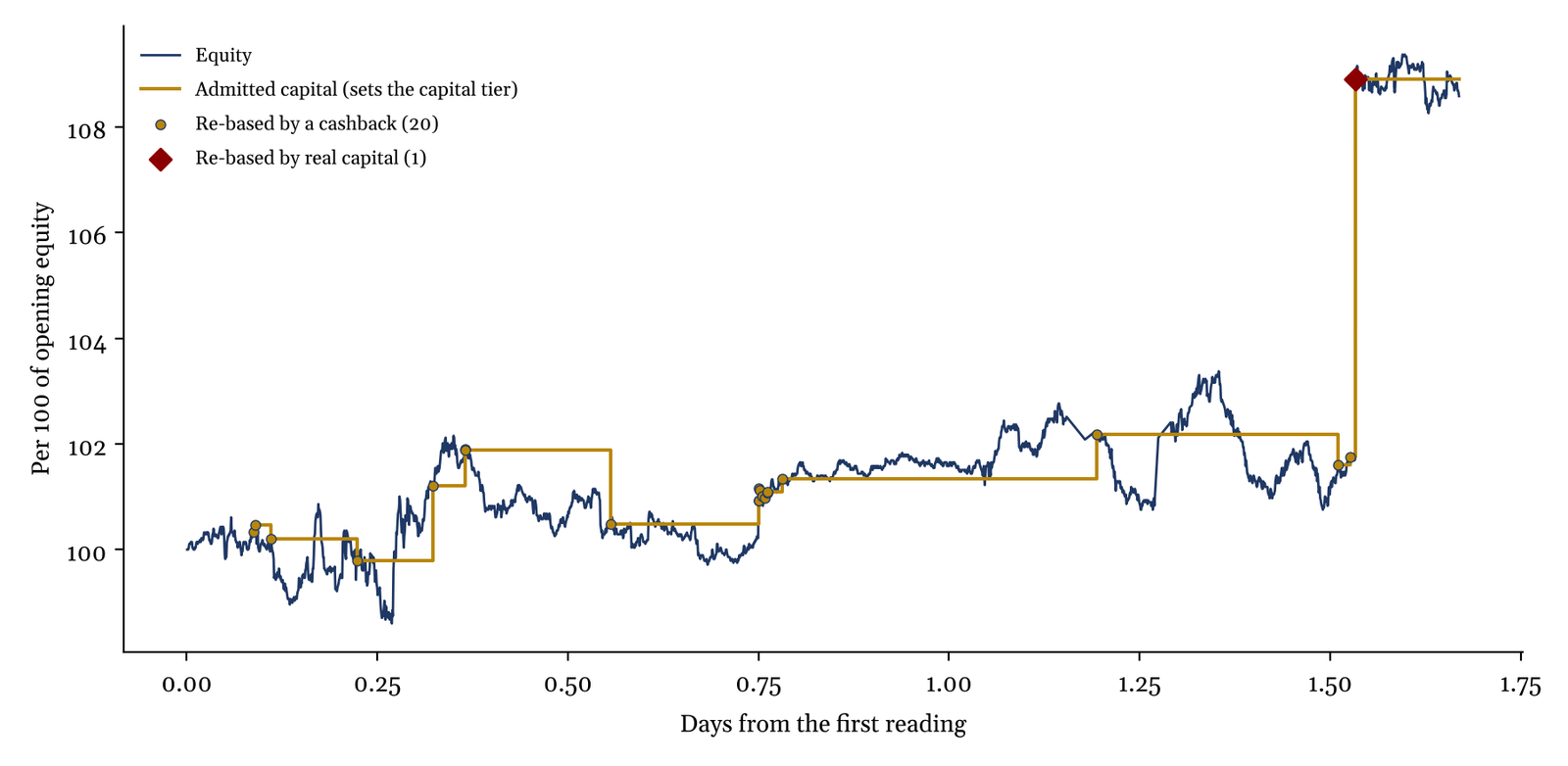
Equity (navy) and admitted capital (gold steps) over two days. Each gold dot is a re-basing triggered by a cashback; the red diamond is the one re-basing triggered by a real deposit. Derived from the capital-registry lines and the gauge in the journal. Figures altered for the case.
Two readers, two rules
The machine did contain the right rule, in one place. Its gauge, which reports return net of capital, already excluded balance entries whose comments named dividends, rebates, cashback or swap. [W] But the test matched whole spellings, and the broker abbreviated: its comment contained none of them. [W] So the gauge, too, counted the rebates as capital, and the capital scan, which decided the tier, had never asked the question at all. [D] The house had one principle and two implementations of it, and neither implementation was faithful to the principle. [I]
III. The Argument
First proposition: money is classified by its cause, not by its drawer
Paper IV held that capital is known by its deal and not by its effect on the balance. The rebate takes the argument one step further: the deal itself must be read for its cause, because the type the broker assigns is a filing decision, not an economic one. Accounting has drawn the same line for a long time. Income is an increase in what an entity owns that does not come from its owners’ contributions; capital is what the owners contribute. A rebate on trading is caused by trading and is income however it is filed. [I] The performance standards that investment firms follow draw the line in the same place: an external cash flow is money that enters or leaves a portfolio from outside it, and money the portfolio earns is return, not flow. [I]
Second proposition: one question must have one answer
When two parts of a system answer the same question, they will eventually answer it differently, and the system will keep two sets of books without anyone deciding that it should. The rebate exposed exactly that: a reader of return that had the rule and misapplied it, and a reader of capital that had no rule at all. [D] The remedy is not a better rule in each place but one classifier in one place, asked by every reader. [I] The correction does precisely that: a single test of whether a balance entry is a trading-side cash adjustment now serves the capital scan, its replay, the observatory’s capital readers and both of the gauge’s readers. [W]
A rebate is caused by trading. However the broker files it, it is not the owner’s money arriving.
Third proposition: materiality is not the test of a classification error
The usual defence of a small misclassification is that it is small. That defence fails here, because the consequence of a classification is set by what the classification triggers, not by the amount classified. [I] A rebate of a few hundredths of a currency unit re-based the capital on which the whole book’s risk scale, commitment ceiling and drawdown threshold are resolved. [W] In the case the tier did not change, because the next tier boundary stood at nearly four times the book. [W] On a book whose equity sits near a boundary, a rebate would re-mark the tier on a day the owner did nothing, in either direction, according to whether equity happened to be up or down at the moment of the trade. [D] The error is measured by its leverage over the system, and its leverage here was total.
Fourth proposition: the venue writes the vocabulary, so the reconciliation must read it
No list of words can anticipate every broker’s abbreviation. The rebate was missed not because the rule was wrong but because the broker spelled the word differently from the rule. [W] The defence against that is not a longer list; it is the reconciliation. Every capital event the machine records must match, one for one, a deposit or withdrawal on the broker’s statement, and every statement deposit must appear in the machine’s ledger. [I] It was the statement, read beside the journal, that found this error, and the statement is the only instrument that can find the next one. [I]
IV. What Would Falsify This Reading
The rebate test. After the correction, the next cashback must write no capital event, re-base nothing and add no row to the dose register; it must appear only as a rise in the balance. If a capital event follows a rebate, the classifier is not being asked by every reader. [I]
The reconciliation. Over any period, the machine’s capital events must match the statement’s deposits and withdrawals one for one, in time and amount. A capital event without a statement deposit means income is still being booked as capital; a statement deposit without a capital event means capital is being booked as income. Either falsifies the claim that the line is now drawn correctly. [I]
The reverse error. The classifier treats as income any balance entry whose comment names dividends, rebates, cashback or swap. If an owner’s deposit ever carries such a word in its comment, it will be booked as income, and the house will have made Paper IV’s error in the other direction. The reconciliation will show it, and the rule must then be narrowed. [I]
The base test. Between two real capital events the tier base must not move. If it moves, some event that is not capital is still reaching it. [I]
V. The Case
The case is a small multi-asset book run by a governed portfolio controller over two days, read against the broker’s statement for three days. The capital events and equity are the controller’s own journal lines. [W]
Table 1. The balance entries of the period
| Kind | Count | Size | Booked by the machine as | What it is |
|---|---|---|---|---|
| Cashback on a closing trade | 23 in the statement | a few hundredths | Capital deposit | Income from trading |
| Owner’s deposit | 2 in the statement | about 4 and 7 per cent of the book | Capital deposit | Capital deposit |
Witnessed from the broker’s statement and the controller’s journal. Figures altered for the case.
References
International Accounting Standards Board (2018). Conceptual Framework for Financial Reporting, Chapter 4: income and contributions from holders of equity claims.
CFA Institute (2020). Global Investment Performance Standards (GIPS) for Firms. Glossary: external cash flow.
Dr. Glen Brown (2026). A Deposit Is Not a Recovery. The Machine Readings, Paper IV. Public Doctrine Series.
Earlier in The Machine Readings
The Seven-Day Horizon: Paper I, on why a ledger reports its successes in hours and its failures in weeks.
The Occupied Book: Paper II, on the Fair Walk Triad and why edge must be priced by the day.
Scheduled Gaps: Paper III, on why a known event kills the positions born a week or two before it.
A Deposit Is Not a Recovery: Paper IV, on why every return must be read against the capital of its own moment.
The Clock Is Not a Protector: Paper V, on why a drawdown circuit must be opened by recovery and not by the clock.
Download the PDF
About the Author
Dr. Glen Brown is President & CEO of Global Financial Engineering, Inc. and Global Accountancy Institute, Inc. He is the architect of the GCPIAUT framework and the broader GATS-native proprietary capital doctrine. His work focuses on sovereign capital governance, algorithmic trading architecture, reserve-first compounding systems, and institutional financial engineering within closed proprietary environments.
Business Model Clarification
Global Financial Engineering, Inc. and Global Accountancy Institute, Inc. operate as closed-loop proprietary institutions. They do not offer public investment products through the doctrines described herein, do not invite retail participation into their proprietary capital architecture, and do not present the GCPIAUT framework as a public collective investment scheme. The concepts discussed in this article are part of the firms’ internal intellectual and operating doctrine.
Risk Disclaimer
Trading and investment activity across foreign exchange, equities, futures, commodities, and digital assets involves substantial risk. Market conditions may change rapidly, and losses may occur. This article is provided for intellectual, institutional, and educational discussion only and does not constitute investment advice, an offer, a solicitation, or a recommendation to buy or sell any financial instrument or to participate in any investment structure.