The Instruments of Capital · Paper IV
Credit: Corporate Bonds, Loans and Securitised Debt
Debt that can fail in the ordinary way: what the extra yield pays for, why it is earned quietly and lost suddenly, and why a quiet price is the wrong measure of its risk.
Dr. Glen Brown · Global Financial Engineering, Inc. · Global Accountancy Institute, Inc. · 14 November 2026 · GFE-PUB-IOC-20261114-B
About this series
The Instruments of Capital is a sub-series of the Public Doctrine Series. It sets out, one class at a time, every kind of asset a proprietary firm could trade, whether or not the firm trades it today. Each paper puts its subject through the six questions set in Paper I: claim, structure, return, carry, ending and risk unit. This paper has no case to report. The firm whose records inform the series does not trade credit, and Section VIII says what that absence shows.
I. Three per cent for what
In late October 2026 the bonds of American companies rated below investment grade yielded about 3.2 percentage points more than Treasuries of the same maturity. The bonds of companies rated investment grade yielded 0.88 of a point more. These differences are called credit spreads, and they are the whole subject of this paper, because they are what distinguishes the debt of a borrower that can fail from the debt examined in Paper III.
The arithmetic of the larger figure is instructive. Moody’s put the share of lower-rated borrowers worldwide that had defaulted over the preceding twelve months at 4.3 per cent in the spring of 2026, close to its long-run average of 4.2. A defaulted bond is not worthless; the holder commonly recovers something in the region of forty cents on the dollar. A holder of a broad portfolio of such debt should therefore expect to lose roughly 4.3 per cent of 60 cents, or about 2.6 per cent of the sum invested, in a typical year. Against a spread of 3.2 points that leaves little more than half a point as payment for bearing the risk. The comparison is rough, since the default rate counts borrowers worldwide and the spread is an American bond index, but it shows the order of magnitude. Most of what a lender to weak companies is paid is simply the return of what the lender will lose.
For the stronger companies the arithmetic runs the other way. Investment-grade borrowers default at a small fraction of one per cent a year, so that almost none of their 0.88 points is needed to cover losses. Why that spread exists at all is one of the standing puzzles of the subject, taken up in Section IV.
Credit is paid for quietly, a little each day, and taken back suddenly, in the few years when it is taken back at all.
II. The claim
A corporate bond is the same legal instrument as a government bond: a promise of fixed payments, ranked ahead of the owners. What differs is the promisor. A company cannot print the currency it owes, and when its assets are worth less than its debts the creditors take what there is. Robert Merton gave this its exact form in 1974. If the firm’s assets at the maturity of the debt are worth more than the debt, the creditors are paid in full and the owners keep the rest. If the assets are worth less, the creditors receive the assets and the owners receive nothing. The creditor’s position is therefore a safe bond less a guarantee: the creditor has in effect insured the owners against the firm’s value falling below its debts, and the spread is the premium for that insurance.
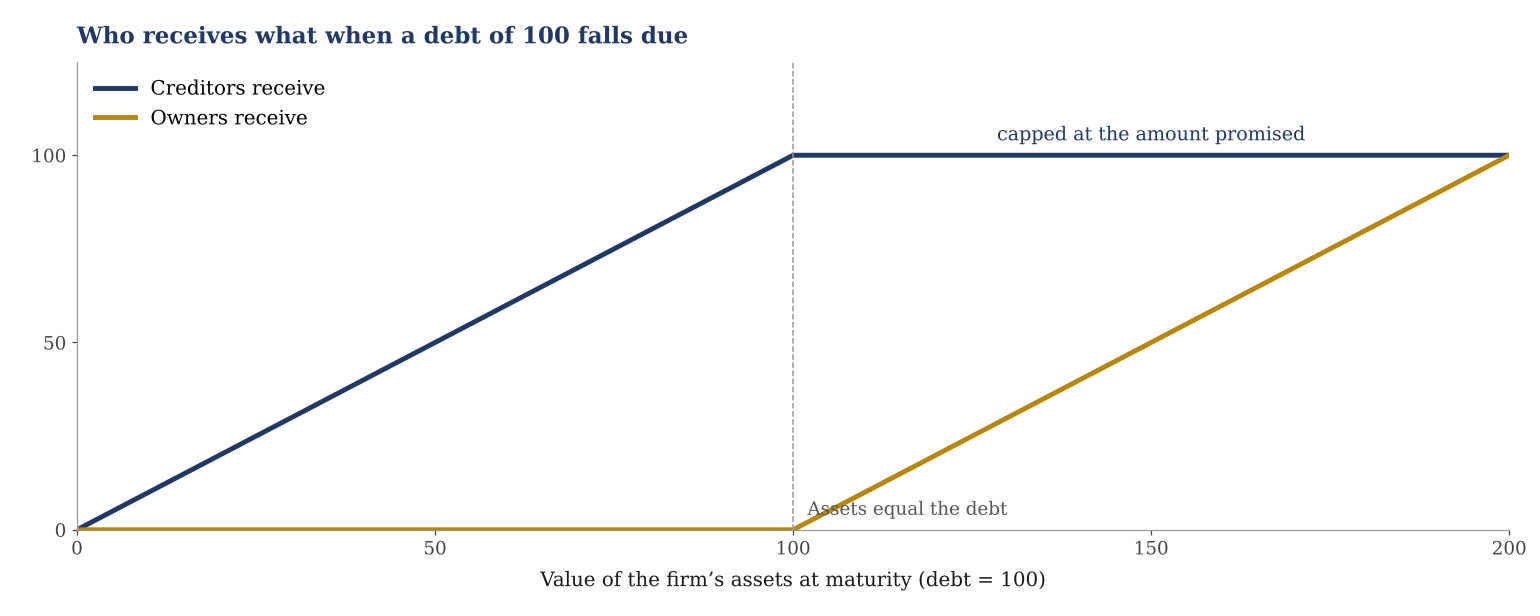
Figure 1. What creditors and owners receive at the maturity of a debt of 100, for each value the firm’s assets might then have. The creditor’s payoff is capped; the owner’s is not. After Merton (1974).
Figure 1 makes plain a property that governs everything else. The creditor’s gain is capped at the amount promised. The creditor’s loss is not capped until the assets are gone. A lender shares in the firm’s failure and not in its success, and no quantity of good news about the borrower can pay the lender more than the coupon.
Within the class the claim varies in three ways. Seniority fixes the order in which creditors are paid, and security gives some creditors a first call on particular assets; both raise what is recovered in default. Covenants are promises by the borrower not to take certain actions, and their strength decides how early a creditor can intervene. Loans, as distinct from bonds, are usually senior and secured and pay a rate that floats with the short-term rate, so that they carry credit risk with almost none of the interest-rate risk of Paper III. A securitisation goes a step further. Loans or bonds are placed in a pool, and claims on the pool’s cash flows are sold in layers, the lowest absorbing the first losses and the highest protected by all those beneath. The holder of a layer has a claim on no borrower in particular, only on what the pool pays after those ranked ahead.
III. The structure
Credit trades among dealers, as government debt does, but with a difference of kind. A government has a handful of benchmark bonds in which most trading occurs. A large company may have dozens of bonds outstanding, each with its own maturity, coupon and terms, and most of them do not trade on a given day. American corporate bonds outstanding stood at $12.1 trillion in mid-2026 and changed hands at a rate of about $67 billion a day, where Treasuries traded some $1.2 trillion a day. The typical corporate bond is held, not traded, and its quoted price is often an estimate.
Three institutions stand between the lender and the borrower. Rating agencies grade issuers, and the line between investment grade and below is written into the mandates of many holders, so that a downgrade across it compels sales irrespective of price. Index providers and the funds that follow them have made a basket of illiquid bonds tradable as a single liquid share, which works until many holders of the share want cash at once. And an increasing part of corporate lending now takes place outside public markets altogether, in loans made and held by funds and never traded. The leveraged loan market in the United States was put at about $1.5 trillion at the end of 2025, and private lending has grown beside it. A loan that does not trade has no market price, which is a different thing from having no risk.
IV. The return
The return on credit is the government yield plus the spread, less whatever is lost to default. Section I showed that for weak borrowers the spread is mostly compensation for expected loss. For strong borrowers it is mostly something else. Edwin Elton and his co-authors found in 2001 that expected default accounted for only a small part of the spread on investment-grade bonds, and Jing-zhi Huang and Ming Huang reached the same conclusion from the Merton model itself: calibrated to actual default experience, it produces spreads well below those observed. The remainder is variously attributed to taxes, to the cost and difficulty of trading, and to a premium for a risk that cannot be diversified.
The last of these follows from the timing of defaults. They do not arrive evenly. In ordinary years few borrowers fail, and in a recession many fail together; the default rate among lower-rated borrowers reached about 13 per cent in late 2009. A portfolio of a thousand bonds is therefore much less diversified than a thousand names suggests, because the event that causes one to fail is the event that causes the others to fail, and it is also the event in which shares fall and incomes shrink. An asset that loses when everything else is losing must pay more than its average loss, and credit does.
The shape of the return follows. In most months a credit portfolio earns its spread and nothing happens. In a few months it loses several years of that income at once. The distribution has a long left tail, and a record assembled from the quiet months alone describes an instrument that does not exist.
V. The carry
For the holder of a corporate bond financed at the government rate, the carry is the spread. This is the sense of the remark that credit is a carry instrument: in normal conditions the carry is the return, and price changes are small beside it. The carry is positive as long as the bond is performing and is paid for the same reason as the carry in a high-interest currency described in Paper II, as compensation for an occasional sharp loss. The resemblance is exact enough that the two have tended to fail in the same months.
Spreads also have a term structure. A longer bond from the same issuer usually carries a wider spread, so that an ageing bond rolls down the spread curve as it rolls down the yield curve. For distressed issuers the relation inverts: when default is expected soon, short bonds trade at the widest spreads, because all bonds are then priced on what will be recovered and not on what was promised.
VI. The ending
Credit has more ways of ending than any class so far. A bond may be repaid at maturity. It may be called: most lower-rated bonds give the issuer the right to repay early, and the issuer will use it when its fortunes have improved and it can borrow more cheaply, which is precisely when the holder would prefer to keep the bond. The call takes away the upside that Figure 1 had already capped.
A bond may default, and the ending is then a negotiation or a court process that can last years, at the end of which the holder receives cash, new debt or shares in the reorganised company. Or the bond may be downgraded, and holders whose rules forbid them to own it must sell into a market in which other holders are under the same compulsion.
Securitised debt has an ending of its own. A layer of a pool can be extinguished entirely while the borrowers in the pool are, on average, still paying, because the layer was sized to absorb only a certain level of loss. Joshua Coval, Jakub Jurek and Erik Stafford showed how the highest-rated layers of mortgage securities came to fail after 2007: the ratings depended on an assumption about how far defaults in the pool would move together, small errors in that assumption were magnified by the layering, and the errors all ran in one direction once house prices fell everywhere at once. The instrument was built on the premise that the timing problem of Section IV had been engineered away, and it had only been moved to where it was harder to see.
VII. The risk unit
A corporate bond has two sensitivities and needs two measures. To the government yield it responds through duration, as in Paper III. To its own spread it responds through spread duration, the percentage change in price for a one-point change in spread. Practitioners have found that spreads tend to move in proportion to their level, so that a bond at a spread of four points is about twice as volatile, per year of duration, as one at two. The product of spread duration and spread is accordingly the usual measure of a position’s exposure, following the work of Arik Ben Dor and his colleagues.
That measure describes the ordinary months. It does not describe default, in which the price moves in a single step from near its face value to its recovery value. A second quantity is therefore needed beside the first: the loss if the borrower fails tomorrow, which is the position multiplied by one minus the expected recovery. The first measure is a volatility. The second is a cliff. A book that sizes credit on the first alone has measured the slope of the ground and not the distance to the edge.
Table 1. The six questions answered for credit
| Question | Answer |
|---|---|
| Claim | A fixed promise by a borrower that can fail; in effect a safe bond less a guarantee given to the owners. Seniority, security and covenants decide what is recovered |
| Structure | Dealer market in many thinly traded issues; ratings and index funds shape who must hold and who must sell; a growing share is private and untraded |
| Return | Government yield plus spread, less default losses; the spread exceeds expected loss because defaults cluster in bad times |
| Carry | The spread, earned daily while the borrower performs |
| Ending | Repayment, early call at the issuer’s option, default and recovery, forced sale on downgrade; for a securitised layer, extinction |
| Risk unit | Two measures: spread duration times spread for ordinary movement, and loss on default for the jump |
The answers apply to bonds, loans and securitised layers alike; the three differ mainly in the first and fifth rows.
VIII. The absent class
The firm whose operating records inform this series has never held a corporate bond, a loan or a securitised layer, and this section accordingly reports no case. The absence is itself worth a paragraph, because it follows from the six questions and it carries a warning for any system that might one day admit the class.
The reason for the absence is structure. The systems in question trade instruments that are quoted continuously, can be bought and sold in small standard units, and can be held on margin. Individual corporate bonds meet none of those conditions. Credit can be reached in a form that does, through index funds and through derivative contracts, and the papers on those wrappers will return to it.
The warning concerns the sixth question. A system that sizes every position against the instrument’s typical recent movement will, in most classes, take smaller positions in riskier things. In credit the rule fails in a particular way. A bond approaching default by slow deterioration does grow more volatile, and the rule responds. But the common pattern in strong and middling credits is a long calm ended by a single event, and through the whole of the calm a rule keyed to movement will read the instrument as safe and size it generously. Paper II noted that in foreign exchange the quiet is the reason for the leverage. In credit the quiet is the product being sold. Any admission of the class to a book governed by such a rule would require the second measure of Section VII, the loss on default, to be made a limit in its own right, alongside the measure of movement and not derived from it.
IX. What would falsify this reading
The paper claims that the spread over a full cycle exceeds the losses from default, and that the excess is payment for losses that cluster. The first part fails if, over a period long enough to include a recession, holders of a broad credit portfolio earned less than holders of government debt of the same maturity. That has occurred over particular decades in particular rating bands, and a reader should treat the claim as holding on average and with wide variation. The second part fails if defaults were shown to arrive independently of the state of the economy, in which case diversification across names would remove the risk and the premium would be unexplained.
The paper has treated private lending in a single paragraph, though it is now large, and has said nothing of contracts that transfer credit risk without transferring the debt. The first belongs to the paper on private markets and the second to the paper on swaps.
Paper V crosses the line drawn in Figure 1, from the capped claim of the creditor to the open claim of the owner: equities.
References
Ben Dor, A., Dynkin, L., Hyman, J., Houweling, P., van Leeuwen, E. and Penninga, O. (2007). DTS (Duration Times Spread). Journal of Portfolio Management 33(2), 77–100.
Coval, J., Jurek, J. and Stafford, E. (2009). The economics of structured finance. Journal of Economic Perspectives 23(1), 3–25.
Dr. Glen Brown (2026). Money and Foreign Exchange; Government Debt and the Price of Time. The Instruments of Capital, Papers II and III. Public Doctrine Series.
Elton, E. J., Gruber, M. J., Agrawal, D. and Mann, C. (2001). Explaining the rate spread on corporate bonds. Journal of Finance 56(1), 247–277.
Federal Reserve Bank of St. Louis (2026). ICE BofA US Corporate Index and US High Yield Index option-adjusted spreads, readings for late October 2026. FRED.
Huang, J.-Z. and Huang, M. (2012). How much of the corporate-Treasury yield spread is due to credit risk? Review of Asset Pricing Studies 2(2), 153–202.
Sikich (2026). Leveraged loan market: full-year 2025 review and 2026 outlook.
Merton, R. C. (1974). On the pricing of corporate debt: the risk structure of interest rates. Journal of Finance 29(2), 449–470.
Moody’s Ratings (2026). Trailing twelve-month global speculative-grade default rate, May 2026, as reported by First Trust Advisors, 22 June 2026.
Securities Industry and Financial Markets Association (2026). US Corporate Bonds Statistics; Research Quarterly: Fixed Income, Issuance and Trading, 3Q26.
Related in the Public Doctrine Series
What an Asset Class Is: The Instruments of Capital, Paper I, which sets the six questions used here.
Government Debt and the Price of Time: The Instruments of Capital, Paper III, on the yield to which the credit spread is added.
Money and Foreign Exchange: The Instruments of Capital, Paper II, on the other class whose carry is paid for bearing a crash.
Download the PDF
About the Author
Dr. Glen Brown is President & CEO of Global Financial Engineering, Inc. and Global Accountancy Institute, Inc. He is the architect of the GCPIAUT framework and the broader GATS-native proprietary capital doctrine. His work focuses on sovereign capital governance, algorithmic trading architecture, reserve-first compounding systems, and institutional financial engineering within closed proprietary environments.
Business Model Clarification
Global Financial Engineering, Inc. and Global Accountancy Institute, Inc. operate as closed-loop proprietary institutions. They do not offer public investment products through the doctrines described herein, do not invite retail participation into their proprietary capital architecture, and do not present the GCPIAUT framework as a public collective investment scheme. The concepts discussed in this article are part of the firms’ internal intellectual and operating doctrine.
Risk Disclaimer
Trading and investment activity across foreign exchange, equities, futures, commodities, and digital assets involves substantial risk. Market conditions may change rapidly, and losses may occur. This article is provided for intellectual, institutional, and educational discussion only and does not constitute investment advice, an offer, a solicitation, or a recommendation to buy or sell any financial instrument or to participate in any investment structure.