The Instruments of Capital · Paper VI
Indices, Funds and Exchange-Traded Products
An index is a number that no one can own. What is actually held when the basket is bought, and why two baskets are often one position.
Dr. Glen Brown · Global Financial Engineering, Inc. · Global Accountancy Institute, Inc. · 14 November 2026 · GFE-PUB-IOC-20261114-D
About this series
The Instruments of Capital is a sub-series of the Public Doctrine Series. It sets out, one class at a time, every kind of asset a proprietary firm could trade, whether or not the firm trades it today. Each paper puts its subject through the six questions set in Paper I: claim, structure, return, carry, ending and risk unit. The case in Section VIII is an illustration built from operating data. Its figures have been altered and it reports no account’s results.
I. A number that became an asset
The first stock index was a sum. In 1896 Charles Dow added the prices of twelve industrial shares and divided by twelve, and published the result as a measure of how the market had done that day. For eighty years an index remained what that was: a statistic, computed by a publisher, describing something other people owned.
In August 1976 a mutual fund was launched whose whole purpose was to hold the shares in an index in the proportions of the index. In January 1993 a fund of the same kind was listed on an exchange, so that the basket could be bought and sold through the day like a single share. By the end of September 2026 funds and products of that listed kind held $23.9 trillion worldwide, having held $19.8 trillion nine months earlier.
Paper V ended on the observation that most equity exposure is now held in baskets. This paper asks what a basket is. The answer depends entirely on which of half a dozen legal forms the basket takes, and that makes it the first paper in the series in which the wrapper matters more than the thing wrapped.
No one has ever bought an index. One buys a fund, a note or a contract whose issuer has undertaken to follow it.
II. The claim
An index is a calculation, defined by a rule book and owned by its publisher. It is not a claim on anything, and its level cannot be held. Every instrument that offers exposure to it is a claim on something else, and the differences among those claims are the substance of the subject.
Table 1. Six ways of holding the same index
| Instrument | What the holder has a claim on | Who can fail |
|---|---|---|
| Index mutual fund | A share of a pool that holds the constituent securities | No one, short of fraud; the pool is segregated |
| Exchange-traded fund, physical | The same, in the form of a share that trades on an exchange | No one, as above; the market price may depart from the pool’s value |
| Exchange-traded fund, synthetic | A share of a pool holding collateral plus a swap that pays the index return | The swap counterparty, to the extent the collateral falls short |
| Exchange-traded note | An unsecured promise by a bank to pay the index return | The bank; the holder is its creditor |
| Index future | A contract to exchange at a later date at the index level | The clearing house, in principle |
| Dealer’s index contract | A claim on a dealer for the change in the index | The dealer |
The first three are ownership held through a pool. The last three are debt or contract, and belong with Papers IV, VII and IX as much as here.
The table repays a slow reading. A fund and a note on the same index will show the same chart and are opposite instruments. The holder of the fund owns a share of real securities held apart from the manager’s own assets. The holder of the note owns none; the holder has lent money to a bank, and the note is worth what the bank can pay. When Lehman Brothers failed in 2008 the holders of its exchange-traded notes became unsecured creditors of the estate, whatever the indices the notes had followed were doing at the time.
III. The structure
An index has structure of its own before any fund is built on it. The rule book decides which securities are included, how they are weighted and when the list is revised. Most broad indices weight companies by market value, and many leave some discretion to a committee. On the dates when the list changes, every fund that follows the index must buy what has been added and sell what has been removed, at the same time and regardless of price. Andrei Shleifer showed as early as 1986 that shares rise on being added to a major index for no reason other than the buying this compels.
The exchange-traded fund adds a second layer. Its shares trade on an exchange at whatever price buyers and sellers agree, while the securities it holds have a value of their own. The two are kept together by a small group of firms entitled to deliver the underlying securities to the fund in exchange for new shares, or to return shares for securities, and so to profit from any gap. In ordinary conditions the mechanism is efficient and the gap is negligible. It depends on those firms being willing and able to trade the underlying securities, and when they are not the fund’s price goes its own way. On 24 August 2015 a disorderly open in American shares left many large funds trading far below the value of their holdings for some minutes. In March 2020 bond funds traded at marked discounts for days, since the fund’s shares were still trading and many of the bonds inside were not.
The fund share also inherits the clock of the exchange on which it is listed, which need not be the clock of what it holds. A fund listed in New York that holds Asian shares trades while its holdings are shut, and its price in those hours is a forecast.
IV. The return
The return on a basket is the return on its contents, less the fee, less whatever is lost in following the index imperfectly. For the broad funds both deductions are now very small. The case for accepting that return and not seeking a better one was put in its shortest form by William Sharpe in 1991. Before costs, the average actively managed dollar must earn the market’s return, since active holders collectively own the market that passive holders also own. After costs, it must earn less. The statement is arithmetic and does not depend on any view about skill.
Paper V supplied a second argument. If the gains of the share market come from a small minority of companies that cannot reliably be named in advance, a holder of the whole list is certain to own them and a holder of a selection is not.
Weighting by market value has a consequence that has become hard to ignore. Such an index holds more of whatever has risen, and when a few companies rise for long enough they come to dominate it. The ten largest companies made up about 41 per cent of the leading American index at the end of 2025, against about 19 per cent ten years before. A fund described as holding five hundred companies now has two-fifths of its value in ten. The return of the basket is the return of its contents, and the contents are less broad than the count suggests.
V. The carry
A physical fund passes its dividends or coupons to the holder after deducting its fee, and may add a little by lending its securities. The carry is therefore that of the contents, slightly reduced. For the contract forms in Table 1 the carry is not paid but built into the price or charged as financing, a matter for the next paper.
One family of products has a carry that is neither of these and is frequently misunderstood. Leveraged and inverse funds undertake to deliver a multiple of the index’s return each day, twice or three times it, or its opposite. To keep that promise the fund must rebalance at every close, buying after a rise and selling after a fall. Over any period longer than a day the result is not the multiple of the index’s return over that period. In a market that moves up and down without getting anywhere, the fund loses steadily, and the loss grows with the square of the leverage.
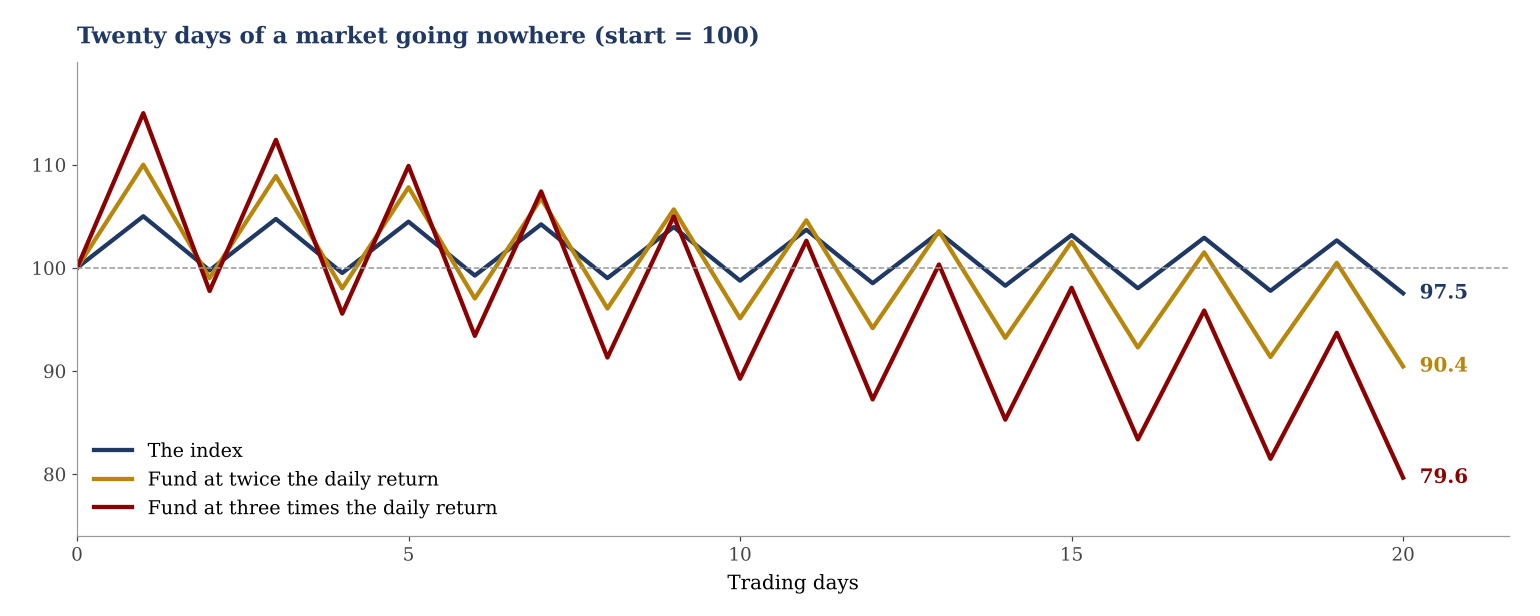
Figure 1. Illustration. An index alternates between a rise of five per cent and a fall of five per cent for twenty days, ending 2.5 per cent below its start. Funds that deliver twice and three times its daily return end 9.6 and 20.4 per cent below theirs. Calculated; no market data.
Figure 1 gives the arithmetic. The cost is not a fee and appears on no statement. It is a carry paid in volatility, and it makes these funds instruments for a day’s exposure that become something else when held.
VI. The ending
A fund can be closed. Managers wind up funds that fail to attract assets, and the holder is paid out at the value of the holdings on a date the holder did not choose. This is an inconvenience and occasionally a tax event, not a loss, and it is common.
The endings that destroy value belong to the forms that are not funds. A note ends with its issuer, as the Lehman notes did. A note or a leveraged product may also carry a term allowing the issuer to redeem it early if its value falls by more than a stated amount in a day. On 5 February 2018 a widely held note designed to return the opposite of a volatility index lost more than nine-tenths of its value in a single session and was terminated by its issuer under such a term. Its holders had earned handsomely for years. The instrument ended on the first day that the thing it was short did what such things occasionally do.
An index itself does not end, but its members do, and the rule book decides what replaces them. The long history of an index is the history of a changing list, from which the failures have been removed along the way.
VII. The risk unit
A basket has less volatility than its typical member, for the reason given in Paper V: the specific risks of the members cancel and the market risk remains. The first approximation to the risk unit of a broad equity fund is therefore the market’s own volatility, and a position in it is a position in the market part of every share at once.
Two corrections are needed. The first follows from concentration. When ten companies make up two-fifths of an index, their specific risks no longer cancel, and the basket carries a large holding in a handful of names alongside its market exposure.
The second concerns books that hold more than one basket. Two funds are independent positions only to the extent that their contents differ. Two funds that follow the same index are one position held twice. A fund on a country’s shares and a fund on a region that includes the country overlap by the country’s weight in the region. The risk unit of a book of baskets cannot be read from the list of funds. It has to be read from what is inside them, added up security by security, exactly as Paper II added up a currency book currency by currency.
Table 2. The six questions answered for the basket
| Question | Answer |
|---|---|
| Claim | Depends on the form: a share of a segregated pool for a fund; an unsecured debt for a note; a contract for a future or a dealer’s product. The index itself is a calculation and confers nothing |
| Structure | An index rule book with fixed revision dates; for a listed fund, an exchange price tied to the value of the holdings by arbitrage that can fail under stress |
| Return | That of the contents, less fee and tracking loss; for an index weighted by market value, increasingly that of its largest members |
| Carry | The income of the contents less the fee; for leveraged and inverse funds, a hidden cost that rises with volatility |
| Ending | Closure and payout for a fund; issuer failure or early termination for a note; none for the index, whose members are replaced |
| Risk unit | Market volatility for a broad basket, corrected for concentration, and read through to the contents wherever baskets overlap |
The answers are for baskets of shares. Baskets of bonds and commodities differ mainly in the second row, where the contents may trade far less readily than the fund.
VIII. The case
The following illustration is drawn from a multi-asset book that admitted two short lists of baskets: a list of large listed funds, and a list of national and regional share indices offered as dealer’s contracts. It traded both under the same rules as every other class, opening each position on its own evidence.
At a weekly close the book held long positions in half a dozen funds. Three of them followed the same index of large American companies. A fourth followed the whole American market, of which those companies are the greater part. The remaining two followed near-identical indices of emerging-market shares. Six positions had been opened, each on its own evidence. Read through to their contents, they were two: one large holding in American shares and one in emerging markets.
The index contracts showed the mirror image. The book was long the national indices of several European countries and at the same time short a regional European index that is composed in good part of companies from those same countries. It was short a broad index of smaller American companies while long the funds just described. And in one American index it held a long and a short position together, opened on different horizons. A material part of what appeared on the list as exposure was therefore the same companies held in both directions through different baskets, and what was left after the netting was a set of differences: one country against its region, large companies against small.
The book did not rely on the list. Beside the rule that opened each position it ran a second, which gathered positions by the influence they shared, American shares in one group and European shares in another, kept long and short apart, and limited the total risk of each group whatever the number of instruments in it. Under that rule the six funds drew on one allowance and not six. The rule worked at the level of region and direction. It did not open the baskets and count companies, so that the long national indices and the short regional index appeared to it as two loaded groups and not as the partial offset they were.
The lesson is the sixth question in its plainest form. The name of a basket identifies a wrapper. The risk is in the contents, and a list of baskets will show the same holding several times when baskets coincide and will hide an offset when they oppose. A rule that groups baskets by what they have in common removes the first error. Only a reading of what the baskets hold removes the second.
IX. What would falsify this reading
Sharpe’s arithmetic cannot be refuted, though its usefulness can: it concerns the average active dollar, and says nothing against the existence of holders who are better than average at others’ expense. The claim that a value-weighted index delivers the return of its largest members is a statement about the present degree of concentration and would lapse if concentration fell back to its earlier level.
The claim about structure is that the link between a fund’s price and the value of its holdings rests on firms that may withdraw. It would be weakened by a period of severe stress in which the gaps did not open, and strengthened by each one in which they do. The episodes cited are few, and a reader is entitled to regard the matter as not yet settled.
The paper has left the contract forms of Table 1 almost untouched. The index future is the most heavily traded of all the ways of holding a basket, and it is where the next paper begins.
References
Cheng, M. and Madhavan, A. (2009). The dynamics of leveraged and inverse exchange-traded funds. Journal of Investment Management 7(4), 43–62.
Dr. Glen Brown (2026). Money and Foreign Exchange; Equities. The Instruments of Capital, Papers II and V. Public Doctrine Series.
ETFGI (2026). Global ETF and ETP assets at the end of September 2026, as reported by First Trust Advisors, 29 October 2026.
RBC Wealth Management (2026). The Narrowing of Focus: concentration in the S&P 500, year-end 2015 and 2025.
Sharpe, W. F. (1991). The arithmetic of active management. Financial Analysts Journal 47(1), 7–9.
Shleifer, A. (1986). Do demand curves for stocks slope down? Journal of Finance 41(3), 579–590.
U.S. Securities and Exchange Commission (2015). Research Note: Equity Market Volatility on August 24, 2015. Division of Trading and Markets.
Related in the Public Doctrine Series
What an Asset Class Is: The Instruments of Capital, Paper I, which sets the six questions and introduces the wrapper.
Equities: The Instruments of Capital, Paper V, on the single share that the basket contains.
Money and Foreign Exchange: The Instruments of Capital, Paper II, where a list of pairs is netted to a handful of currencies.
Download the PDF
About the Author
Dr. Glen Brown is President & CEO of Global Financial Engineering, Inc. and Global Accountancy Institute, Inc. He is the architect of the GCPIAUT framework and the broader GATS-native proprietary capital doctrine. His work focuses on sovereign capital governance, algorithmic trading architecture, reserve-first compounding systems, and institutional financial engineering within closed proprietary environments.
Business Model Clarification
Global Financial Engineering, Inc. and Global Accountancy Institute, Inc. operate as closed-loop proprietary institutions. They do not offer public investment products through the doctrines described herein, do not invite retail participation into their proprietary capital architecture, and do not present the GCPIAUT framework as a public collective investment scheme. The concepts discussed in this article are part of the firms’ internal intellectual and operating doctrine.
Risk Disclaimer
Trading and investment activity across foreign exchange, equities, futures, commodities, and digital assets involves substantial risk. Market conditions may change rapidly, and losses may occur. This article is provided for intellectual, institutional, and educational discussion only and does not constitute investment advice, an offer, a solicitation, or a recommendation to buy or sell any financial instrument or to participate in any investment structure.