The Instruments of Capital · Paper XVII
One Book, Many Classes
The closing paper of the series. What fifteen classes look like when they are held together, what the six questions found, and what a single unit of risk leaves out.
Dr. Glen Brown · Global Financial Engineering, Inc. · Global Accountancy Institute, Inc. · 14 November 2026 · GFE-PUB-IOC-20261114-O
About this series
The Instruments of Capital is a sub-series of the Public Doctrine Series. It sets out, one class at a time, every kind of asset a proprietary firm could trade, whether or not the firm trades it today. Each paper puts its subject through the six questions set in Paper I: claim, structure, return, carry, ending and risk unit. This is the last paper of the series. The case in Section VIII is an illustration built from operating data. Its figures have been altered and it reports no account’s results.
I. The question the series asked
Paper I began with a cabinet of drawers labelled shares, bonds, currencies and commodities, and asked whether the labels described how the things in them behave when held. It proposed six questions in their place. What does the holder have a claim on? How is the instrument made? Where does its return come from? What does it pay or cost while nothing happens? How does it end? In what unit should its risk be measured? Fifteen papers then put those questions to every class a firm could trade, from money to the outcome of events.
This paper does not add a class. It asks what the answers look like when the classes are held together in one book, which is how a firm holds them. Three findings recur across the series, and they are the substance of what follows. The legal form of an instrument decides much of what it is. The positions in a book are often not the ones its labels show. And the common unit in which risk is measured makes the classes comparable in size while leaving out most of what distinguishes them.
The wrapper decides the claim. The label is not the position. A common unit of risk makes classes comparable in size and in nothing else.
II. The classes in one view
Table 1. The series in one view
| Paper | Class | A claim on | While nothing happens | How it ends |
|---|---|---|---|---|
| II | Money and currencies | A central or commercial bank | The interest differential | It does not; the issuer can debase it |
| III | Government debt | A state | The coupon less financing | Maturity, or default by a state |
| IV | Credit | A company or a pool of loans | The coupon; the spread pays for default | Maturity, default, restructuring |
| V | Equities | The residual of a company | Dividends, often small | Takeover, delisting, failure |
| VI | Index funds and notes | A fund’s holdings, or a bank | Fees; for leveraged funds, a cost in volatility | Closure of the fund; termination of the note |
| VII | Futures and forwards | A clearing house or counterparty | The slope of the curve | On a fixed date, by delivery or cash |
| VIII | Options | A clearing house or the writer | Time decay, paid by the buyer | Expiry; the writer’s ending is a single large move |
| IX | Swaps | A counterparty | The difference between two streams | Maturity, or a collateral call that cannot be met |
| X | Volatility | A clearing house or dealer | Heavily negative for the buyer | Settlement on a constructed number |
| XI | Energy | Goods in a place, or a contract | Storage, or the slope | Consumption; delivery into finite storage |
| XII | Metals | A bar, a warehouse, a bank | Interest forgone; the slope | Gold none; the contract by its venue |
| XIII | Farm products | A warehouse receipt, or a contract | Storage with a ceiling, scarcity without a floor | Consumption; the harvest renews the stock |
| XIV | Digital tokens | No one, if the key is held | None; else fees or financing | Lost key, failed intermediary, abandonment |
| XV | Property and infrastructure | Title, concession or licence | Rent against the cost of debt | Obsolescence, concession date, foreclosure |
| XVI | Newer markets | A registry, exchange or counterparty | None, except allowances | On a date, often at one or zero |
Each row compresses a paper. Read down any column and the classes differ; read across a row and the claim, the carry and the ending are seen to be separate facts about an instrument.
Table 1 shows why Paper I distrusted the drawers. The same word, a future on oil, a share, a token, covers instruments whose answers in one column differ more within the class than across classes. The claim column is the clearest: an index can be held as a share in real securities or as a loan to a bank, and gold as a bar or as a deposit with a bank.
III. The wrapper decides the claim
Paper I named the legal form of an instrument its wrapper and argued that the class decides the claim and the return while the wrapper decides most of the structure, the carry and the ending. The series found the wrapper to be stronger than that. In case after case it decided the claim as well.
A fund and a note on the same index show the same chart and are opposite instruments, one a share in securities and the other a promise by a bank (Paper VI). Gold allocated in a vault is a claim on metal; gold unallocated is a deposit (Paper XII). A token held by its key is a claim on no one; the same token held through an exchange or a dealer is a claim on the exchange or the dealer (Paper XIV). A stopped position and a bought option draw the same diagram, and one is a contract while the other is a request (Paper VIII). A dealer’s contract on a share pays the share’s price and charges interest every night, which makes it a swap (Paper IX).
The practical rule that follows is that the first question must be asked of the wrapper and not of the class. A book that holds many classes through one kind of wrapper holds one kind of claim, whatever its classes.
IV. Labels and positions
The second finding came from the cases, and it was not anticipated in Paper I. A book that reaches its positions one instrument at a time, by rules that read each instrument’s own prices, will often hold something other than what its list shows. Six funds were two positions, and a set of long national share indices was close to a short position in the regional index made largely of the same companies (Paper VI). Long crude oil and short natural gas were reported as one class pointing two ways (Paper XI). Three falling crops shared a stage in a supply cycle and four contracts were one view of what animals eat (Paper XIII). A dozen tokens, long and short, were chiefly a position in small against large (Paper XIV). Two telephone companies were reported as infrastructure and were not (Paper XV).
None of these was an error. Each followed from the rules. What they show is that the unit in which a book is reported, the instrument grouped by class, is not the unit in which it is exposed. The exposure lives in shared influences: a region, a currency, a cycle, the appetite of investors for risk. Those cross the class labels freely.
V. One unit for risk, and what it leaves out
Every paper answered the sixth question with some form of volatility, and that common answer is what allows one book to hold many classes at all. If each position is sized so that an ordinary adverse move costs the same fraction of capital, a currency pair and a cocoa contract can sit side by side as equals.
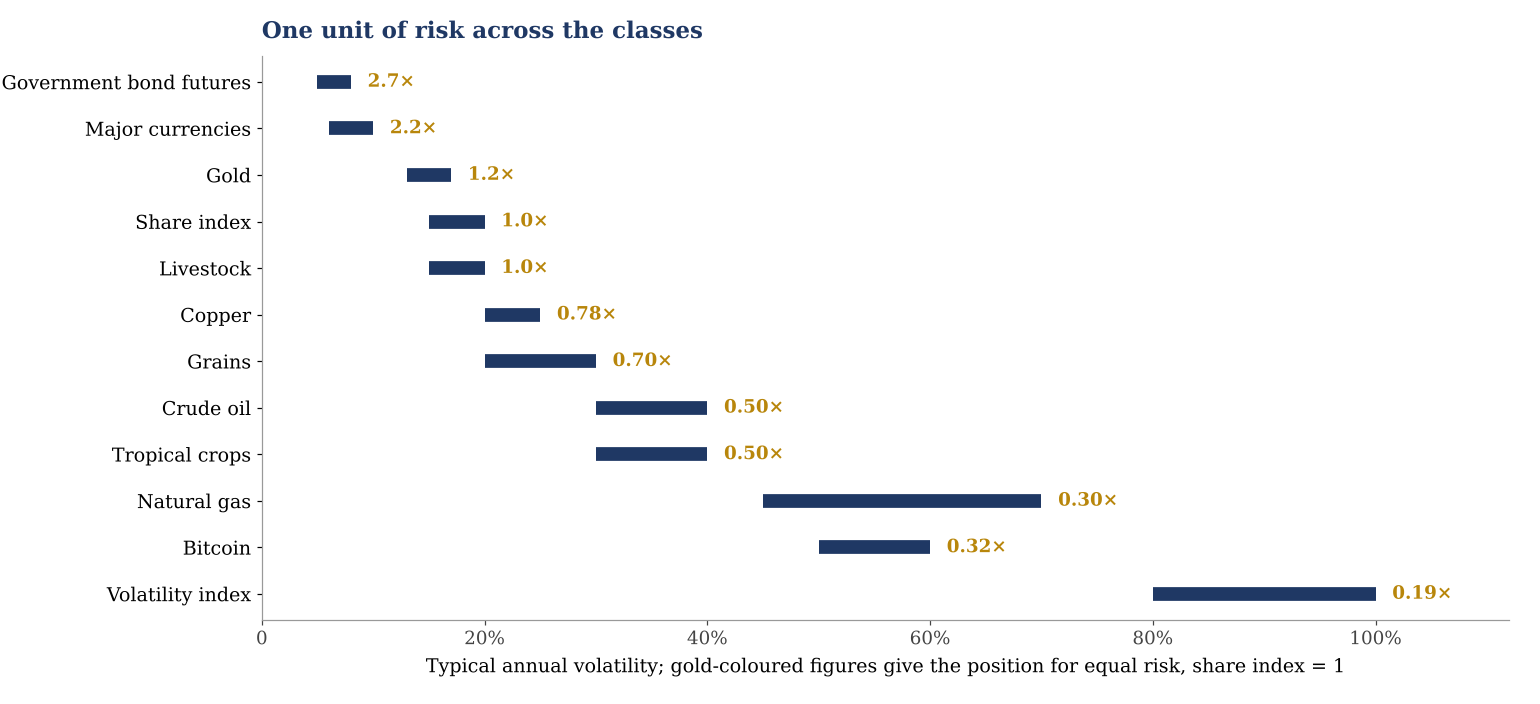
Figure 1. Illustration. Typical ranges of annual volatility for the classes of the series, as stated in Papers V to XIV, with currencies and government bonds added from general experience, and the size of position, relative to a share index, that a rule sizing by volatility would hold for equal risk at the middle of each range. Not measured for this paper.
Figure 1 gathers the ranges stated across the series. They differ by a factor of more than ten, and a rule that sizes by volatility would hold more than ten times as much of a government bond as of a volatility index for the same risk. That is the rule working as intended. It is also the point at which the common unit stops describing the classes. It does not measure the claim, which may be on a state, a company, a dealer or no one; the ending, which may be a date, a vote, a harvest or a single move; the time needed to sell, which is a second for a currency and months for a building; the gap, across which a stop cannot act, which is rare in currencies and routine in energy and event contracts; and the construction of the price, which for an appraisal, a freight index, a settlement auction or an event rule is a decision made by someone. Each of these appeared in the series as a separate answer to one of the six questions. A book that sees only the common unit sees none of them.
VI. The markets that do not trade
Paper I’s map included a paper on private markets, and the map was amended when Paper XV showed how much of the subject it had already covered. Private equity, venture capital and private credit are ownership and debt of the kinds treated in Papers IV and V. What makes them a separate field is not the claim but the absence of a market. The assets of funds managed in private markets were put at about $20 trillion in 2026, and private credit alone at about $4.1 trillion at the end of 2025, 17 per cent more than a year before, with its funds borrowing a further quarter of their net assets.
The six questions apply to them unchanged, and the answers are those of Paper XV. The price is an estimate by the manager, so that reported returns move less and later than the value would if it were offered for sale, and a measure of volatility taken from those returns understates the risk. The time to sell is the life of the fund, perhaps ten years, or a sale to another investor at whatever discount that investor asks. The industry’s own estimate of the default rate in private credit, counting distressed exchanges, approached five per cent entering 2026, against reported rates below two. For a book that sizes by measured movement these classes cannot be admitted at all, and a book that admitted them on reported prices would be sizing on a number someone chose.
VII. The holders
Paper I admitted one weakness at the outset. The six questions describe an instrument as held by one party, and say little about what happens when many holders give the same answers and act on them at once. The series met that situation repeatedly, and it is the one finding that belongs to the population of holders and not to any instrument.
Portfolio insurance in October 1987 required its users to sell as prices fell, and the selling was more than the market could take (Paper VIII). Funds that sold volatility in February 2018 were obliged to buy it back at the close as it rose, and drove it higher (Paper X). Pension funds called for collateral in 2022 sold gilts to raise it and drove yields higher (Paper IX). Traders in digital tokens with borrowed money were closed out by their venues in October 2025, nineteen billion dollars in a day, each closure pressing the price towards the next (Paper XIV). Merchants hedging cocoa in 2024 cut their hedges as margins rose, and the market thinned as the price climbed (Paper XIII).
The pattern is the same in every class: a rule followed by many holders that requires them to sell when the price falls, or buy when it rises. The rule may be sound for any one of them. Followed by all, it creates the move it was meant to survive. No answer to the six questions about the instrument predicts this. It is predicted by asking who else holds the instrument and what their rules oblige them to do, and that is a question about the market and not about the claim.
VIII. The case
The following illustration is drawn from a single multi-asset book at one weekly close. The firm’s other books are separate, answer for their own risk under their own limits, and are not added to this one; nothing below aggregates them. The book held positions in some sixty instruments across eight classes: currencies, shares, share indices, index funds, energy, metals, farm products and digital tokens. Four observations bring the series’ findings into one place.
The first is the claim. Every one of those positions was a contract with the same dealer. By the labels the book was spread across eight classes; by the first question of Paper I it held one kind of claim, on one counterparty, and its diversification by class did not extend to diversification by claim. The paper reports this as a fact about the book’s structure. It makes no recommendation about it.
The second is the labels. The groupings described in Section IV were found in this book: funds that were one position, national indices set against a regional one, tokens long and short, two telephone companies. Several of the earlier cases were drawn from it.
The third is the book’s own answer to Section IV. Its rules include a budget that groups open positions by shared influence and by side, and limits the loss each group could take at the stops. Some of its groups, by their names, follow the classes: the long side of American shares, or of the energy complex, or of digital tokens. Others cut across them: the strength of the dollar, the strength of the euro, the yen as a refuge, and the appetite of investors for risk. In that rule the book had already begun to treat itself as one book and not as eight drawers. How each group is composed is the paper’s reading of the names in the book’s log, and not of the rule’s source.
The fourth is what the common unit left out. Every position was sized by the same rule from the distance to its stop. The same weekly record showed digital positions open on a Saturday while every other class was shut (Paper XIV), short positions in crops whose risk was lopsided upward (Paper XIII), copper and telephone shares aged without progress and untouched by any rule (Papers XII and XV), and a rule standing aside from scheduled releases across all classes alike (Paper XVI). Each is a difference between classes that the common unit did not register and that some other part of the book’s rules, or no part, had to carry.
The case does not show that the book was well or badly constructed. It shows a book of many classes answering the six questions as one book: in a single claim, in groupings its labels do not show, and in risks its common unit does not measure.
IX. The six questions, tested
Paper I set its own test. The six questions would fail if two instruments returning the same answers behaved persistently differently, which would reveal a seventh question, or if one question never separated any two instruments. Across fifteen classes no question proved idle; each separated instruments that the others did not. No class produced two instruments with the same six answers and different behaviour in the strict sense of the test, and the list stands without amendment.
Two matters strained it, and the series records them rather than conceal them. The time needed to sell, decisive for property and private markets, was answered under structure and risk unit, and a reader could fairly argue that it is a question in its own right. The construction of the price, decisive for appraisals, indices, settlement auctions and event rules, was answered under structure, and the same argument could be made. The holders’ behaviour treated in Section VII lies outside the questions by design, as Paper I said it would.
The claims of this paper rest on the cases of the earlier ones, which were drawn mostly from a few books over a few months and were offered as illustrations. A firm with a longer record and more books would be in a better position to test them, and the findings of Sections III and IV in particular should be read as patterns observed and not as laws.
The series was written from the position of a firm that expects its field to widen. Its purpose was to understand each class before capital is committed to it. The six questions are the same whichever class comes next.
References
Alternative Credit Council (2026). Financing the Economy 2026: global private credit market reached US$4.1tn AUM in 2025. Press release, 22 October 2026.
Dr. Glen Brown (2026). The Instruments of Capital, Papers I to XVI. Public Doctrine Series.
PitchBook (2026). Q1 2026 Global Private Market Fundraising Report.
With Intelligence (2026). Private Credit Outlook 2026: Market Faces First Big Test.
Related in the Public Doctrine Series
What an Asset Class Is: The Instruments of Capital, Paper I, which set the six questions and the test this paper reports.
Indices, Funds and Exchange-Traded Products: The Instruments of Capital, Paper VI, where six funds were found to be two positions.
Swaps and the Over-the-Counter Contract: The Instruments of Capital, Paper IX, on the dealer’s contract through which one book held every class.
Download the PDF
About the Author
Dr. Glen Brown is President & CEO of Global Financial Engineering, Inc. and Global Accountancy Institute, Inc. He is the architect of the GCPIAUT framework and the broader GATS-native proprietary capital doctrine. His work focuses on sovereign capital governance, algorithmic trading architecture, reserve-first compounding systems, and institutional financial engineering within closed proprietary environments.
Business Model Clarification
Global Financial Engineering, Inc. and Global Accountancy Institute, Inc. operate as closed-loop proprietary institutions. They do not offer public investment products through the doctrines described herein, do not invite retail participation into their proprietary capital architecture, and do not present the GCPIAUT framework as a public collective investment scheme. The concepts discussed in this article are part of the firms’ internal intellectual and operating doctrine.
Risk Disclaimer
Trading and investment activity across foreign exchange, equities, futures, commodities, and digital assets involves substantial risk. Market conditions may change rapidly, and losses may occur. This article is provided for intellectual, institutional, and educational discussion only and does not constitute investment advice, an offer, a solicitation, or a recommendation to buy or sell any financial instrument or to participate in any investment structure.