The Instruments of Capital · Paper XVI
Newer Markets of Risk: Carbon, Power, Freight, Weather and Event Contracts
Some risks had no price until a contract was written for them. What is held when a permit, a voyage, a winter or an outcome is held, and why each ends differently from everything before it.
Dr. Glen Brown · Global Financial Engineering, Inc. · Global Accountancy Institute, Inc. · 14 November 2026 · GFE-PUB-IOC-20261114-N
About this series
The Instruments of Capital is a sub-series of the Public Doctrine Series. It sets out, one class at a time, every kind of asset a proprietary firm could trade, whether or not the firm trades it today. Each paper puts its subject through the six questions set in Paper I: claim, structure, return, carry, ending and risk unit. The case in Section VIII is an illustration built from operating data. Its figures have been altered and it reports no account’s results.
I. Markets made by design
Every class in this series so far began with something that existed before its market: money, a debt, a company, a barrel, a bushel, a building, even a token on a ledger. The markets in this paper began the other way round. A risk was recognised, a contract was written to carry it, and only then was there anything to trade. Four of them are markets in a thing that is not an asset at all: a permission, a voyage, a season’s temperature and the outcome of an event.
They are newer than the classes before them and growing faster. Trading in emission allowances in the European Union, which created its market by law in 2005, came to 13.8 billion tonnes of carbon dioxide in 2025, and the allowances averaged €74 a tonne that year. The main German power contract for a month’s delivery traded 1.86 million times in the first nine months of 2026, 18.6 per cent more than a year earlier. The Baltic Dry Index, the oldest published measure of what it costs to hire a ship, stood at 2,805 on 6 November 2026. Most striking of all, contracts that pay on the outcome of events, from sporting fixtures to economic releases, traded $120.7 billion on American venues in October 2026, and the largest venue alone traded $98.2 billion, more than twenty times its volume of a year earlier.
Each of these was an obscure corner of finance a decade ago. The series includes them because a firm that intends to widen its field will meet them, and because each answers at least one of the six questions in a way no earlier class has.
A barrel exists before its contract. An allowance, a freight index and an event contract exist because someone wrote the contract.
II. The claim
Table 1. Five markets made by contract
| Market | What is held | Created by | Settled against |
|---|---|---|---|
| Carbon | An allowance: the right to emit one tonne of carbon dioxide, surrendered to the state | Law: a cap set by the legislature, issued by auction or free allocation | Delivery of allowances in a state registry |
| Power | A quantity of electricity at a place and hour, or a contract on its price | Grid operators and exchanges | Physical delivery, or cash against a published price |
| Freight | A forward freight agreement: the difference between an agreed rate and a published rate for a route | Agreement between two parties, now mostly cleared | Cash against an index compiled from brokers’ assessments |
| Weather | A contract on an index of temperature, rainfall or snow at a named place | Exchanges and insurers | Cash against measurements at named weather stations |
| Events | A contract that pays one unit if a stated event occurs and nothing if it does not | Exchanges regulated as derivatives markets, and some that are not | Cash, on the exchange’s determination of the outcome |
Only the allowance is an asset in law, and it exists only because a statute says so. The others are contracts on numbers.
The allowance deserves particular notice, because it is the only kind of claim in this series that is created and destroyed by the state for a purpose other than finance. An allowance is a licence to pollute. Its holder has a claim on the registry for its recognition and nothing else. Its supply is the cap, which the legislature sets and has repeatedly changed, and it is extinguished when it is surrendered against a tonne actually emitted. It is closer to a coupon than to a commodity.
The other four are contracts on numbers that no one owns. A freight agreement pays on an index of charter rates, a weather contract on a count of degrees, an event contract on a fact. In each the holder’s claim is on the counterparty or the clearing house, as described in Papers VII and IX, and the value depends on how the number is compiled.
III. The structure
Each market rests on a constructed number, and the construction is part of the instrument. The carbon market rests on a cap, a reserve that withdraws allowances when too many are in circulation, and a rulebook that the European Commission proposed to revise once again in July 2026. The freight market rests on assessments submitted each day by panels of shipbrokers. The weather market rests on readings at particular airports. The event market rests on a written rule for deciding what happened, and on the exchange’s judgement when the rule is unclear.
The event contract has the simplest structure in the series and the most unusual. It is priced between zero and one, and the price can be read as the market’s estimate of the probability that the event will occur. Its payoff is binary: at the end it is worth everything or nothing. Much of the recent growth has come from sports, which made up 84 per cent of trading on the largest American venue and 68 per cent on the second in the last week of September 2026; commodities, politics and weather were the most active of the rest. State regulators in America have contested whether such contracts are financial instruments or bets, and the question is in the courts.
Power and weather are joined by the same physics. Electricity cannot be stored, as Paper XI explained, so its price is set hour by hour by the demand of that hour, and demand is driven above all by temperature. A contract on heating degree days in a city in winter is, in substance, a contract on how much power and gas that city will burn.
IV. The return
None of these markets offers income, and most offer no long-run return at all. An event contract is a wager between two parties on a fact: what one gains the other loses, and fees are deducted. The expected return to the market as a whole is negative by the amount of the fees. An individual can earn more only by knowing better than the price, and the research on prediction markets, summarised by Wolfers and Zitzewitz in 2004, found them to be good forecasters on average. It also found a persistent pattern noted long before in betting on horses: outcomes priced as long shots win less often than their prices imply, and favourites slightly more often.
A freight or weather contract is similar in kind, with one difference. The parties on one side are often hedgers, a shipowner fearing low rates or a gas utility fearing a mild winter, who may accept a price worse than their own forecast to be rid of the risk. In that case the other side is paid for carrying it, as Keynes argued of commodity futures in Paper VII. How large that payment is in these markets is not well established.
Carbon is the exception, and its return is political. The price of an allowance depends on how tight the cap is expected to be, and that is decided by votes. In the first trading period of the European scheme, which ran from 2005 to 2007, too many allowances were issued and they could not be carried into the next period; their price fell from above €30 to almost nothing. The price in 2026 has been decided as much by negotiations over the scheme’s reform and its possible link with the British scheme as by industry’s emissions.
V. The carry
An allowance can be held from one year to the next within a trading period, costs almost nothing to store and pays nothing. Its futures curve is therefore governed by the rate of interest, as the curve of gold is in Paper XII, and a long position in futures pays approximately that rate. It is, in this one respect, the most money-like of the goods.
None of the others can be stored. A freight rate for March cannot be bought in January and kept; a cold week in February is not a cold week in March; an event contract on one release has no bearing on the next. Each month or each event is a separate instrument, as Paper XIII found for livestock, and there is no carry in the series’ sense. The event contract has a cost of its own: on most venues it must be paid for in full, so that its holder forgoes interest on the whole stake until it resolves.
VI. The ending
These are the instruments in the series whose endings are most certain. A weather contract ends with its season. A freight agreement ends with its month. An event contract ends when the event is decided, at a price of exactly one or exactly zero. In the last days of its life it does not drift; it jumps.
The allowance ends by being surrendered, which is to say consumed by compliance, and the scheme that created it can itself be ended or redesigned. That is an ending of a kind not met elsewhere: the asset can be devalued by the authority that issued it, not through inflation as with money but through a change in the rules that say how many there will be.
Two further endings belong to the market and not to the contract. The first is a dispute about what happened. An event contract is only as good as its rule for deciding outcomes, and several venues have had to settle contracts whose questions turned out to be ambiguous. The second is the law. A market whose instruments a court may find to be unlicensed gambling, or whose index a regulator may find to have been misreported, carries a risk that no measurement of price movement reveals.
VII. The risk unit
The risk unit in the earlier papers was the volatility of the full value controlled. For the event contract the idea needs restating, since the contract has no continuous path and ends at one of two values.
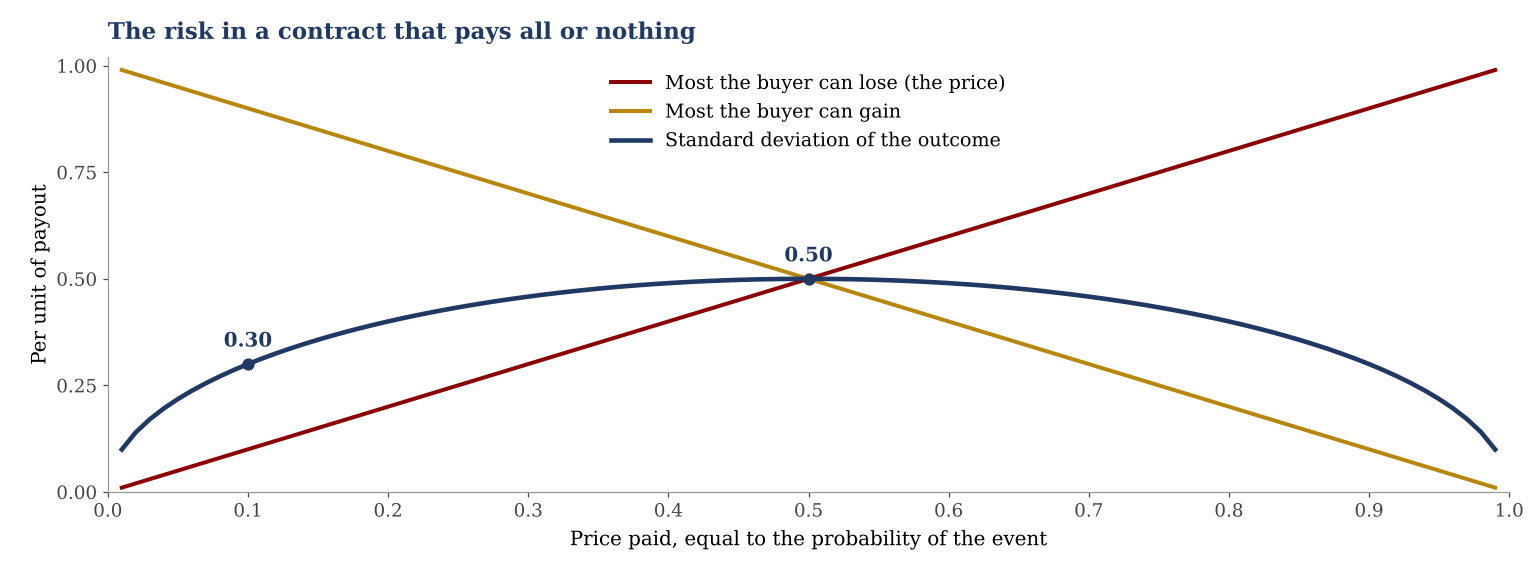
Figure 1. Illustration. For a contract that pays one unit if an event occurs, bought at a price equal to the probability of the event: the most the buyer can lose (the price), the most the buyer can gain (one less the price), and the standard deviation of the outcome. At a price of 0.50 the standard deviation is 0.50; at 0.10 it is 0.30, with a possible gain nine times the possible loss. Calculated; no market data.
Figure 1 shows the arithmetic. Bought at a price equal to the true probability, a contract’s outcome has a standard deviation that is greatest at even odds and falls towards the extremes. The figure also shows what the standard deviation hides. At a price of one-tenth the buyer risks a tenth to gain nine-tenths, and will lose the whole stake nine times in ten. No stop can limit that loss, since the price does not travel towards the outcome; it arrives there. For an event contract the risk unit is simply the stake, and the sizing rule is the one Paper VIII gave for the buyer of an option.
The other markets have the volatility of the earlier papers, at unusual levels. Freight is among the most volatile prices in the economy: the index of rates for the largest bulk carriers ranged between about 2,100 and 5,500 in the twelve months to July 2026. Power, for the reasons in Paper XI, can multiply in an hour. Carbon moves with policy, and its largest moves have come on the days of political decisions. In all four the scheduled date of a decision or a report is a known point at which the price may jump.
Table 2. The six questions answered for the newer markets
| Question | Answer |
|---|---|
| Claim | For carbon, an allowance recognised by a state registry. For the others, a contract on a number: a power price, a freight index, a weather reading or a fact. On a clearing house, a counterparty or an exchange |
| Structure | Each rests on a constructed number: a legislated cap, a brokers’ panel, a weather station, a rule for deciding outcomes. Event contracts are binary and priced as probabilities |
| Return | No income. Event contracts are a wager net of fees; freight and weather may pay those who carry hedgers’ risk; carbon is driven by the expected tightness of the cap |
| Carry | For allowances, roughly the rate of interest. For the others, none in the series’ sense, since nothing can be stored; event contracts tie up the whole stake |
| Ending | Certain and dated: the season, the month, the decision. Allowances by surrender. For the market, disputes over outcomes and the risk of a change in law |
| Risk unit | For event contracts, the stake, which cannot be limited by a stop. For the others, volatility at high levels, with jumps on the dates of decisions and reports |
Power is also treated in Paper XI. Its inclusion here is for its link with weather and for the separateness of each hour.
VIII. The case
The book from which this illustration is drawn traded exchange futures across currencies, share indices, government bonds, energy, metals and farm products. It held no allowance, no freight or weather contract and no event contract. What it held was a rule about events.
Before a scheduled economic release of the first rank, the book’s rules refuse every new position for a stated period, and continue to manage the positions already open. On the day of one American inflation report the window opened about ninety minutes before the release and was still open more than half an hour after it. In that time the book recorded some fourteen hundred refusals across all of its instruments, every one traced to the single scheduled event. The rule applied the American release to European bond and share futures as fully as to American ones.
The book’s equity that day was recorded at intervals. It had begun to recover from its low for the day well before the release. Of the recovery from that low to the last reading some twenty minutes after the release, more than half came before the figure was published. The release appears to have quickened a movement already under way. It did not start one. Three readings after the event cannot establish a trend, and the record shows only that much.
The rule is a position on event risk, held without an instrument. It says, in effect, that the outcome of the release is unknowable, that its effect on prices may be large, and that the best course is to take on no new exposure to it. An event contract on the same release would have priced the risk the rule avoids: a probability for each range of outcomes, available to anyone. The book’s rule does not consult such a price and treats every release of the first rank as the same hazard, whatever the market expects of it. It also treats the hazard as the same for every instrument, although the record suggests that a European bond and an American share index may not respond to an American release in the same way.
Nothing in the case shows that the rule is wrong. A rule that stands aside from scheduled jumps follows directly from Section VII and from Paper VIII’s account of why a stop cannot act across a gap. The case shows something narrower. One of the newest markets in this paper trades the very risk on which an existing rule was built. A firm that already prices its own exposure to events has, in that market, a source of information it has not yet used, and the market does not have to be traded for its prices to be read.
IX. What would falsify this reading
The paper has described event contracts as a wager whose expected return is negative after fees, and their prices as good forecasts on average. If they proved to be systematically poor forecasts, the second claim would fall; if they proved to offer a reliable premium to one side, as freight and weather may to those who carry hedgers’ risk, the first would need qualifying. The evidence on both is drawn largely from earlier and much smaller markets than those of 2026, and a market dominated by sports may behave differently from one built for economics and politics.
The claim that the carbon price is political rests on the history of one scheme. Other schemes, and a linked European and British market, may prove more stable or less. The statement that allowance futures carry roughly the rate of interest is an argument from storability and has not been tested here against the actual curve.
The case rests on one day’s record. It reports the scope of a rule and the timing of one recovery. It does not show how prices of event contracts on that release behaved, and the suggestion that they would have informed the rule is the paper’s inference, not an observation.
This completes the classes. The last paper brings them back into one book.
References
DeFi Rate (2026). Prediction market volume reaches $120.7 billion in October, up 64%.
Dr. Glen Brown (2026). Futures and Forwards; Options; Swaps and the Over-the-Counter Contract; Energy; Metals; Agricultural Commodities and Livestock. The Instruments of Capital, Papers VII, VIII, IX, XI, XII and XIII. Public Doctrine Series.
European Securities and Markets Authority (2026). EU carbon markets 2026. ESMA Market Report, 9 July 2026.
FIA (2026). Trends in ETD Trading, Q3 2026.
Snowberg, E. and Wolfers, J. (2010). Explaining the favorite–long shot bias: is it risk-love or misperceptions? Journal of Political Economy 118(4), 723–746.
Trading Economics (2026). Baltic Dry Index market notes, November 2026.
Wolfers, J. and Zitzewitz, E. (2004). Prediction markets. Journal of Economic Perspectives 18(2), 107–126.
Related in the Public Doctrine Series
Energy: The Instruments of Capital, Paper XI, on power and on goods whose supply cannot respond quickly.
Options: The Instruments of Capital, Paper VIII, on a payoff that cannot be protected by a stop.
What an Asset Class Is: The Instruments of Capital, Paper I, which names the contract as the sixth kind of claim.
Download the PDF
About the Author
Dr. Glen Brown is President & CEO of Global Financial Engineering, Inc. and Global Accountancy Institute, Inc. He is the architect of the GCPIAUT framework and the broader GATS-native proprietary capital doctrine. His work focuses on sovereign capital governance, algorithmic trading architecture, reserve-first compounding systems, and institutional financial engineering within closed proprietary environments.
Business Model Clarification
Global Financial Engineering, Inc. and Global Accountancy Institute, Inc. operate as closed-loop proprietary institutions. They do not offer public investment products through the doctrines described herein, do not invite retail participation into their proprietary capital architecture, and do not present the GCPIAUT framework as a public collective investment scheme. The concepts discussed in this article are part of the firms’ internal intellectual and operating doctrine.
Risk Disclaimer
Trading and investment activity across foreign exchange, equities, futures, commodities, and digital assets involves substantial risk. Market conditions may change rapidly, and losses may occur. This article is provided for intellectual, institutional, and educational discussion only and does not constitute investment advice, an offer, a solicitation, or a recommendation to buy or sell any financial instrument or to participate in any investment structure.