The Instruments of Capital · Paper XV
Real Assets: Property and Infrastructure
The largest store of wealth in the world cannot be bought by the hour. What is owned when land, buildings and the works built on them are owned, and why their prices appear calmer than they are.
Dr. Glen Brown · Global Financial Engineering, Inc. · Global Accountancy Institute, Inc. · 14 November 2026 · GFE-PUB-IOC-20261114-M
About this series
The Instruments of Capital is a sub-series of the Public Doctrine Series. It sets out, one class at a time, every kind of asset a proprietary firm could trade, whether or not the firm trades it today. Each paper puts its subject through the six questions set in Paper I: claim, structure, return, carry, ending and risk unit. The case in Section VIII is an illustration built from operating data. Its figures have been altered and it reports no account’s results.
I. The oldest store of wealth
Land was wealth before there was money to measure it. Most of the law of property, of contract and of credit grew up around it, and for most of history the question of who owned the land was the question of who was rich. The last paper described an asset invented in 2009. This one describes the oldest.
It is also the largest by a wide margin. Savills estimated the value of the world’s real estate at the start of 2025 at $393.3 trillion: $286.9 trillion of housing, $58.5 trillion of commercial property and some $48 trillion of farmland. By the same firm’s count the world’s listed shares were worth about $126 trillion and its debt securities about $144 trillion. Property is worth more than both together. China and the United States account for 23.5 and 20.7 per cent of it.
Infrastructure, the roads, ports, pipes, cables, power lines and towers on which the rest of the economy runs, is much smaller as a financial asset, since most of it is owned by governments and never traded. The part held by private funds reached about $1.6 trillion in the first half of 2025, and money raised for such funds in 2025 rose by almost sixty per cent, to about $211 billion, much of it for data centres and the power to run them.
These are the real assets of the paper’s title. They differ from every class so far in one respect above all: none of them can be bought or sold in an afternoon.
A building has one price a year and an index has one a second. The calm of property is a property of the measurement.
II. The claim
To own property outright is to hold title to a defined piece of land and whatever stands on it, registered with the state. It is the most fully protected form of ownership the law provides, and it comes with obligations the owner of a share does not have: to repair, insure, pay local taxes and find tenants.
Infrastructure is often not owned in that sense at all. A toll road may be held under a concession, a right granted by a government to build, operate and collect from it for a fixed number of years, after which it returns to the state. A water or power network may be owned by a company whose prices are set by a regulator, which allows a return on the value of the assets it recognises. The holder of such an asset has a claim on a stream of income whose size depends on a contract or a regulator as much as on the asset.
Table 1. Five ways of holding real assets
| Form | What is held | Can be sold | Valued by |
|---|---|---|---|
| Direct ownership | Title to land and buildings, or a concession or licence | In months, by private sale | Periodic appraisal, or the sale price |
| Private fund | A share in a partnership or trust that owns properties or works | Closed funds: at the end of their term, or at a discount to another buyer. Open funds: at intervals, subject to limits | The manager’s appraisal of the holdings |
| Listed property company | A share in a company or trust that owns and lets property | Every second the exchange is open | The market price of the share |
| Listed infrastructure or utility | A share in a company that owns a network or concession | Every second the exchange is open | The market price of the share |
| Debt on real assets | A mortgage, or a bond secured on a building or a project | Varies; much of it rarely trades | Appraisal or market price |
The same building can sit behind all five. What differs is the claim on it, the time needed to sell and the way its price is found.
The last column of Table 1 matters more for this class than for any other. Shares, bonds, futures and tokens have a price because they are traded. A building has a price only when it is sold or when someone is paid to estimate what it would sell for. Most of the time it has only the estimate.
III. The structure
Every building is unique. It stands in one place, with its own tenants, leases, condition and planning permission, and no other building is a perfect substitute. That is why property is bought through months of inspection and negotiation and why the cost of buying and selling, in taxes, fees and lawyers, commonly runs to several per cent of the price. It is also why a single good building is too large for most investors to own, and why funds and listed companies exist.
The income of property is set by leases, which run for years and often rise with inflation or at fixed steps. The income of regulated infrastructure is set by a formula reviewed every few years. Both are slower to change than the earnings of an ordinary company, which gives the class its reputation for steadiness. The steadiness is in the income. The value is another matter.
Property is usually bought with borrowed money. A typical commercial purchase may be financed half or more by a mortgage, and a regulated utility may carry debt of several times its annual revenue. The owner of real assets therefore almost always owns them through a structure with leverage of the kind described in Paper IV, and a modest fall in the value of the asset can remove most of the owner’s equity.
IV. The return
The return on property has two parts: the rent, after the costs of keeping the property let, and the change in its value. Over long periods the first has been by far the larger. Eichholtz’s index of house prices on one Amsterdam canal, from 1628 to 1973, found real prices little higher at the end than at the start after more than three centuries of wars, plagues and booms. Jordà and his colleagues, assembling returns for sixteen countries from 1870, found that housing had returned about as much as shares over the period, almost all of it from rent, with considerably less variation from year to year.
That last finding needs to be read with Section II in mind. An index of property values compiled from appraisals is an index of estimates. Appraisers look to recent sales, and recent sales are few and slow to reflect a change in the market, so that each estimate leans on the last. The index that results moves less, and later, than the prices that would have been paid had the buildings been offered for sale.
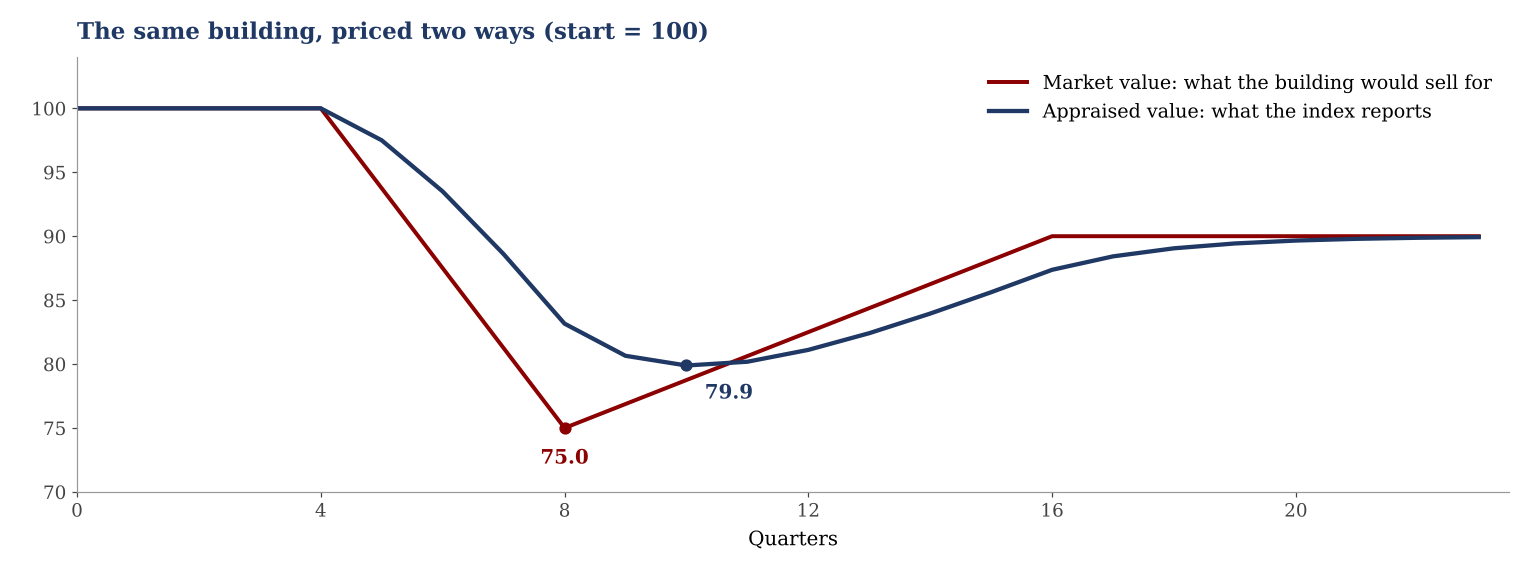
Figure 1. Illustration. The market value of a building falls by a quarter over a year and recovers part of the loss over two more. An appraisal that each quarter gives forty per cent weight to the current market and sixty per cent to its own last estimate falls to 79.9 instead of 75, reaches its low two quarters later, and shows quarterly changes with 31 per cent less variation. Calculated; no market data.
Figure 1 shows the mechanism on simple assumptions. Nothing about the building is calmer than the market; only the estimate is. The economist David Geltner, who worked out how to reverse the smoothing in the 1990s, found that the true variability of commercial property values was substantially greater than appraisal indices showed. Listed property companies, priced on an exchange, have moved much more than the appraisal indices and have moved first; in the short run they move with the stock market, and over longer periods with the property they own.
Infrastructure returns have the same two parts and the same difficulty of measurement. The income is often protected by contract or regulation, and in some cases linked to inflation. The value depends heavily on the rate at which that long income is discounted, so that the asset behaves, in part, like the long bond of Paper III.
V. The carry
The carry of property held outright is its rent less its costs, and it is the best-known carry in the series: the yield that a landlord receives while waiting. Against it stands the cost of the money borrowed to buy the building. When the rent yield is well above the cost of borrowing, the owner is paid to hold, and buildings are bought with as much debt as lenders will provide. When interest rates rise above the rent yield, the carry turns negative, and the owner must either accept a lower value, so that the yield rises, or put in more money.
That arithmetic was tested from 2022, when official interest rates in America and Europe rose faster than at any time in a generation. Buildings did not change; the rate at which their rents were capitalised did. Offices, already weakened by the spread of working from home, were hit hardest, and several large landlords in America, Europe and China defaulted on loans secured on them.
For infrastructure the carry is the margin between the regulated or contracted income and the cost of the debt that finances the asset, and the same arithmetic applies. Assets whose income is fixed and whose debt must be refinanced at higher rates lose value as surely as a bond does.
VI. The ending
Land does not end. Buildings do, slowly, through wear and obsolescence; an office designed for one generation’s work can become unlettable in the next. Concessions end on a fixed date, when the asset passes to the state and the holder’s claim is extinguished, a feature that gives a concession something in common with the bonds of Paper III and nothing in common with land.
The endings that matter to investors are those of the vehicles. The open-ended property fund promises to return money at intervals while owning buildings that take months to sell, and the promise fails when many holders ask at once. British open-ended property funds suspended redemptions after the referendum on leaving the European Union in 2016 and again in March 2020. In December 2022 one of the largest American property trusts sold to private investors began limiting withdrawals when requests exceeded its monthly limit, and continued to do so for many months. In each case the buildings were sound. The fund’s promise of liquidity was not.
The leveraged owner has a more familiar ending. When the value of the building falls below the debt, or the income no longer covers the interest, the lender takes the building. Infrastructure has shown the same: a heavily indebted English water company whose regulated income could not support its borrowing came close to being placed under special administration by the government. The pipes stayed in the ground. The owners’ equity did not survive.
VII. The risk unit
The risk unit of a real asset is the variability of its true value, and Section IV has shown why that is not the variability of its appraisals. A rule that sized a position in property from an appraisal index would treat it as among the safest assets in the series. A rule that sized it from listed property shares would treat it as somewhat riskier than the stock market, because those shares carry the owners’ debt. The truth for an unleveraged building lies between the two, and for most owners, who borrow, it lies nearer the second.
Two further quantities belong in the unit. The first is time to sell, which no measure of volatility captures. A loss that cannot be cut for six months is a different risk from one that can be cut in a second, and the open-ended funds of Section VI were the cost of forgetting it. The second is that real assets are indivisible and local. One building, or one toll road, can be a large part of a portfolio, and its fate turns on one city’s market or one regulator’s decision.
Table 2. The six questions answered for real assets
| Question | Answer |
|---|---|
| Claim | Title to land and buildings; for infrastructure often a concession or a regulated licence. Held directly, through private funds, through listed shares, or as debt secured on the asset |
| Structure | Unique, local, indivisible assets; costly to trade; income set by leases or regulation; almost always financed with debt |
| Return | Over long periods mostly the rent, with real values roughly flat; measured by appraisal, so that reported values move less and later than prices |
| Carry | Rent or regulated income less costs, against the cost of borrowing; positive when rates are low, negative when they rise above the yield |
| Ending | Land none; buildings by obsolescence; concessions on a date. For vehicles, suspension of withdrawals; for leveraged owners, foreclosure |
| Risk unit | The variability of true value, greater than appraisals show; with time to sell and concentration in one place added |
The answers describe the assets. A listed share in a property or infrastructure company takes many of its answers from Paper V.
VIII. The case
The following illustration is drawn from a multi-asset book that traded through a dealer’s contracts in currencies, shares, share indices, funds, commodities and digital tokens. It held no property and no infrastructure asset, and could not have: its rules open and close positions on the evidence of prices that change many times a day, and nothing in Table 1 above the third row has such prices. Three observations concern how the largest asset class in the world reached it nonetheless.
The first is through the index funds. At one weekly close the book held long positions in four funds that track the broad American share market, three of them the leading index and one the whole market. The property sector made up about 1.8 per cent of the leading index in the middle of 2026, and among its members were owners of data centres and telephone masts, the infrastructure of Section I classified as property. Through those funds the book therefore held a little property and a little infrastructure, in the form of shares in listed property trusts, amounting to about two per cent of the funds’ value. Nothing in the book’s records distinguished that part; it was booked, sized and limited as American shares. The world’s largest store of wealth was present in the book as a rounding error in another class.
The second concerns the works that the rest of the economy runs on. The nearest the book came to infrastructure was two telephone companies, owners of large networks of cables, masts and exchanges. It was long a European one and short an American one. At that close the long had been open for nearly eight weeks and stood about eight per cent below its entry; the short had been open for two and a half weeks and stood about six per cent against it. The book’s log recorded both as having aged without progress and referred them for review, and took no action, since its rules permit none on those grounds.
Those two positions illustrate Section II from the outside. A telephone company owns infrastructure, but its shares are not a claim on infrastructure in the sense of this paper. Its income depends on selling a competitive service in markets where prices fall, technology changes and rivals spend heavily, and only in part on the networks it owns. The market classifies such companies with media and internet businesses, not with utilities. The book’s two positions moved, as Section IV would predict of listed shares, with the share market and with each company’s own news, and their behaviour says nothing about the value of a cable in the ground.
The third observation is the absence itself. The book’s rules measure an instrument’s risk from the movement of its price, and that measure is meaningless for an asset that has no price between sales. A building could not be admitted to the book without either an appraisal, which Figure 1 shows would understate its risk, or a listed share, which would bring with it the owner’s debt and the stock market’s moods. Neither is the building.
The case is therefore an account of how a class is held by a book designed for other things: indirectly, in small amounts, and through wrappers that change its character. It does not show that the book should hold more of it, and the paper makes no such argument.
IX. What would falsify this reading
The paper has argued that appraisal indices understate the volatility of property. The argument is well established, but the size of the understatement is not, and methods of reversing it disagree. If properly corrected values turned out to vary little more than appraisals suggest, the calm of property would be partly real, and the case for sizing it as a low-risk asset stronger than this paper allows.
The long-run figures cited, from Amsterdam and from sixteen countries since 1870, are evidence about housing in particular places and periods. Commercial property and infrastructure have shorter records, and the returns of the private funds that hold them are reported by their managers on the basis of their own appraisals.
The case rests on one book’s positions at one close. The weight of property in its index funds is taken from the published sector weight of the index and not from the funds’ own holdings, and the reading of the telephone companies as something other than infrastructure is the paper’s own.
Most of the world’s property and infrastructure is held privately, through funds that do not trade, and the private markets in which it is held are taken up again in the closing paper. The next paper turns to markets newer than any described so far: in carbon, power, freight, weather and events.
References
Dr. Glen Brown (2026). What an Asset Class Is; Government Debt and the Price of Time; Credit; Equities; Indices, Funds and Exchange-Traded Products. The Instruments of Capital, Papers I, III, IV, V and VI. Public Doctrine Series.
Boston Consulting Group (2026). Infrastructure Strategy 2026: A Year of Increasing Scale and Diversification. March 2026.
Eichholtz, P. M. A. (1997). A long run house price index: the Herengracht index, 1628–1973. Real Estate Economics 25(2), 175–192.
Geltner, D. (1993). Estimating market values from appraised values without assuming an efficient market. Journal of Real Estate Research 8(3), 325–345.
Jordà, Ò., Knoll, K., Kuvshinov, D., Schularick, M. and Taylor, A. M. (2019). The rate of return on everything, 1870–2015. Quarterly Journal of Economics 134(3), 1225–1298.
Savills (2025). World’s real estate worth $393.3 trillion and is the world’s largest store of wealth.
Schwab Center for Financial Research (2026). Sector Views: Monthly Stock Sector Outlook. Sector weights as of 30 June 2026.
Related in the Public Doctrine Series
Government Debt and the Price of Time: The Instruments of Capital, Paper III, on why long, steady income behaves like a long bond.
Indices, Funds and Exchange-Traded Products: The Instruments of Capital, Paper VI, on what is inside the funds through which the book held its property.
Credit: The Instruments of Capital, Paper IV, on borrowing secured on assets.
Download the PDF
About the Author
Dr. Glen Brown is President & CEO of Global Financial Engineering, Inc. and Global Accountancy Institute, Inc. He is the architect of the GCPIAUT framework and the broader GATS-native proprietary capital doctrine. His work focuses on sovereign capital governance, algorithmic trading architecture, reserve-first compounding systems, and institutional financial engineering within closed proprietary environments.
Business Model Clarification
Global Financial Engineering, Inc. and Global Accountancy Institute, Inc. operate as closed-loop proprietary institutions. They do not offer public investment products through the doctrines described herein, do not invite retail participation into their proprietary capital architecture, and do not present the GCPIAUT framework as a public collective investment scheme. The concepts discussed in this article are part of the firms’ internal intellectual and operating doctrine.
Risk Disclaimer
Trading and investment activity across foreign exchange, equities, futures, commodities, and digital assets involves substantial risk. Market conditions may change rapidly, and losses may occur. This article is provided for intellectual, institutional, and educational discussion only and does not constitute investment advice, an offer, a solicitation, or a recommendation to buy or sell any financial instrument or to participate in any investment structure.