The Instruments of Capital · Paper XIV
Digital Assets
A token that is no one’s promise, held by whoever holds its key. What the several things called digital assets are claims on, and what is left of them inside a wrapper.
Dr. Glen Brown · Global Financial Engineering, Inc. · Global Accountancy Institute, Inc. · 14 November 2026 · GFE-PUB-IOC-20261114-L
About this series
The Instruments of Capital is a sub-series of the Public Doctrine Series. It sets out, one class at a time, every kind of asset a proprietary firm could trade, whether or not the firm trades it today. Each paper puts its subject through the six questions set in Paper I: claim, structure, return, carry, ending and risk unit. The case in Section VIII is an illustration built from operating data. Its figures have been altered and it reports no account’s results.
I. The fifth kind of claim
Paper I listed six kinds of claim, and five of them are old. Ownership, debt, money, goods and contracts were all familiar to a merchant of the seventeenth century. The fifth on the list, the bearer digital token, dates from 2009. It is the only kind of claim in this series to have been invented within the working life of those now trading it.
The invention was a way for strangers to keep a single ledger without anyone being in charge of it. A network of computers agrees, every few minutes, on which entries are valid, and an entry can be changed only by whoever holds a secret number, the key, associated with it. The units recorded on such a ledger are the tokens. The first of them, bitcoin, was designed to be money that no bank or government issues.
The class has since grown large and been absorbed, in part, into ordinary finance. The total value of all tokens stood at about $2.66 trillion in early November 2026. Bitcoin, which reached $126,250 in October 2025, ended the first week of November 2026 at about $76,000, some forty per cent lower. Tokens designed to hold a value of one dollar amounted to about $300 billion in the middle of 2026, with two issuers accounting for more than four-fifths. Funds holding bitcoin have been listed on American stock exchanges since January 2024.
The difficulty for this paper is that the name covers instruments with almost nothing in common but the ledger they are recorded on. The first task is to separate them.
A token held by its key is a claim on no one. Held any other way, it is a claim on whoever is holding it for you.
II. The claim
Table 1. Five things called digital assets
| Family | Examples | A claim on | Income |
|---|---|---|---|
| Monetary tokens | Bitcoin, and its lesser imitators | No one. A unit on a ledger, limited in number by the rules of the network | None |
| Platform tokens | Ether, Solana | No one. Needed to pay for the use of a network that runs programs | New tokens paid to those who lock theirs up to help run the network |
| Stablecoins | Dollar tokens of two large issuers and many small ones | The issuer, for one dollar, backed by reserves of Treasury bills and deposits | None to the holder; the issuer keeps the interest on the reserves |
| Tokenised securities | Shares of money-market funds and bonds recorded on a ledger | Whatever the security is a claim on, through its issuer | That of the security |
| Application and other tokens | Votes in a protocol; tokens issued as a joke | Usually nothing; sometimes a say in how a program is run | Usually none |
Only the first two rows are new kinds of claim. The third is a deposit and the fourth a security, each recorded in a new way.
The table’s note deserves emphasis. A dollar token is a promise by a company to pay a dollar, supported by a portfolio of short government debt. It belongs with the money of Paper II and the bills of Paper III, and its risks are theirs: the quality of the reserves and the conduct of the issuer. American law since July 2025 has regulated such tokens as payment instruments and forbidden their issuers to pay interest on them. A tokenised fund share is the fund share. Neither is a new asset. They are old assets on a new register.
The new thing is the token that is nobody’s liability. Whoever controls the key controls the units, and no court, bank or registrar stands between. That is ownership in a purer form than a share or a bond allows, and it has the corresponding defect: a key that is lost or stolen is not recoverable, and there is no one to appeal to.
Most holders therefore do not hold the key. They hold an account at an exchange, which is a claim on the exchange; or a share in a listed fund, as in Paper VI; or a future, as in Paper VII; or a contract with no expiry on which the two sides exchange a payment every few hours to keep its price near the token’s; or a dealer’s contract, as in Paper IX. Each restores exactly the dependence on an intermediary that the token was invented to remove.
III. The structure
The supply of bitcoin is fixed by its software. New units are issued to those who maintain the ledger, at a rate that halves about every four years, most recently in April 2024, and the total can never exceed twenty-one million. About ninety-five per cent of them already exist. No other asset in this series has a supply so completely indifferent to its price.
The market has no closing bell. Tokens trade every hour of every day on dozens of venues in many countries, with no central exchange, no official price and no single regulator. A transfer on the ledger itself is final within minutes and cannot be reversed.
Leverage is built into those venues. A trader may post a small deposit and take a position many times larger, and when the price moves against the position the venue closes it automatically. Since many traders are positioned the same way, closures can feed on themselves. On 10 October 2025 positions of the order of nineteen billion dollars were closed in this manner within a day, the largest such event on record.
IV. The return
A monetary token pays nothing. It has no earnings, no coupon and no use in industry, and its value rests wholly on the expectation that others will want to hold it. Paper XII said much the same of gold, and the comparison is the one its advocates make. The difference is that gold has several thousand years of being held and a floor of sorts in jewellery, and bitcoin has seventeen years and none.
Over those years the return has been very large and very uneven. From its peaks of 2013, 2017 and 2021 bitcoin fell by roughly four-fifths before recovering, and from the peak of October 2025 it stood some forty per cent lower thirteen months later. A history of that shape supports any conclusion its reader brings to it. What can be said is that the return has come entirely from a rise in the price others would pay, that there is no cash flow against which that price can be checked, and that estimates of what the token should be worth differ by orders of magnitude.
The platform tokens add a yield. A holder who locks tokens up to take part in validating the ledger is paid in newly issued tokens, at a few per cent a year. Since the payment is made by issuing more of the same token to those who take part, it resembles a share dividend paid in shares: those who take part keep their proportion, and those who do not are diluted.
In its early years bitcoin moved independently of other assets, and was recommended on that ground. Since about 2020 it has tended to rise and fall with technology shares, more so in falling markets. The diversification it offers a share portfolio has been least when most wanted.
V. The carry
A token held by its key costs nothing to hold and earns nothing. Every other way of holding has a carry, and it is often larger than holders suppose. A listed fund charges a fee. A future ordinarily stands above the token’s price, and a long position rolled forward pays the difference; those who buy the token and sell the future earn it. The contract without expiry settles a payment between longs and shorts several times a day, which in rising markets has run for long periods at rates far above those in money markets, paid by those who are long. A dealer’s contract carries a nightly financing charge of the kind described in Paper IX.
VI. The ending
A token that is no one’s liability cannot default. It can end in other ways, and the class has a fuller record of endings than any other in this series over so short a life.
The holder’s key can be lost, and the units are then beyond anyone’s reach. The intermediary can fail: an exchange in Tokyo closed in 2014 with some 850,000 bitcoin missing, and one of the largest exchanges in the world collapsed in November 2022 with a shortfall of several billion dollars in customers’ assets. The design of a token can fail: in May 2022 a dollar token that was supported by an algorithm and not by reserves lost its value in a week, and some forty billion dollars with it. The program that holds tokens can be robbed. And a token can simply cease to be wanted. Thousands have been issued and most are worth nothing.
The leveraged contracts have an ending of their own. When a venue cannot close a losing position at a price that covers the loss, its rules allow it to close profitable positions on the other side instead. A trader who was right may find the position gone at the moment it was most valuable. It is the cancellation of trades from Paper VII in automatic form.
VII. The risk unit
The risk unit of a digital asset is its volatility, and three features distinguish it.
The first is the level. Bitcoin has in recent years varied by fifty to sixty per cent a year, three or four times a share index, and most other tokens by considerably more. A position sized by volatility will be a small one.
The second is that the tokens move together. In a general fall nearly all of them fall, the smaller ones further. A book that holds a dozen tokens does not hold a dozen positions.
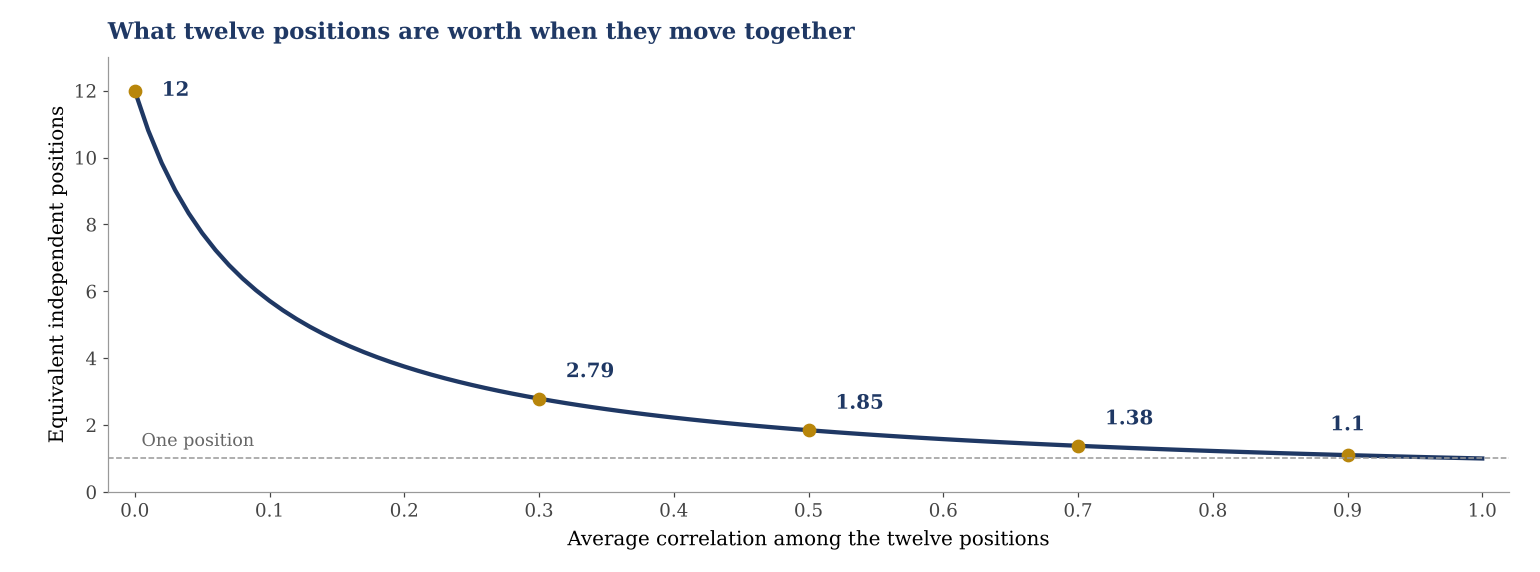
Figure 1. Illustration. The number of independent positions to which twelve equally sized positions are equivalent, as the average correlation among them rises. At a correlation of 0.5 the twelve are equivalent to 1.85 independent positions; at 0.7, to 1.38; at 0.9, to 1.10. Calculated; no market data.
Figure 1 gives the arithmetic. With no correlation, twelve positions of equal size diversify as twelve. At an average correlation of one-half they are worth fewer than two, and at the levels often seen among large tokens in a falling market they are little more than one. This is the point of Paper VI about baskets, in a class where it applies with unusual force.
The third is the calendar. The market trades at weekends and through holidays, when shares, bonds and most futures are shut. A token’s risk accrues over three hundred and sixty-five days and not two hundred and fifty-two, and for two days in seven it is the only part of a mixed book that can move. The weekend is also when trading is thinnest and the automatic closures described above have often occurred.
Table 2. The six questions answered for digital assets
| Question | Answer |
|---|---|
| Claim | For monetary and platform tokens, on no one: control of a key. For dollar tokens, on an issuer and its reserves. For any token held through an exchange, fund or contract, on that intermediary |
| Structure | A shared ledger without an operator; supply set by software; trading at all hours on many venues; heavy use of leveraged contracts closed automatically |
| Return | No cash flow. A price that rests on the willingness of others to hold; very large and very uneven to date; for platform tokens, a yield paid in new tokens |
| Carry | None for a token held by its key. A fee, a futures premium, a periodic payment between longs and shorts, or a financing charge for every other form |
| Ending | No default. Loss of the key, failure of the intermediary, failure of the design, theft, or simple abandonment; for leveraged contracts, closure by the venue |
| Risk unit | Volatility several times that of shares; tokens that move as one; risk that runs seven days a week |
Tokenised securities take their answers from the security they record.
VIII. The case
The following illustration is drawn from a multi-asset book that traded a dozen of the largest tokens through a dealer’s contracts, beside currencies, shares, indices and commodities. Four observations are reported.
The first is what the book held. It held no token and no key. It had no account on any ledger and could not have withdrawn a unit of anything. Its positions were contracts with a dealer that paid the change in a quoted price. Of the properties that make a token a new kind of claim, the absence of an issuer, the finality of transfer and control by key, none reached the book. What reached it were the price, the volatility and the calendar. The book’s claim was the claim of Paper IX, on a dealer, and the first question of Paper I had the same answer for its bitcoin as for its copper.
The second is direction. At one weekly close the book was short the two largest tokens and one other, and long two smaller ones. A token itself is awkward to sell short, since it must first be borrowed; a contract makes it as simple as buying, so the wrapper had supplied a facility the token lacks. The book’s rules had reached the five positions separately. In a class that moves as Figure 1 describes, they were not five positions. The longs and the shorts largely offset one another against a general move, and what remained was chiefly a position in the difference between smaller tokens and larger ones, which no rule of the book had chosen.
The third is the calendar. The book’s rules run every day. One of those short positions was opened in the first hours of a Saturday, when every other market the book trades was closed. Until the following Monday the digital positions were the only part of the book that could change in value or be added to, and nothing else in the book could be adjusted in response.
The fourth concerns stops. The book records, for each class, what a position cost when its protective stop was reached, as a multiple of the loss planned for. In most classes the figure stood within a per cent or two of the plan. In the digital class it was several per cent above, the widest overshoot in the book. This rests on two instances and proves nothing by itself. It is the direction that Sections III and VII would lead one to expect, in a market that gaps and is thin at the hours when stops are reached.
The case shows a class entering a book stripped of what makes it a class. The book did not own digital assets. It owned a dealer’s promise indexed to them, and it received their risk unit in full: high volatility, common movement and a seven-day week. Whether that is a reason to hold such contracts or to avoid them is not a question this paper answers. It is a reason to be clear about which of the two things is in the book.
IX. What would falsify this reading
The paper has described the value of a monetary token as resting on the willingness of others to hold it, with no cash flow behind it. Those who hold it would say the same of gold and of banknotes and would add that scarcity enforced by software is a firmer basis than either. The paper’s account would be weakened by a long period in which the token held its real value through a general fall in other assets, which is the test gold has passed and bitcoin has not yet faced in that form.
The claim that tokens move as one is strongest in falling markets and for the largest tokens. In quieter periods correlations are lower and individual tokens have their own histories. Figure 1 shows a mechanism and uses no measured correlation. A book that found its tokens to be weakly related over a full cycle would be right to count them as more than one position.
The fourth observation of the case rests on two events and is offered as an indication only. A larger record in which stops in this class were filled as close to plan as in others would remove it.
The next paper turns from the newest asset to the oldest: land, buildings and the works built on them.
References
Dr. Glen Brown (2026). What an Asset Class Is; Money and Foreign Exchange; Indices, Funds and Exchange-Traded Products; Futures and Forwards; Swaps and the Over-the-Counter Contract; Metals. The Instruments of Capital, Papers I, II, VI, VII, IX and XII. Public Doctrine Series.
Nakamoto, S. (2008). Bitcoin: a peer-to-peer electronic cash system.
RTTNews (2026). Cryptos extend gains amidst short squeeze. 6 November 2026.
The Block (2026). The largest stablecoins ranked; and Stablecoin supply tops $300 billion but growth stalls. May and July 2026.
United States Congress (2025). Guiding and Establishing National Innovation for U.S. Stablecoins Act. Signed 18 July 2025.
Related in the Public Doctrine Series
What an Asset Class Is: The Instruments of Capital, Paper I, which names the bearer digital token as the fifth kind of claim.
Metals: The Instruments of Capital, Paper XII, on gold, the asset to which bitcoin is most often compared.
Swaps and the Over-the-Counter Contract: The Instruments of Capital, Paper IX, on the dealer’s contract through which the book in the case held its positions.
Download the PDF
About the Author
Dr. Glen Brown is President & CEO of Global Financial Engineering, Inc. and Global Accountancy Institute, Inc. He is the architect of the GCPIAUT framework and the broader GATS-native proprietary capital doctrine. His work focuses on sovereign capital governance, algorithmic trading architecture, reserve-first compounding systems, and institutional financial engineering within closed proprietary environments.
Business Model Clarification
Global Financial Engineering, Inc. and Global Accountancy Institute, Inc. operate as closed-loop proprietary institutions. They do not offer public investment products through the doctrines described herein, do not invite retail participation into their proprietary capital architecture, and do not present the GCPIAUT framework as a public collective investment scheme. The concepts discussed in this article are part of the firms’ internal intellectual and operating doctrine.
Risk Disclaimer
Trading and investment activity across foreign exchange, equities, futures, commodities, and digital assets involves substantial risk. Market conditions may change rapidly, and losses may occur. This article is provided for intellectual, institutional, and educational discussion only and does not constitute investment advice, an offer, a solicitation, or a recommendation to buy or sell any financial instrument or to participate in any investment structure.