The Instruments of Capital · Paper XII
Metals
One metal is held and never used. The others are used and scarcely held. What is owned when metal is owned, and why gold and copper answer the six questions differently.
Dr. Glen Brown · Global Financial Engineering, Inc. · Global Accountancy Institute, Inc. · 14 November 2026 · GFE-PUB-IOC-20261114-J
About this series
The Instruments of Capital is a sub-series of the Public Doctrine Series. It sets out, one class at a time, every kind of asset a proprietary firm could trade, whether or not the firm trades it today. Each paper puts its subject through the six questions set in Paper I: claim, structure, return, carry, ending and risk unit. The case in Section VIII is an illustration built from operating data. Its figures have been altered and it reports no account’s results.
I. Goods that are not destroyed
Paper XI described goods that are bought to be burned. Metals differ in the one respect that matters most to their price: they survive use. Copper drawn into wire in 1950 is copper still, and much of it will be melted and drawn again. Gold survives so completely that nearly all that has ever been mined is thought to exist today, in vaults, in jewellery and in the reserves of central banks.
That durability divides the class in two. Most metals are industrial materials, wanted for what can be made from them, and their markets resemble the energy markets of the last paper. One metal is wanted chiefly in order to be kept, and its market resembles the market for money described in Paper II. To speak of metals as an asset class is to join two things that answer the six questions in nearly opposite ways.
Both halves have been active. Trading in metals futures and options on the world’s exchanges rose 63 per cent to 2.64 billion contracts in the first half of 2026. The London price of gold averaged $4,262 an ounce in the third quarter, 23 per cent above a year earlier and below its average of $4,873 in the first. Central banks bought a net 321 tonnes in that quarter, 42 per cent more than a year before, and 675 tonnes in the first nine months. Copper for delivery in three months on the London exchange reached a record of about $14,728 a tonne on 8 September 2026.
Gold is priced by those willing to hold what already exists. Copper is priced by those who need what has not yet been mined.
II. The claim
Metal owned outright is a physical object in a named place: a numbered bar in a vault, or a parcel of copper cathode in an approved warehouse, evidenced by a document of title. That is the one form in which the claim is on the goods and on no one’s promise.
Most holdings are something else, and the difference is easily overlooked. In the London bullion market the greater part of gold is held unallocated: the customer has an account with a bank denominated in ounces, and is the bank’s creditor for that quantity, with no particular bars set aside. It is a deposit in gold, with the same dependence on the bank that Paper II described for a deposit in dollars. A fund that holds bars in trust for its shareholders is nearer to ownership, on the terms set out in Paper VI. A future is a contract, as in Paper VII. A share in a mining company is not a claim on metal at all. It is a share, with a management, a cost of production and a balance sheet, and it belongs in Paper V.
Table 1. Five families called metals
| Family | Members | Principal use | What moves the price |
|---|---|---|---|
| Monetary | Gold; silver in part | Kept as a store of value by households, funds and central banks; jewellery | Interest rates after inflation, the dollar, official purchases, fear |
| Industrial | Copper, aluminium, zinc, nickel, lead, tin | Wiring, construction, transport, packaging, alloys | World industrial activity; mine and smelter supply; the cost of power |
| Platinum group | Platinum, palladium, rhodium | Catalysts for vehicle exhausts and chemistry | Vehicle output and regulation; supply from very few countries |
| Ferrous | Iron ore, steel, coking coal | Construction and manufacturing | Building activity, above all in China |
| Battery and minor | Lithium, cobalt, rare earths | Batteries, magnets, electronics | Choices of technology; concentrated processing; thin futures markets or none |
Silver belongs to two families. About half of its use is industrial, and it trades with gold on some days and with copper on others.
III. The structure
The property that separates the families can be put as a single number: how much of the metal is held above ground compared with how much is produced in a year. For gold the stock is of the order of sixty years of mine output. For copper the metal visible in exchange warehouses has typically amounted to a few weeks of world use.
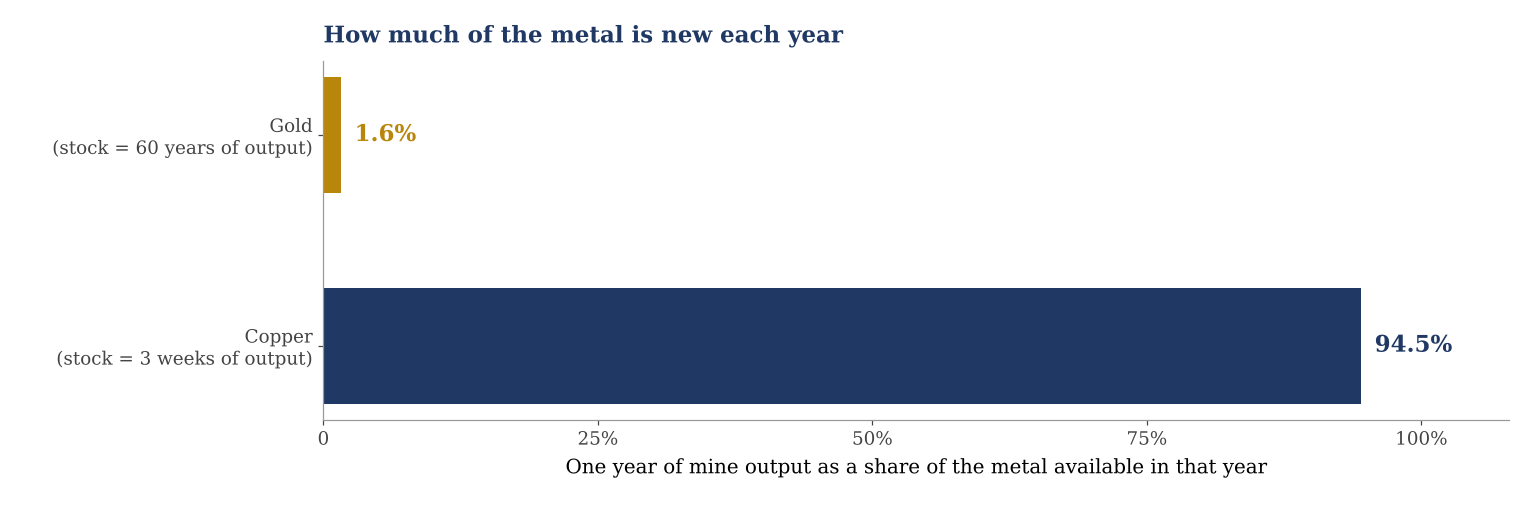
Figure 1. Illustration. One year’s mine output as a share of the metal available in that year, taken as the stock held above ground plus the year’s output. With a stock equal to sixty years of output, as assumed for gold, the year’s output is 1.6 per cent of what is available. With a stock equal to three weeks of output, as assumed for copper, it is 94.5 per cent. Calculated on round assumptions; no market data.
Figure 1 turns the two ratios into the share of available metal that a year’s mining represents. For gold it is under two per cent. If every gold mine closed for a year, the quantity of gold in the world would be all but unchanged, and the price of gold cannot therefore be set by mining. It is set by the terms on which the holders of the existing stock are willing to go on holding it. For copper nearly all the metal available in a year is that year’s production. A strike at a large mine, a smelter without power or a change in a tariff bears directly on what can be delivered, and the price responds as an energy price does.
The venues reflect the difference. Gold trades chiefly between banks in London for delivery there, in a market without an exchange, and through futures in New York and Shanghai. The industrial metals trade on an exchange in London whose contracts are unlike other futures: a position may be opened for any business day up to three months ahead, and the difference in price between two dates is itself the principal object of trade. Those differences are how the market reports whether metal is plentiful or short in the warehouses today.
IV. The return
Gold yields nothing. A holder is rewarded only by a rise in price, and over very long periods the rise has approximately matched the rise in other prices and no more. Jastram’s study of gold’s purchasing power over four centuries called it the golden constant. Erb and Harvey, revisiting the question in 2013, agreed about the very long run and observed that over any span relevant to an investor the real price of gold has wandered far from that level in both directions for decades at a time. The buyer of gold at a high real price in 1980 waited more than a quarter of a century to be made whole.
What moves the price within those spans is the cost of holding something that pays nothing. When interest rates stand well above inflation, the holder of gold forgoes a real income, and gold has tended to fall; when they stand below, it has tended to rise. That relation was close for many years. It has been weaker since about 2022, a period in which gold rose while real interest rates were high and central banks bought on a scale not seen in decades. The purchases reported at the head of this paper are part of that pattern. Whether it is a lasting change in who holds gold and why, or an episode, cannot yet be said.
The industrial metals have no such monetary character. Their prices follow the world’s industrial cycle, and their supply responds slowly, since a new mine takes ten years or more from discovery to production. The result is the pattern seen in energy: long periods near the cost of production, interrupted by years in which demand outruns the mines and the price must rise far enough to ration what there is.
V. The carry
The cost of keeping gold is small in outlay and large in income forgone. Vaulting and insurance come to a fraction of one per cent a year. The interest that the same money would earn is the real carry, and it is why gold is sensitive to interest rates.
The gold futures curve shows the same fact from another side. Since the stock is vast and can be lent, there is never a shortage of gold for delivery today, and later months stand above earlier ones by close to the rate of interest. The curve reports the price of money and tells nothing about gold. A long position in gold futures pays that slope, which is the holder’s forgone interest in another form.
For the industrial metals the curve reports the state of the warehouses, as Paper VII described for goods in general. When stocks are ample, later dates stand above earlier ones by roughly the cost of storage and finance. When stocks are low, metal for immediate delivery commands a premium, and a holder who is long is paid to wait while one who is short pays, sometimes heavily, for each day.
VI. The ending
Gold does not end. It is not consumed, does not mature and cannot default. That is the whole of its claim to be money, and it means that the question of the ending applies only to the instrument through which it is held.
Those instruments have ended in instructive ways. In January 1980 silver stood near fifty dollars an ounce after two brothers and their associates had accumulated a large part of the deliverable supply through futures. The exchange changed its rules to permit only the closing of positions, the price fell, and by 27 March, when the brothers failed to meet a margin call, it had lost more than three-quarters. In 1996 a trader at a Japanese trading house was found to have held copper prices up for years through positions that cost his employer some $2.6 billion. In March 2022 the London exchange cancelled a morning’s trades in nickel, as Paper VII recorded. In each case the metal was unaffected and the contract was not.
There is a quieter kind of ending in the differences between places. Gold in London and gold in New York are the same metal in bars of different sizes, and in March 2020, when refineries and flights stopped, the two prices parted by tens of dollars an ounce for want of a way to turn one into the other. In 2025 the prospect of an American tariff carried the New York price of copper far above London’s, and when refined metal was exempted at the end of July the New York price fell by about a fifth in a day. A position in a metal is always a position in that metal at a place.
VII. The risk unit
The two halves of the class have different risk units. Gold has commonly varied by about fifteen per cent a year, similar to a share index or somewhat less, and its movements are related to interest rates and the dollar more than to industry. Copper has varied by twenty to twenty-five per cent, and silver and the platinum metals by thirty or more. A rule that sizes positions by volatility will treat an ounce of gold and a tonne of copper correctly as to size. It will not thereby know that they respond to different things.
The contracts are large. The standard gold future is for one hundred ounces, which at the third-quarter average price is some $426,000 of metal. The London copper contract is for twenty-five tonnes, about $350,000 at fourteen thousand dollars a tonne. Smaller versions exist for both. A book that cannot divide the contract meets the difficulty described for energy: the least it can hold may be more than its rule would choose.
The relation between the families is unstable. In an industrial boom copper rises and gold may not. In a financial panic gold may rise while copper falls with shares. Positions in the two under one heading can therefore offset one another on some days and compound on others, and silver may side with either.
Table 2. The six questions answered for metals
| Question | Gold | Industrial metals |
|---|---|---|
| Claim | On a bar in a vault if allocated; otherwise on a bank, a fund or a contract | On metal in an approved warehouse, or on a contract that refers to it |
| Structure | A stock of some sixty years of output; traded between banks and through futures | Stocks of weeks; traded by date on an exchange, with the differences between dates central |
| Return | No income. Over centuries, the rate of inflation; over decades, far from it in both directions | No income. The industrial cycle against a supply that takes a decade to respond |
| Carry | Storage is small; the interest forgone is the cost. The futures curve is a money curve | Storage and finance when stocks are ample; a premium for metal now when they are not |
| Ending | None for the metal. For the instrument, the rules of the venue and the place of delivery | Use and recycling for the metal. For the instrument, the same, with squeezes more frequent |
| Risk unit | About fifteen per cent a year; linked to interest rates and the dollar | Twenty per cent and upward; linked to industrial activity; large contracts |
Silver takes its answers from both columns.
VIII. The case
The following illustration is drawn from a multi-asset book that held copper through a dealer’s contract. It concerns two positions and what the book did and did not do about them.
The book’s rules open a position when an instrument’s own prices show a trend, set a protective stop at a distance derived from the instrument’s measured movement, and size the position so that a close at the stop costs a fixed fraction of capital. They do not close a position on the passage of time. In the weeks after copper had set its record, the rules opened two long positions in the metal within three days of each other, at prices close to that record.
Copper then fell. At a weekly close some seven weeks later it stood roughly a tenth below the two entry prices. Neither position had reached its stop. Each had been charged or credited financing every night, as Paper IX described for contracts of this kind. The book’s own log recorded both positions as having aged without progress and referred them for review, and it took no action, since no rule of the book permits a close on those grounds.
Two readings of this are available and the paper cannot choose between them. On the first, the book bought an industrial metal at the top of a move, as trend-following rules are liable to do, and has carried a loss for seven weeks. On the second, nothing has yet happened. A metal that varies by something over twenty per cent a year will, over seven weeks, move by about eight per cent in one direction or the other as a matter of course. A fall of a tenth is a little more than one such ordinary move. A stop set close enough to have been reached by it would be reached, in copper, by most positions held for two months, and the positions were sized on the understanding that it would not be.
The case is open at the date of writing. It may end at the stop, at the entry price or in profit, and the paper does not know which. What it illustrates is the risk unit in operation. The distance of the stop and the size of the position are a statement, made in advance, about how far copper may go against a position before the position is wrong. Seven weeks and a tenth of the price had not exhausted that statement. Whether the statement was well made is the question the outcome will bear on, and one outcome will not settle it.
It also illustrates Section VII’s last point from the other side. The book held no gold beside the copper. Had it done so, a report would have shown two positions in metals, and they would have had almost nothing to do with one another.
IX. What would falsify this reading
The account of gold rests on its being held and not used, and on the price being set by the willingness to hold. The weakening since 2022 of the link between gold and real interest rates is a difficulty for the simple version of that account, and the paper has said so. If official purchases were to cease and gold did not return towards its former relation with interest rates, some further explanation would be required.
Figure 1 is drawn on two round assumptions about stocks. The stock of gold above ground is an estimate, and the copper figure counts only metal in exchange warehouses and leaves out unreported stocks, which may be larger. With any plausible revision the two metals remain far apart, but the copper bar in particular should be read as an order of magnitude.
The volatility figures in Section VII are typical levels from past decades and not constants. The arithmetic in the case depends on one of them. If copper’s variability over the period was materially lower than assumed, a fall of a tenth was a larger event than the paper has allowed.
The next paper completes the goods that are grown and reared: the agricultural commodities and livestock.
References
Dr. Glen Brown (2026). Money and Foreign Exchange; Indices, Funds and Exchange-Traded Products; Futures and Forwards; Swaps and the Over-the-Counter Contract; Energy. The Instruments of Capital, Papers II, VI, VII, IX and XI. Public Doctrine Series.
Erb, C. B. and Harvey, C. R. (2013). The golden dilemma. Financial Analysts Journal 69(4), 10–42.
FIA (2026). Commodity fragmentation reshapes derivatives markets. FIA MarketVoice, citing Trends in ETD Trading, Q2 2026.
Jastram, R. W. (1977). The Golden Constant: The English and American Experience, 1560–1976. New York: Wiley.
Shanghai Metals Market (2026). LME copper hits fresh record above $14,700/mt as supply concerns support rally. 9 September 2026.
World Gold Council (2026). Gold Demand Trends: Q3 2026. 3 November 2026.
Related in the Public Doctrine Series
Energy: The Instruments of Capital, Paper XI, on goods that are bought to be destroyed.
Money and Foreign Exchange: The Instruments of Capital, Paper II, on money and on the difference between holding it and holding a claim to it.
Futures and Forwards: The Instruments of Capital, Paper VII, on what the slope of a futures curve reports.
Download the PDF
About the Author
Dr. Glen Brown is President & CEO of Global Financial Engineering, Inc. and Global Accountancy Institute, Inc. He is the architect of the GCPIAUT framework and the broader GATS-native proprietary capital doctrine. His work focuses on sovereign capital governance, algorithmic trading architecture, reserve-first compounding systems, and institutional financial engineering within closed proprietary environments.
Business Model Clarification
Global Financial Engineering, Inc. and Global Accountancy Institute, Inc. operate as closed-loop proprietary institutions. They do not offer public investment products through the doctrines described herein, do not invite retail participation into their proprietary capital architecture, and do not present the GCPIAUT framework as a public collective investment scheme. The concepts discussed in this article are part of the firms’ internal intellectual and operating doctrine.
Risk Disclaimer
Trading and investment activity across foreign exchange, equities, futures, commodities, and digital assets involves substantial risk. Market conditions may change rapidly, and losses may occur. This article is provided for intellectual, institutional, and educational discussion only and does not constitute investment advice, an offer, a solicitation, or a recommendation to buy or sell any financial instrument or to participate in any investment structure.