The Instruments of Capital · Paper XI
Energy
Oil, refined fuels, natural gas and power are called one asset class and are several markets. What is held when energy is held, and why its price moves as it does.
Dr. Glen Brown · Global Financial Engineering, Inc. · Global Accountancy Institute, Inc. · 14 November 2026 · GFE-PUB-IOC-20261114-I
About this series
The Instruments of Capital is a sub-series of the Public Doctrine Series. It sets out, one class at a time, every kind of asset a proprietary firm could trade, whether or not the firm trades it today. Each paper puts its subject through the six questions set in Paper I: claim, structure, return, carry, ending and risk unit. The case in Section VIII is an illustration built from operating data. Its figures have been altered and it reports no account’s results.
I. The goods themselves
The last four papers described forms of contract. This one and the three that follow describe goods: things that are produced, moved, stored and used up. Paper I called this the fourth kind of claim. A barrel of oil promises nothing and pays nothing, and unlike every instrument so far it ceases to exist when it serves its purpose.
Energy comes first among the goods since it is the largest and the one on which the others depend. It is also the plainest case of a general difficulty. The word suggests one market. There are at least five, each with its own unit, its own geography and its own behaviour, and a position in one is not a position in another.
The year of writing has supplied an illustration that no paper on the subject can pass over. Before 28 February 2026 the international benchmark for crude oil stood at about seventy dollars a barrel. A conflict that began on that date brought shipping through the Strait of Hormuz, which ordinarily carries about a fifth of the world’s oil and liquefied natural gas, almost to a halt. On 30 April the benchmark touched $126.41, its highest since March 2022. The International Energy Agency described the event as the largest disruption of supply in the history of the market, and its report of October 2026 expected world oil demand to be 2.6 million barrels a day lower over the year. Trading in energy futures and options on the world’s exchanges reached 2.08 billion contracts in the first half of 2026, 34 per cent more than a year earlier.
This paper is not about that event, whose course is not settled as it is written. It is about the properties of the class that made such a price movement possible, and they were present long before.
Energy is bought to be destroyed. Its price is set by those who must have it this month, and they will pay almost anything.
II. The claim
To own energy outright is to own a physical thing in a particular place: crude oil in a tank at a named terminal, gas in an underground cavern, a cargo on a ship. The claim is on the goods and, in practice, on whoever operates the tank, the cavern or the vessel.
Very few participants in the financial market hold energy in that form. They hold a future, an option on a future, a swap, a dealer’s contract or a fund that holds futures, each of which has been the subject of an earlier paper. The answers given there apply in full. What this paper adds is the nature of the thing those contracts refer to.
Table 1. Five markets called energy
| Market | Unit and principal benchmarks | Storage | What moves the price in the short run |
|---|---|---|---|
| Crude oil | The barrel; Brent, West Texas Intermediate, Dubai | In tanks and ships, at a cost | Stocks, producers’ decisions, shipping routes |
| Refined products | The barrel or tonne; petrol, diesel, heating oil, jet fuel | Possible, and dearer than for crude | Refinery capacity, the season, local shortage |
| Natural gas | Energy content; Henry Hub in America, TTF in Europe, a marker for Asian cargoes | Underground, where geology allows | Weather, pipeline and liquefaction capacity |
| Electricity | The megawatt-hour, for a named place and hour | Scarcely at all | Demand and the plant available, hour by hour |
| Coal | The tonne; Newcastle, Rotterdam | Cheap and simple | Demand from power stations, freight |
Emission allowances, often traded beside these, are a created instrument and are treated in Paper XVI.
III. The structure
Crude oil is not one substance. It varies in density and sulphur content, and each grade suits some refineries and not others. The quoted price of oil is the price of a benchmark grade at a benchmark place, and every other barrel in the world is priced at a premium or discount to one of three or four such markers. The premiums and discounts move, sometimes sharply, when a route closes or a refinery fails.
Nobody burns crude oil. It is bought by refiners and turned into products, and the difference between the price of the products and the price of the crude is the refiner’s margin. That margin is traded in its own right, and it means that crude and its products, though made from one another, can part company. When refining capacity is short, diesel may rise while crude falls.
Natural gas was for most of its history a set of regional markets joined by pipelines and otherwise separate. The growth of trade in liquefied gas by ship has connected them without merging them. A cargo can go to Europe or to Asia, so that a shortage in one raises the price in the other, but the cost and limited capacity of liquefaction and shipping allow American, European and Asian prices to stand far apart for years. In August 2022 the European benchmark rose to more than ten times its level of two years before; the American one did not come close to that. In the first half of 2026 trading in futures on the European benchmark was 36 per cent above the same months of 2025.
Electricity is the limiting case. It cannot be stored in quantity and must be produced at the instant it is used, so that a megawatt-hour at six in the evening in one region is a different good from a megawatt-hour at three in the morning or in the neighbouring region. Prices can be negative when wind and sun exceed demand and can reach the regulatory ceiling when plant fails in a cold spell, as they did in Texas in February 2021.
IV. The return
Goods pay no interest and no dividend. The holder of energy has a return only if the price rises by more than the cost of holding it. Hotelling argued in 1931 that the price of an exhaustible resource in the ground should rise at the rate of interest, since otherwise its owners would extract it faster or slower. The record of real oil prices over a century does not show such a rise. It shows long flat stretches broken by violent episodes.
The source of the violence is that neither the use of energy nor its supply can change quickly. A household must still heat the house and a haulier must still run the lorries next month, whatever the price; a new field or pipeline takes years. Hamilton, reviewing the estimates in 2009, put the short-run response of petrol demand to price at well below one-tenth: a rise of ten per cent in price reduces the quantity bought by less than one per cent. When both sides are so unresponsive, a small shortfall can be closed only by a large change in price.
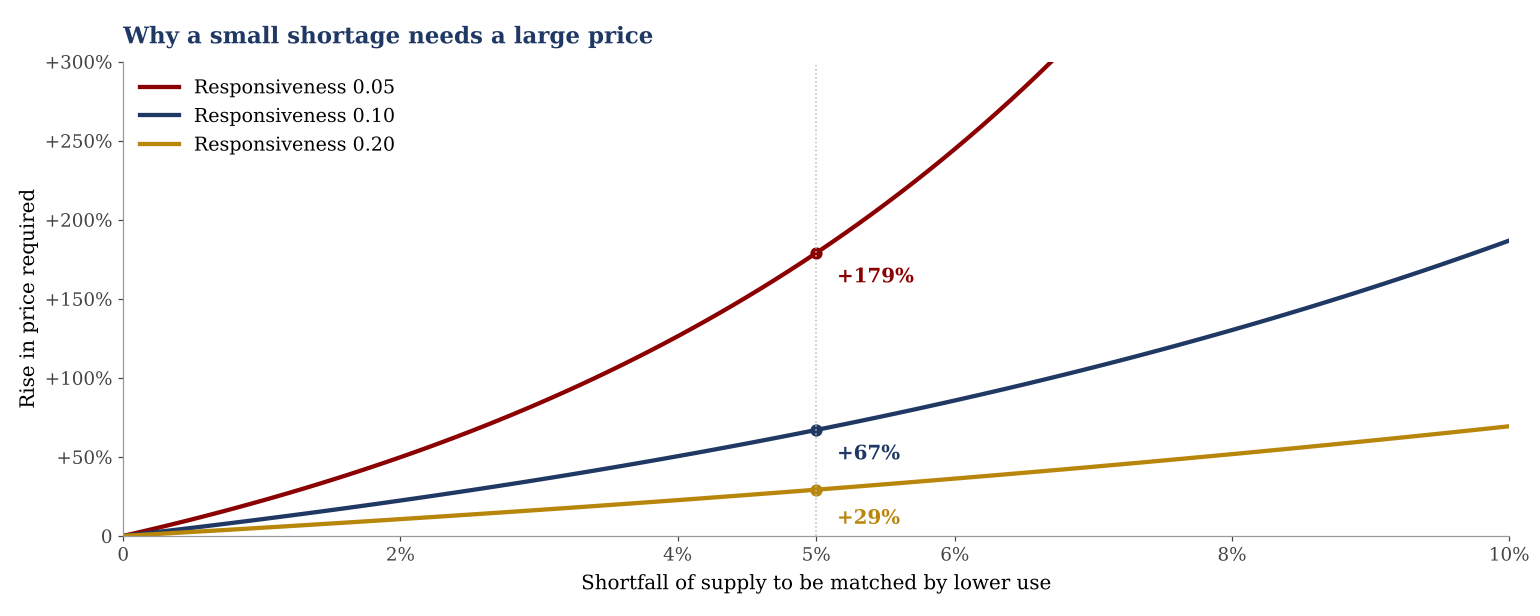
Figure 1. Illustration. The rise in price required to reduce the quantity demanded by a given percentage, supply being fixed, when the responsiveness of demand to price is 0.05, 0.10 and 0.20. With responsiveness of 0.10, a shortfall of five per cent requires a rise of 67 per cent. Calculated from a demand curve of constant elasticity; no market data.
Figure 1 gives the arithmetic. If demand responds to price with an elasticity of one-tenth, the loss of five per cent of supply needs a price two-thirds higher to bring consumption down to match. At one-twentieth the price must nearly triple. The figure is not a forecast of any episode. It shows why a market of this kind is capable of moves that no share index makes without a financial crisis, and why they reverse as sharply when supply returns.
For the holder of futures there has been a second source of return, described in Paper VII. Oil has spent much of its history with nearby prices above distant ones, and a long position rolled along such a curve earns the difference. Litzenberger and Rabinowitz documented this in 1995 and connected it to producers’ option to leave oil in the ground. It is the principal reason long-only holdings of oil futures had respectable returns in some decades. It reverses when stocks are plentiful.
V. The carry
The carry of energy held physically is negative: tanks must be rented, ships chartered, the goods insured and the money tied up. For the holder of a future the carry is the slope of the curve, and in energy the slope is unusually informative. A curve in which nearby months stand above later ones says that the goods are scarce now and that those who hold them are being paid to release them. A curve sloping the other way says that there is more than can be used and that someone is being paid to store it.
Natural gas adds the season. Gas for delivery in winter ordinarily costs more than gas for the preceding autumn, since it must be held underground in between. A long position kept through the year is rolled up that slope every autumn. The curve of power is steeper still and is cut into days, peak and off-peak hours.
VI. The ending
Energy held through a future ends as Paper VII described, and the examples there were not chosen at random. The contract that settled below zero in April 2020 was an oil contract, and the hedging programme that failed in 1993 was in oil products. The goods are bulky, storage at the delivery point is finite, and the last days of an energy contract belong to those with tanks.
The goods themselves end by being burned, which no financial asset does. The stock of any energy commodity above ground is a few weeks or months of use. That is why the market has no cushion of long-term holders of the kind that steadies shares or gold, and why the price must do all the work of matching use to supply.
There is a longer ending about which forecasters disagree. Some projections have the world’s use of oil reaching a peak within a decade as transport is electrified. Others, among them those of the producing countries, see demand growing beyond the middle of the century. The question bears on the value of reserves in the ground and on the shares of companies that own them more than on the price of a contract for delivery next quarter, and this paper takes no position on it.
VII. The risk unit
The risk unit of an energy position is the volatility of the full value of the goods the contract controls, and three features make it larger and less stable than in any class so far.
The first is the level. Crude oil has commonly varied by thirty to forty per cent a year, about twice the variability of a share index, and natural gas by half as much again or more. The second is the size of the contract. The standard crude future is for a thousand barrels, so that at ninety dollars one contract controls ninety thousand dollars of oil; the standard American gas contract is for ten thousand units of energy content. For any but a large book the smallest position available is already a considerable one. The third is that energy prices jump. The events that move them, a closed strait, a damaged pipeline, a decision by a producers’ group, often occur when markets are shut, and the price reopens at a distance from where it closed. A stop cannot act across such a gap, for the reasons given in Paper VIII.
A fourth point follows from Section III. The relationships among the energy markets are not fixed. Crude and its products usually rise and fall together and sometimes do not; gas in one continent may be unrelated to gas in another. A book that treats positions in crude, diesel and gas as one exposure, or as offsetting exposures, has assumed something the market does not guarantee.
Table 2. The six questions answered for energy
| Question | Answer |
|---|---|
| Claim | On goods in a named place, and on whoever stores them; for nearly all financial participants, on a contract that refers to those goods |
| Structure | Several distinct markets: crude by grade, products, gas by region, power by place and hour; joined by refining, shipping and substitution, none of them fixed |
| Return | No income. Long flat periods and violent episodes, since neither use nor supply responds quickly to price; for futures, the slope of the curve |
| Carry | Negative for goods held: storage, freight, insurance and interest. For futures, the slope, which reports scarcity or surplus and, for gas, the season |
| Ending | Delivery into finite storage for the contract; consumption for the goods; no large stock held above ground to steady the price |
| Risk unit | The volatility of the full value controlled, about twice that of shares for crude and more for gas; in large indivisible contracts; subject to gaps |
The answers describe the goods. The instrument through which they are held adds its own answers, given in Papers VI to IX.
VIII. The case
The following illustration is drawn from a book that traded exchange futures across many classes, among them crude oil, refined products and natural gas, over a single season. Four observations from its energy positions are reported. Each bears on a point made above.
The first concerns the word energy. In the same weeks the book was long crude oil and long two refined products, and short natural gas. Its rules had reached those positions separately, on the evidence of each market’s own prices, and a report that grouped them under one heading showed a class that was at once long and short. The short was not a hedge of the longs and did not behave as one. The grouping was a convenience of the report and described nothing in the markets.
The second concerns the size of the contract. The book sized every position by the same rule, from the distance to its stop, and it could take no less than one contract, that being the least that can be traded. Within a few minutes on one day the rule placed two contracts of a government bond future at a risk of under two per cent of capital, and a single contract of crude oil at a risk of more than four and a half per cent. Nothing had gone wrong. One crude contract, with a stop set at a distance proportionate to the movement of oil, was simply the largest risk the book could take in the smallest unit the exchange offered.
The third concerns positions that appear to be several and are one. The book opened three positions in heating oil within one day, at three prices, on three time scales. Each trailed its own stop. The distance of each trailing stop was computed from the current price and from a measure of the contract’s movement that all three shared, and not from each position’s own entry. As the price rose, the three stops therefore arrived at the same level. The market stood above that level for some nine hours and then touched it, and the three positions closed in the same second at the same price. It was at that date the largest single realisation of profit in the book’s record, and it was one exit, not three.
The fourth concerns reversal. The book’s first position of all was a short in natural gas. It was held for ten days, stood at one point at a gain equal to a meaningful fraction of the risk taken, and was closed by its trailing stop for a sum close to nothing. Section IV described prices that move far and return. This was the same property seen from inside one position.
These are four observations from one book in one season, taken from the record kept at the time, and they are offered as illustrations. They do not establish how often such things occur. The sizing rule and the trailing rule are described in general terms; the paper has not tested whether different rules would have done better.
What the case shows is that the properties of the goods pass through the contract into the book. The separateness of the energy markets, the size of their contracts and the abruptness of their prices were not removed by holding futures in place of barrels. They appeared as a class that pointed two ways, a minimum position that was the book’s largest risk, three positions with one exit, and a gain that came and went.
IX. What would falsify this reading
The paper’s account of energy prices rests on the unresponsiveness of supply and demand in the short run. The estimates are imprecise and vary by fuel, country and period, and some later work finds demand more responsive than the figures cited. If the true response were several times larger, Figure 1 would overstate the price changes that a given shortfall requires, and some other explanation of the observed volatility would be needed.
The claim that the energy markets are distinct is a matter of degree. Over long periods crude, products and gas share common influences, and in a general shortage they rise together, as in 2022 and in 2026. A reader who held energy as a single exposure through those years would not have been badly misled. The claim is that the relationship cannot be relied on in the short run, and the separation of American from European gas is the strongest evidence for it.
The paper has declined to take a position on the long-run demand for oil. A reader may fairly say that this leaves out the most important question about the class. It has been left out because the series concerns what an instrument is and how its risk is to be measured, and neither depends on which forecast proves right.
The next paper turns to the metals, where the goods are not consumed and one of them is held as money.
References
Dr. Glen Brown (2026). What an Asset Class Is; Futures and Forwards; Options. The Instruments of Capital, Papers I, VII and VIII. Public Doctrine Series.
FIA (2026). Trends in ETD Trading, Q2 2026; and Commodity fragmentation reshapes derivatives markets. FIA MarketVoice.
Hamilton, J. D. (2009). Causes and consequences of the oil shock of 2007–08. Brookings Papers on Economic Activity, Spring 2009, 215–261.
Hotelling, H. (1931). The economics of exhaustible resources. Journal of Political Economy 39(2), 137–175.
International Energy Agency (2026). Oil Market Report, October 2026.
Kilian, L. (2009). Not all oil price shocks are alike: disentangling demand and supply shocks in the crude oil market. American Economic Review 99(3), 1053–1069.
Litzenberger, R. H. and Rabinowitz, N. (1995). Backwardation in oil futures markets: theory and empirical evidence. Journal of Finance 50(5), 1517–1545.
Reuters (2026). Oil retreats after hitting four-year high on concern of US-Iran war escalation. 30 April 2026.
Related in the Public Doctrine Series
Futures and Forwards: The Instruments of Capital, Paper VII, on the contract through which nearly all energy is held, and on how it ends.
What an Asset Class Is: The Instruments of Capital, Paper I, which names goods as the fourth kind of claim.
Options: The Instruments of Capital, Paper VIII, on why a stop cannot act across a gap.
Download the PDF
About the Author
Dr. Glen Brown is President & CEO of Global Financial Engineering, Inc. and Global Accountancy Institute, Inc. He is the architect of the GCPIAUT framework and the broader GATS-native proprietary capital doctrine. His work focuses on sovereign capital governance, algorithmic trading architecture, reserve-first compounding systems, and institutional financial engineering within closed proprietary environments.
Business Model Clarification
Global Financial Engineering, Inc. and Global Accountancy Institute, Inc. operate as closed-loop proprietary institutions. They do not offer public investment products through the doctrines described herein, do not invite retail participation into their proprietary capital architecture, and do not present the GCPIAUT framework as a public collective investment scheme. The concepts discussed in this article are part of the firms’ internal intellectual and operating doctrine.
Risk Disclaimer
Trading and investment activity across foreign exchange, equities, futures, commodities, and digital assets involves substantial risk. Market conditions may change rapidly, and losses may occur. This article is provided for intellectual, institutional, and educational discussion only and does not constitute investment advice, an offer, a solicitation, or a recommendation to buy or sell any financial instrument or to participate in any investment structure.