The Instruments of Capital · Paper XIII
Agricultural Commodities and Livestock
Goods that are grown and reared arrive once a season, spoil, and cannot be hurried. What is held when a crop or an animal is held, and why its price behaves as no other does.
Dr. Glen Brown · Global Financial Engineering, Inc. · Global Accountancy Institute, Inc. · 14 November 2026 · GFE-PUB-IOC-20261114-K
About this series
The Instruments of Capital is a sub-series of the Public Doctrine Series. It sets out, one class at a time, every kind of asset a proprietary firm could trade, whether or not the firm trades it today. Each paper puts its subject through the six questions set in Paper I: claim, structure, return, carry, ending and risk unit. The case in Section VIII is an illustration built from operating data. Its figures have been altered and it reports no account’s results.
I. The oldest goods
The first organised markets in this series were markets in grain. The forward contract of Paper VII was invented for a harvest, and the rice exchange of Osaka and the grain pits of Chicago were built to trade it. Agricultural goods are the oldest subject of speculation and remain among the least understood by those who come to them from shares and bonds.
They differ from energy and metals in three respects that govern everything else. Supply arrives once a year, at harvest, and cannot be increased until the next. The goods are alive or lately were: they spoil, they vary in quality, and in the case of animals they go on eating while they wait. And the quantity produced is decided by weather, which no one controls and no one forecasts well beyond a fortnight.
The year of writing offers examples from each end of the class. On 10 November 2026 the American agriculture department lowered its estimate of the national maize yield to 179.6 bushels an acre and of the crop to 15.9 billion bushels, 141 million fewer than a month before, and the price of maize rose by more than three per cent within the morning. Cocoa, which had stood above twelve thousand dollars a tonne at the end of 2024 after poor harvests in West Africa, traded near five thousand in early November 2026, at a four-month low, with exchange warehouses at their fullest in two and a half years. In the same weeks the weather agency of the largest producing country warned that an unusually strong El Niño could reduce the next crop by between 21 and 25 per cent.
A mine can work a second shift. A field cannot. In agriculture the supply answers the price one season late.
II. The claim
To own an agricultural commodity outright is to own a quantity of a stated grade in an approved store: so many bushels of maize of a given quality in a licensed elevator, so many bags of cocoa in an exchange warehouse. The document of title is a warehouse receipt, and its holder depends on the warehouse, on the grading and on the goods keeping.
Livestock cannot be owned in that way by anyone but a farmer. A live animal is not stored; it is fed, and it must be sold when it reaches weight. The cattle contract is settled by delivery of animals to a stockyard, and the contracts on pigs and on young cattle are settled in cash against an index of prices paid, since there is nothing that could sensibly be delivered to a financial holder.
Nearly all participants outside the trade therefore hold these goods through futures, options on futures and dealers’ contracts on futures. The answers of Papers VII to IX apply. This paper describes what lies beneath them.
Table 1. Four families of agricultural goods
| Family | Members | Where grown or reared | What moves the price |
|---|---|---|---|
| Grains and oilseeds | Maize, wheat, soybeans and their meal and oil, rice | The Americas, the Black Sea, Europe, Australia, Asia | Planted area, weather in the growing months, official crop reports, export policy |
| Tropical products | Coffee, cocoa, sugar, cotton, orange juice, palm oil | A few countries each: cocoa in West Africa, coffee in Brazil and Vietnam | Frost, drought and disease in one region; the age of the trees |
| Livestock and dairy | Cattle, young cattle for fattening, pigs, milk | Chiefly priced in North America | Herd size, the cost of feed, disease, slaughter capacity |
| Fibres and forest | Cotton, wool, rubber, timber | Varied | Industrial demand as well as the harvest |
The families are joined by use. Maize and soybean meal are fed to cattle and pigs; maize and sugar are made into fuel.
III. The structure
Agricultural markets run on a calendar that has no counterpart elsewhere. Each crop has a year that begins at harvest. Before harvest the market trades two different things under one name: what remains of the old crop in store, and the new crop still in the ground, whose size is unknown. Contracts for delivery before and after the harvest can stand at very different prices, and the difference is the market’s estimate of how the season will end.
Information arrives by appointment. Governments publish estimates of area, yield and stocks on dates known months ahead, and the market moves in the minutes after each, as maize did on 10 November. Between reports it trades the weather. The exchanges limit how far a price may move in a day, and on the day of a surprise the price may reach the limit and stop there, with no trading until the next session.
Production is concentrated to a degree that surprises newcomers. Two neighbouring West African countries grow about half the world’s cocoa. One country grows about a third of its coffee. A single season’s weather in one region can therefore be the whole of the news.
The goods are linked to one another by what they are used for. Soybeans are crushed into meal and oil, and the margin for doing so is traded. Maize and meal are the cost of fattening an animal, so that dear grain squeezes the farmer who feeds it: animals are sent to slaughter early, which lowers the price of meat at once and raises it later when the herd is smaller. A book that holds grain and livestock holds two ends of one chain.
IV. The return
Agricultural goods pay no income, and over the long run their prices have fallen relative to other prices. Jacks, assembling real prices for forty commodities back to 1850, found the grains and tropical products among those with the clearest downward trend. The reason is the success of farming. Yields rise year after year, and the gain goes to the consumer.
Around that falling trend the prices do not move symmetrically. Deaton and Laroque showed in 1992 that when a commodity can be stored, its price spends long periods in a low and quiet range, since any surplus is carried forward, and occasionally leaps when a poor harvest finds the stores empty, since a shortage cannot be carried back. The pattern is long valleys and sharp peaks. Cocoa in 2024 was a peak of that kind.
What follows a peak is as regular. A high price is an instruction to plant, and the response arrives a season later, or several years later for a crop that grows on trees. Ezekiel described the mechanism in 1938. Farmers decide this year’s planting on last year’s price, and the harvest that results is sold at whatever the market will then bear.
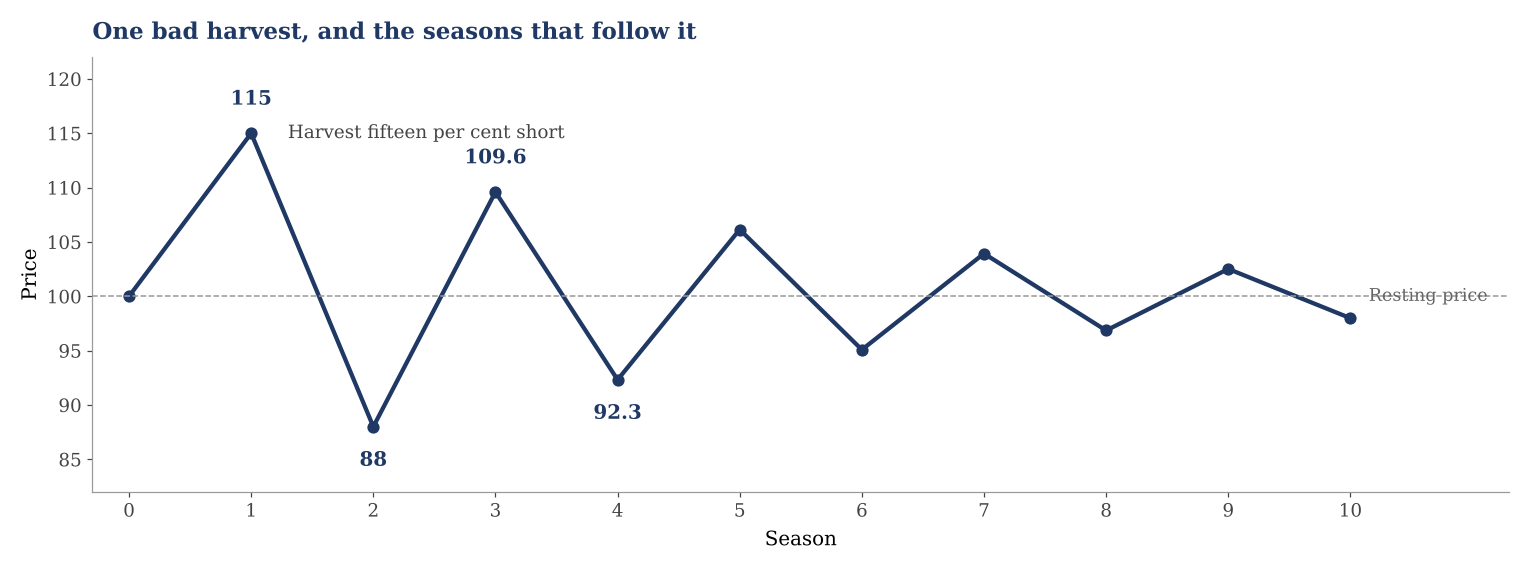
Figure 1. Illustration. A market at rest at a price of 100 loses fifteen per cent of one harvest. Each later season’s supply responds to the previous season’s price. The price goes to 115, then 88, then 109.6, and settles over about ten seasons. Calculated from a linear demand curve and a supply response of 0.8; no market data.
Figure 1 traces one such sequence on simple assumptions. A single bad harvest raises the price; the high price brings a large crop and a low price; the low price brings a small crop. The disturbance takes years to die away, and for most of that time the price is on the opposite side of its resting level from the season before. For a tree crop, where each step takes several years, one failure can govern a decade. The fall of cocoa by more than half from its peak, as plantings and better weather restored the supply, is the second step of the figure.
V. The carry
Grain in store costs money every month: the charge for the elevator, insurance, interest and some loss of quality. After a normal harvest, when stores are full, contracts for later delivery stand above nearer ones by about that cost, and a long position rolled forward pays it. The slope has a ceiling, the full cost of storage, since beyond that anyone could buy grain, store it and sell it forward at a certain profit.
It has no floor. In a short year, grain for immediate delivery is worth more than grain after the next harvest by whatever the user who cannot wait is obliged to pay, and a long holder is paid to hold. The slope between an old-crop month and a new-crop month is thus the market’s plainest statement about scarcity.
Livestock is different in kind. Since an animal cannot be stored, nothing connects the price for delivery in one month to the price in another. Each month’s contract is a separate forecast of the supply of animals at that date. The curve of cattle or pigs has no carry in the sense used in this series, and its shape should not be read as it is read for grain.
VI. The ending
Agricultural goods end by being eaten, spun or spoiled, and the stock is rebuilt from nothing every year. The crop year gives the market a rhythm of annual endings that shares and bonds lack: at each harvest the uncertainty about one season is resolved and that of the next begins.
The contracts end as Paper VII described, and its case was drawn from livestock. For goods settled by delivery the last weeks belong to the trade. A financial holder who remains long may be assigned a warehouse receipt for goods in a place and of a grade not of the holder’s choosing.
One further ending belongs to the hedger and has lessons for anyone who is short. A merchant who has bought a crop forward from farmers sells futures against it. If the price then rises steeply, the futures lose at once and in cash, while the gain on the physical crop is realised only when it is delivered months later. In the cocoa market of 2024, as the price tripled and the exchanges raised their margin requirements, merchants and processors cut back their hedges, and the number of contracts outstanding fell as the price rose. It is the mechanism of 1993 described in Paper VII, in another commodity.
VII. The risk unit
The risk unit is again the volatility of the full value the contract controls, and in agriculture it is neither constant through the year nor symmetrical.
It changes with the season. Maize is most volatile in the northern summer, when the crop is made or lost in a few weeks of weather, and quietest after harvest, when the size of the crop is known. A measure of movement taken in January understates what July can do. The families differ: livestock has commonly varied by fifteen to twenty per cent a year, grains by twenty to thirty, and the tropical products by thirty to forty and at times far more.
It is lopsided. A price in one of the long valleys can fall only so far, since at some level farmers plant something else. It can rise several-fold in a failed season. The danger to a holder who is short is of a different order from the danger to one who is long, and a sizing rule that measures only recent movement in a quiet market will treat them alike.
It includes days on which nothing can be done. When a price is locked at its daily limit, a position cannot be closed and a stop cannot be executed; the loss is taken at whatever price trading resumes. And the scheduled reports are known occasions for a jump of several per cent between one trade and the next.
Table 2. The six questions answered for agricultural goods
| Question | Answer |
|---|---|
| Claim | On graded goods in an approved store, through a warehouse receipt. For livestock no such claim is possible. For nearly all, a contract that refers to the goods |
| Structure | A crop year from harvest to harvest; old crop and new crop priced apart; official reports on fixed dates; daily price limits; production concentrated in a few regions; goods linked by use |
| Return | No income, and a falling real trend. Long quiet valleys and sharp peaks when the stores are empty; then a supply response a season or more late |
| Carry | For stored crops, the cost of storage when stocks are ample, with a ceiling; a premium for the old crop when they are not, without a floor. None, properly speaking, for livestock |
| Ending | Consumption or spoilage, with the stock rebuilt each year. For the contract, delivery of a grade at a place; for the hedger, margin calls on a rising price |
| Risk unit | The volatility of the full value controlled, higher in the growing months than after harvest; far greater upward than downward from a low price; with limit days and report days |
The answers describe the goods. The instrument through which they are held adds its own, given in Papers VII to IX.
VIII. The case
The following illustration is drawn from two books in two seasons. One held dealers’ contracts on agricultural futures among many other instruments. The other traded exchange futures. Their rules were the same: a position is opened on the evidence of the instrument’s own prices, with a stop derived from its measured movement, and no reference to crops or weather.
At one weekly close the first book was short cocoa, coffee and maize, and held nothing long in the class. Its rules had reached each position separately, from three falling prices. The three have almost nothing in common as crops. Cocoa is a tree crop of the West African forest belt, coffee a tree crop of the Brazilian highlands, maize an annual of the American plains, and no weather system links them. What they shared in that season was a place in the sequence of Figure 1: each had come through a period of high prices, each had been answered by larger supply, and each was falling. The book had no knowledge of that. It had three downward trends.
It also had, on each, the exposure that Section VII calls lopsided. In the days before that weekly close an official report had lifted maize by more than three per cent in a morning, and a weather agency had published a warning about the next cocoa crop of a size that, if borne out, would be the first step of Figure 1 over again. Neither event is known to have harmed the positions, and this paper does not report their results. They are noted to show what stands on the other side of a short in a crop: a price with limited room to fall and, in a bad season, a great deal of room to rise, with the news arriving on a schedule or from the sky.
The second book, in an earlier season, held wheat and soybean meal long and cattle and pigs short at the same time. Its rules had again reached the four positions one by one. Taken together they were a single view of the feed chain, dear feed and cheap animals, though no rule in the book had formed it. Positions that a report would list under two headings, grains and livestock, were in substance one.
Neither observation shows that the books were wrong to hold what they held, and the paper has not examined how the positions ended. What they show is that rules reading only prices will find themselves in positions whose connection lies in the goods: three crops joined by the stage of a supply cycle, four contracts joined by what animals eat. The six questions cannot be answered from the price series alone. In this class more than any other, the answers are in the field.
IX. What would falsify this reading
Figure 1 is the simplest possible model of a lagged supply response, and real farmers are not so naive. They can see the mechanism and the futures price for the next harvest, and to the extent they plant on that and not on last year’s price the oscillation is damped or absent. The evidence for cycles of this kind is strongest for tree crops and livestock, where the lag is long and cannot be shortened, and weakest for annual grains.
The claim that risk is lopsided depends on the price being low to begin with. From a peak the greater risk is downward, as holders of cocoa learned in 2025. The claim is about a short position taken in a valley, and it would be refuted by a record showing that from such levels large rises have been no more frequent than large falls.
The case reads a connection into positions after the fact. That three falling crops shared a stage in a cycle is an interpretation, and a sceptic may say that three falling prices is all there was. The paper cannot exclude that. The stronger of the two observations is the second, where the link between feed and animals is a matter of arithmetic and not of pattern.
With this paper the series has covered the goods. The next turns to an asset with no goods, no issuer and no income behind it: the digital token.
References
Deaton, A. and Laroque, G. (1992). On the behaviour of commodity prices. Review of Economic Studies 59(1), 1–23.
Dr. Glen Brown (2026). Futures and Forwards; Options; Energy; Metals. The Instruments of Capital, Papers VII, VIII, XI and XII. Public Doctrine Series.
Ezekiel, M. (1938). The cobweb theorem. Quarterly Journal of Economics 52(2), 255–280.
Jacks, D. S. (2019). From boom to bust: a typology of real commodity prices in the long run. Cliometrica 13(2), 201–220.
Trading Economics (2026). Cocoa market notes, 6 and 12 November 2026.
United States Department of Agriculture (2026). World Agricultural Supply and Demand Estimates, WASDE-677. 10 November 2026.
Related in the Public Doctrine Series
Futures and Forwards: The Instruments of Capital, Paper VII, whose case was the ending of a livestock contract.
Energy: The Instruments of Capital, Paper XI, on goods whose supply and demand respond slowly to price.
Metals: The Instruments of Capital, Paper XII, on goods that survive use.
Download the PDF
About the Author
Dr. Glen Brown is President & CEO of Global Financial Engineering, Inc. and Global Accountancy Institute, Inc. He is the architect of the GCPIAUT framework and the broader GATS-native proprietary capital doctrine. His work focuses on sovereign capital governance, algorithmic trading architecture, reserve-first compounding systems, and institutional financial engineering within closed proprietary environments.
Business Model Clarification
Global Financial Engineering, Inc. and Global Accountancy Institute, Inc. operate as closed-loop proprietary institutions. They do not offer public investment products through the doctrines described herein, do not invite retail participation into their proprietary capital architecture, and do not present the GCPIAUT framework as a public collective investment scheme. The concepts discussed in this article are part of the firms’ internal intellectual and operating doctrine.
Risk Disclaimer
Trading and investment activity across foreign exchange, equities, futures, commodities, and digital assets involves substantial risk. Market conditions may change rapidly, and losses may occur. This article is provided for intellectual, institutional, and educational discussion only and does not constitute investment advice, an offer, a solicitation, or a recommendation to buy or sell any financial instrument or to participate in any investment structure.