The Instruments of Capital · Paper III
Government Debt and the Price of Time
The one instrument whose return can be known on the day it is bought, and why its price still moves enough to undo the holder.
Dr. Glen Brown · Global Financial Engineering, Inc. · Global Accountancy Institute, Inc. · 14 November 2026 · GFE-PUB-IOC-20261114-A
About this series
The Instruments of Capital is a sub-series of the Public Doctrine Series. It sets out, one class at a time, every kind of asset a proprietary firm could trade, whether or not the firm trades it today. Each paper puts its subject through the six questions set in Paper I: claim, structure, return, carry, ending and risk unit. The case in Section VIII is an illustration built from operating data. Its figures have been altered and it reports no account’s results.
I. Five weeks in the safest asset
At the start of October 2026 the yield on the ten-year United States Treasury note touched 5.34 per cent, its highest in more than twenty years. By the close on 6 November it stood at 4.86 per cent. Nothing about the borrower had changed in those five weeks. The United States had not become more likely to repay, since it was never in doubt that it would. Yet a holder who bought the note at the October high was, five weeks later, nearly four per cent richer on paper, and a holder who had bought it a few months earlier at a lower yield had, at that high, been several per cent poorer.
This is the first thing to understand about government debt. The promise is fixed and, for the strongest issuers, certain. The price of the promise is neither. A government bond is the purest instrument there is for trading one quantity, the price of time, meaning the rate at which money later is exchanged for money now. Every other asset in this series is valued by discounting what it will pay at some version of that rate, which is why the paper on debt comes before the papers on anything that depends on it.
A government bond free of default is not a bond free of loss. It is a bond whose only risk is time.
II. The claim
A bond is a promise to pay stated amounts on stated dates: a coupon at intervals and the face amount at maturity. The holder is a creditor and ranks ahead of any owner. When the borrower is a government borrowing in a currency it issues, the promise carries a further assurance, because the issuer can always create the money it owes. That is the sense in which such debt is called risk-free.
The phrase needs three qualifications. The first is that it describes the nominal amount. The holder will receive the dollars promised; what those dollars will buy is not promised, and inflation can take from a creditor as surely as default, without any clause being broken. Bonds whose payments are indexed to prices exist to remove that risk and are a small part of the market. The second is that the assurance is a matter of ability and not of law. Carmen Reinhart and Kenneth Rogoff have documented that governments have defaulted on debt in their own currencies more often than is commonly remembered, and Russia did so in 1998. The third is that the assurance stops at the currency’s edge. A government that borrows in another country’s money is an ordinary debtor, and the history of sovereign default is mostly the history of such borrowing.
Government debt is also large and growing. The International Monetary Fund put gross government debt worldwide at nearly 94 per cent of world output in 2025 and expects it to reach 100 per cent by 2029, with interest payments having risen from two to nearly three per cent of world output in four years. A claim of this kind is being issued in greater quantity than at any time since the 1940s, and the price of time is partly the price at which that quantity can be sold.
III. The structure
Government bonds come into existence at auction. The treasury announces an amount, dealers and investors bid a yield, and the debt is sold at the yield that clears. After issue it trades among dealers and their clients, as foreign exchange does, with no single exchange and with prices made by banks. Two further markets sit beside this one and cannot be separated from it. In the repurchase market, holders lend bonds overnight against cash, which is how most large positions are financed. In the futures market, contracts on a notional bond trade on an exchange and allow the same exposure to be taken with a margin deposit and no bond at all.
The market in United States Treasuries is the deepest of any security. It averaged about $1.2 trillion of trading a day in the third quarter of 2026, by the industry’s own count, against roughly $62 billion a day in American corporate bonds. Depth of that order is why the instrument serves as collateral for much of the rest of the financial system, and that role is itself part of the structure: a bond that is pledged, lent and re-pledged is held by more parties than own it, and a fall in its price reaches all of them at once.
One participant is unlike the others. The central bank sets the shortest interest rate by decree, and since 2008 the major central banks have also bought and sold longer debt in quantities large enough to move its price. In no other market does the largest trader also write some of the rules.
IV. The return
Government debt is the only instrument in this series whose return can be known on the day it is bought. A holder who pays a price implying a yield of five per cent, and who holds to maturity, will earn five per cent a year in nominal terms on the sum invested, whatever happens to the price in between. The fluctuations that enriched and impoverished holders in the autumn of 2026 are differences between that known return and the return available to someone who sells early, at whatever yield then prevails.
What the yield is made of matters more than its level. Irving Fisher separated a nominal rate into a real rate and the inflation expected over the bond’s life. A long yield can be divided another way, into the average short rate the market expects over the period and a further amount, the term premium, paid to the holder for bearing the uncertainty of the long bond rather than rolling short ones. The term premium cannot be observed and must be estimated; the method of Tobias Adrian, Richard Crump and Emanuel Moench is the one most often cited. The division is useful because the two parts answer to different forces. Expected short rates answer to the central bank. The term premium answers to the supply of debt and the willingness of holders to absorb it, and when that changes a long yield can rise while the central bank does nothing.
V. The carry
A bond held with the holder’s own money carries at its yield. A bond held with borrowed money, as most professional positions are, carries at the yield less the cost of financing it in the repurchase market. When long yields stand above short ones the difference is positive, and the holder is paid to wait. When the short rate is above the long yield, the position costs money every day it is held, and only a rise in price can pay for it.
There is a second element that has no counterpart in currencies. A ten-year bond becomes a nine-year bond after a year. If shorter maturities yield less than longer ones, the bond’s yield falls as it ages even if nothing in the market changes, and its price rises accordingly. This is the roll-down, and on an upward-sloping curve it adds to carry. Both elements depend entirely on the shape of the curve, which is why those who trade debt watch the difference between two yields as closely as the level of either. On 6 November 2026 the two-year Treasury yielded 4.51 per cent and the ten-year 4.86, a difference of about a third of a percentage point.
VI. The ending
A bond is the only instrument examined so far whose ending is written on its face. At maturity the principal is repaid and the position ceases to exist. For a holder who intends to wait, this is the property that makes the return knowable. For a holder of bond futures the ending comes sooner and differently: the contract expires every three months and must be closed or replaced.
The involuntary endings are three. A government can restructure, as Greece did in 2012 in the largest such operation on record, replacing its bonds with new ones worth much less. A government can inflate, which ends nothing in law and a great deal in substance. And a leveraged holder can be forced out by a fall in price, however certain the eventual repayment. The clearest recent instance came in Britain in the autumn of 2022. Pension funds that held long government bonds with borrowed money faced margin calls as yields rose, sold bonds to meet them, and by selling pushed yields higher still, until the Bank of England intervened on 28 September to buy the debt. Every one of those bonds was going to be repaid in full. The funds were at risk of being ended before the bonds were.
VII. The risk unit
The measure that makes bonds comparable with one another is duration, introduced by Frederick Macaulay in 1938. Duration is the average time at which a bond’s payments arrive, weighted by their present value, and in a slightly adjusted form it gives the percentage change in price for a change of one percentage point in yield. A ten-year bond at current yields has a duration a little under eight, and a thirty-year bond one of about fifteen. The same move in yield therefore costs the holder of the long bond about twice what it costs the holder of the ten-year, and more than seven times what it costs the holder of a two-year note.
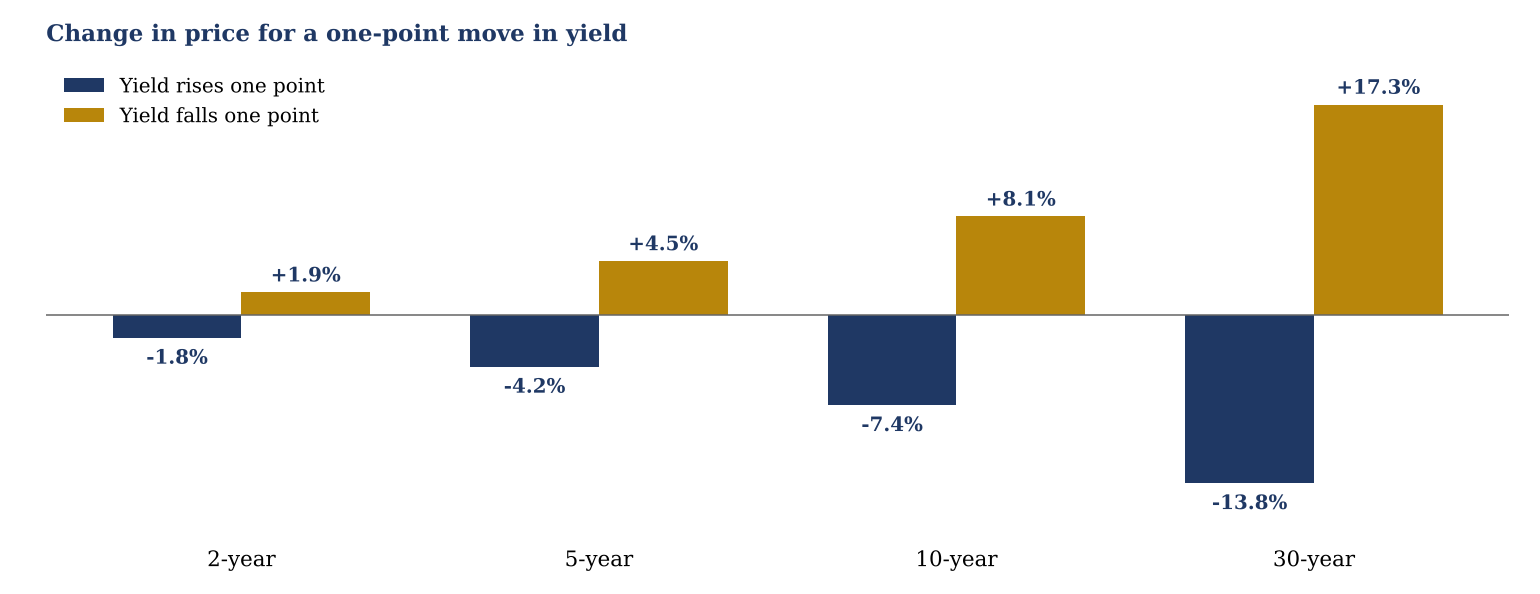
Figure 1. Change in the price of a bond issued at par with a five per cent annual coupon when its yield moves by one percentage point, by maturity. The gain from a fall in yield exceeds the loss from an equal rise, and the gap widens with maturity; this asymmetry is convexity. Calculated from the standard pricing formula.
The risk unit of a bond position is accordingly not its face amount and not its market value. It is the money gained or lost per small move in yield, the product of value and duration. Two positions of equal value can differ in risk by a factor of ten. Figure 1 also shows why duration is only a first approximation: the price of a long bond rises more for a fall in yield than it falls for an equal rise, and the difference grows with maturity.
For a book that holds other classes there is a further step. The yield that moves the bond is also the rate at which the cash flows of every share and property are discounted. A fall in bond prices caused by a rise in that rate is therefore not independent of the other holdings, and the hope that bonds will rise when shares fall holds only when the two are being moved by different things. Paper I noted that in 2022 they were moved by the same thing.
Table 1. The six questions answered for government debt
| Question | Answer |
|---|---|
| Claim | A fixed promise by a state, senior to all ownership; certain in nominal terms only where the state issues the currency owed |
| Structure | Sold at auction, traded through dealers, financed in the repurchase market, mirrored in exchange-traded futures; the central bank is a participant |
| Return | The yield at purchase if held to maturity; otherwise the yield plus or minus the change in price |
| Carry | Yield less the cost of financing, plus the roll-down on an upward-sloping curve; negative when short rates exceed long |
| Ending | Repayment at a known date; involuntarily by restructuring, by inflation, or by forced sale of a leveraged position |
| Risk unit | Money per unit move in yield: market value multiplied by duration |
The answers describe debt issued by a government in its own currency. Debt in a foreign currency differs in the first and fifth rows.
VIII. The case
This paper has less operating evidence behind it than the two before. The firm whose records inform this series has not held a government bond outright. Its experience of the class is through futures, and the illustration that follows is about what that wrapper adds.
During weeks in which long American yields were rising toward multi-year highs, a futures book held a short position in contracts on ten-year German government bonds. A short position in bond futures gains when yields rise. Over those weeks German yields fell while American yields rose, and the position lost money. An observer who had read the position as a view on the long end of the American curve would have judged the view correct and the result wrong, and would have been right on both counts.
The explanation is in the first and second of the six questions. German and American government bonds are claims on different states, priced by different central banks and supplied by different treasuries. They are the same kind of instrument and they often move together, which is the reason one is used as a stand-in for the other. But the term premium described in Section IV is local. When the pressure on a yield comes from the supply of one government’s debt, it need not appear in another’s, and in those weeks it did not. A position in one market that is held for a reason belonging to another carries two exposures: the reason, and the assumption that the two markets will transmit it. The second is rarely written down and is the one that failed.
The wrapper added its own term. Because the position was in futures it could not simply be held until the argument resolved. The contract had an expiry date, and continuing the exposure beyond it would have meant closing one contract and opening the next at whatever price difference the market offered. A holder of the bond itself would have had no such date.
IX. What would falsify this reading
The paper’s central claim is that for a government borrowing in its own currency the risk of the bond is the risk of the discount rate and not of the borrower. The claim would fail if the yields of such governments began to move with estimates of their solvency as the yields of companies do, rising on bad fiscal news independently of inflation and of the expected path of the central bank. With public debt approaching the size of world output, that is no longer a remote test, and it is the one to watch.
A second claim is that the term premium is set locally by supply and by the appetite of holders. If long yields across the major issuers were shown to move as one regardless of each country’s issuance, the German and American episode above would be an accident and this paper’s account of it mistaken.
The paper has said little about the shortest debt, bills and the money markets, where the central bank’s rate is transmitted and where most financing is done, and it has treated the bond and its future as near substitutes while showing in its own case that they are not. Both omissions are taken up later in the series, the second in the paper on futures.
Paper IV turns to debt that can fail in the ordinary way: the bonds and loans of companies, and the securities built from them.
References
Adrian, T., Crump, R. K. and Moench, E. (2013). Pricing the term structure with linear regressions. Journal of Financial Economics 110(1), 110–138.
Advisor Perspectives (2026). Treasury Yields Snapshot: November 6, 2026.
Business Today (2026). Treasury yields ease after 10-year hits 2002 high. 2 October 2026.
Dr. Glen Brown (2026). What an Asset Class Is; Money and Foreign Exchange. The Instruments of Capital, Papers I and II. Public Doctrine Series.
Fisher, I. (1930). The Theory of Interest. Macmillan.
International Monetary Fund (2026). Fiscal Monitor: Fiscal Policy under Pressure: High Debt, Rising Risks. April 2026.
Macaulay, F. R. (1938). Some Theoretical Problems Suggested by the Movements of Interest Rates, Bond Yields and Stock Prices in the United States since 1856. National Bureau of Economic Research.
Reinhart, C. M. and Rogoff, K. S. (2009). This Time Is Different: Eight Centuries of Financial Folly. Princeton University Press.
Securities Industry and Financial Markets Association (2026). Research Quarterly: Fixed Income, Issuance and Trading, 3Q26.
Related in the Public Doctrine Series
What an Asset Class Is: The Instruments of Capital, Paper I, which sets the six questions used here.
Money and Foreign Exchange: The Instruments of Capital, Paper II, on the class whose carry is set by the yields examined here.
Two Fears, One Discount Rate: The Engineered Long End, on bond yields, inflation and the rate at which everything else is valued.
Fiscal Space Is a Price: on what a government’s room to borrow is worth and who sets it.
Download the PDF
About the Author
Dr. Glen Brown is President & CEO of Global Financial Engineering, Inc. and Global Accountancy Institute, Inc. He is the architect of the GCPIAUT framework and the broader GATS-native proprietary capital doctrine. His work focuses on sovereign capital governance, algorithmic trading architecture, reserve-first compounding systems, and institutional financial engineering within closed proprietary environments.
Business Model Clarification
Global Financial Engineering, Inc. and Global Accountancy Institute, Inc. operate as closed-loop proprietary institutions. They do not offer public investment products through the doctrines described herein, do not invite retail participation into their proprietary capital architecture, and do not present the GCPIAUT framework as a public collective investment scheme. The concepts discussed in this article are part of the firms’ internal intellectual and operating doctrine.
Risk Disclaimer
Trading and investment activity across foreign exchange, equities, futures, commodities, and digital assets involves substantial risk. Market conditions may change rapidly, and losses may occur. This article is provided for intellectual, institutional, and educational discussion only and does not constitute investment advice, an offer, a solicitation, or a recommendation to buy or sell any financial instrument or to participate in any investment structure.